 Back
BackLipids, Membranes, and the First Cells: Structure and Function of Biological Membranes
Study Guide - Smart Notes
 Tailored notes based on your materials, expanded with key definitions, examples, and context.
Lipids, Membranes, and Cells
Introduction to Biological Membranes
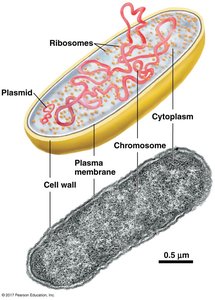
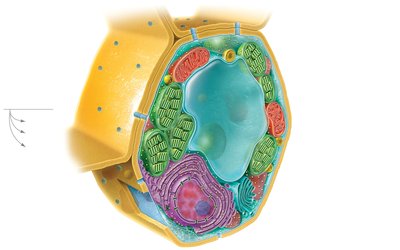
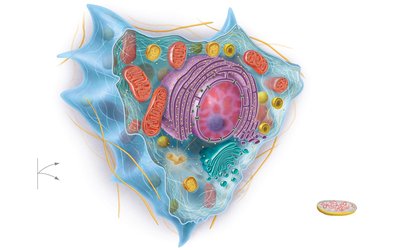
The plasma membrane is a fundamental structure that separates the cell’s interior from the external environment. In eukaryotic cells, membranes also create internal compartments, forming membrane-bound organelles. Membranes are essential for maintaining cellular integrity and facilitating the chemical reactions necessary for life.
Plasma membrane: Defines the boundary of the cell and regulates the movement of substances in and out.
Membrane-bound organelles: Present in eukaryotes, allowing compartmentalization of cellular functions.
Functions of Cell Membranes
Selective barrier: Keeps damaging materials out of the cell.
Transport: Allows entry of materials needed by the cell.
Biochemical platform: Facilitates the chemical reactions necessary for life.
Membrane Lipids: Structure and Types
Definition and Types of Lipids
Lipids are a diverse group of biological molecules that are largely nonpolar and hydrophobic. The three most important types of lipids found in cells are:
Phospholipids
Fats (Triglycerides)
Steroids
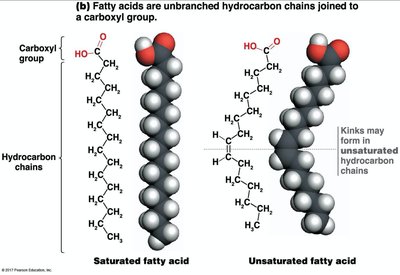
Phospholipids and fats are composed of fatty acids, which are hydrocarbon chains bonded to a carboxyl (–COOH) functional group. Fatty acids are amphipathic, meaning they have both hydrophilic and hydrophobic regions.
Saturated vs. Unsaturated Fatty Acids
Saturated fatty acids: Contain only single bonds between carbon atoms, resulting in straight chains. These pack tightly and are solid at room temperature (e.g., butter).
Unsaturated fatty acids: Contain one or more double bonds, introducing kinks that prevent tight packing. These are liquid at room temperature (e.g., vegetable oil).
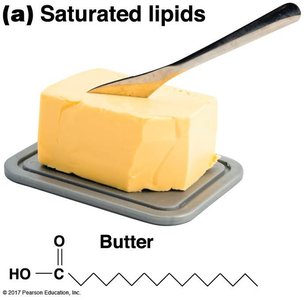
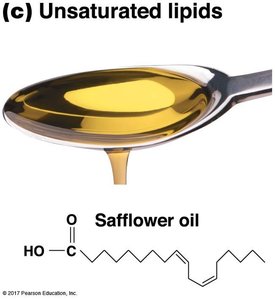
Fats (Triglycerides)
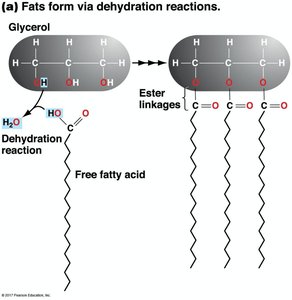
Fats are composed of three fatty acids linked to a glycerol molecule via ester linkages. Their primary role is energy storage.
Formation: Fats form via condensation (dehydration) reactions, releasing water as fatty acids bond to glycerol.
Phospholipids
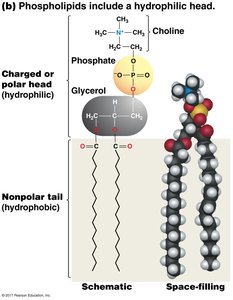
Phospholipids consist of a glycerol backbone linked to two fatty acids and a phosphate group bonded to a charged or polar molecule. They are amphipathic, with hydrophilic heads and hydrophobic tails.
Hydrophilic head: Contains phosphate and a polar group.
Hydrophobic tails: Two fatty acid chains.
Glycolipids
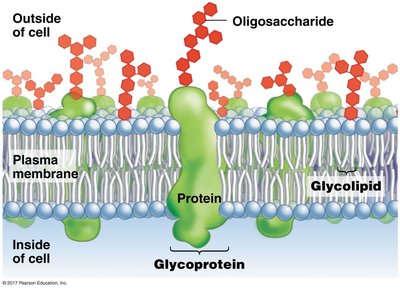
Glycolipids are membrane lipids composed of two fatty acids and a hydrophilic sugar (oligosaccharide) head group. They lack a glycerol backbone and phosphate group, but are also amphipathic.
Steroids
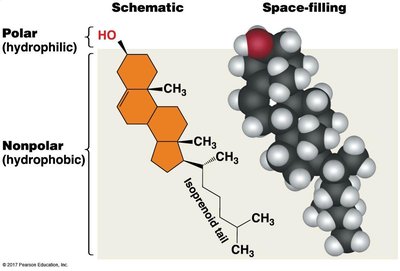
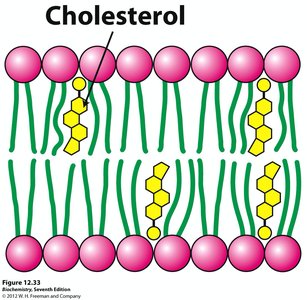
Steroids are characterized by a bulky, four-ring structure. Examples include hormones such as estrogen and testosterone. In animal cells, cholesterol is a key component of plasma membranes and is amphipathic.
Membrane Lipid Behavior in Water
Amphipathic Nature and Bilayer Formation
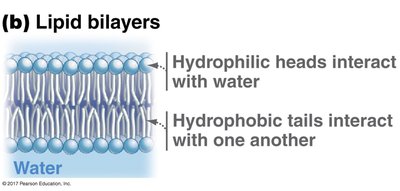
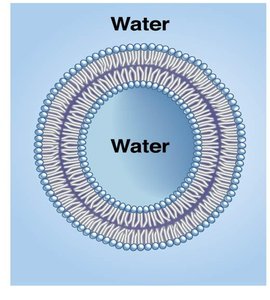
Phospholipids, glycolipids, and cholesterol are all amphipathic membrane lipids. When placed in water, phospholipids spontaneously form bilayers due to the hydrophilic heads interacting with water and hydrophobic tails clustering away from water. This process requires no energy input.
Asymmetry of the Lipid Bilayer
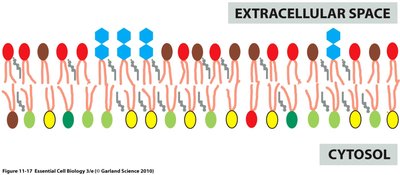
The lipid bilayer in cell membranes is asymmetrical. Some phospholipids are found only on one side of the bilayer, and glycolipids are typically present only on the extracellular side.
Membrane Properties: Fluidity and Permeability
Selective Permeability of Lipid Bilayers
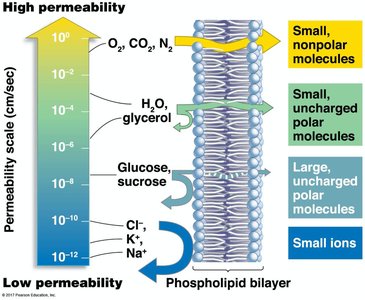
Lipid bilayers show selective permeability, allowing some molecules to cross more easily than others. Small, nonpolar molecules (e.g., O2, CO2) pass through readily, while large or charged molecules (e.g., ions, glucose) are restricted.
Membrane Fluidity
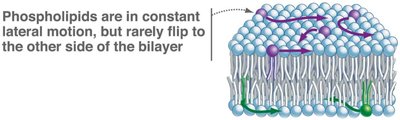
Membrane fluidity is associated with the movement of lipids within the bilayer. Types of movement include:
Flexion: Bending of fatty acid tails.
Rotation: Spinning of individual lipid molecules.
Lateral diffusion: Movement of lipids within the same layer.
Transverse diffusion (flip-flop): Rare movement of lipids between layers.
Factors Affecting Membrane Fluidity and Permeability
Fatty acid tail length: Shorter tails increase fluidity and permeability.
Degree of saturation: Unsaturated tails (with double bonds) increase fluidity and permeability; saturated tails decrease them.
Cholesterol: Reduces membrane permeability by filling spaces between phospholipids.
Temperature: Higher temperatures increase membrane fluidity.
Summary Table: Major Membrane Lipids
Lipid Type | Structure | Key Features | Example/Function |
|---|---|---|---|
Phospholipid | Glycerol + 2 fatty acids + phosphate group | Amphipathic; forms bilayers | Main component of cell membranes |
Glycolipid | 2 fatty acids + oligosaccharide head | Amphipathic; no glycerol or phosphate | Cell recognition, only on extracellular side |
Steroid (e.g., cholesterol) | Four-ring structure | Amphipathic; rigid | Membrane fluidity and permeability regulation |
Key Equations and Concepts
Ester linkage formation (dehydration reaction):
$ \text{Glycerol} + 3 \ \text{Fatty Acids} \rightarrow \text{Triglyceride} + 3 \ \text{H}_2\text{O} $
Amphipathic molecule: Contains both hydrophilic and hydrophobic regions, critical for bilayer formation.
Conclusion
Membrane lipids are essential for the structure and function of biological membranes. Their amphipathic nature drives the spontaneous formation of bilayers, which serve as selective barriers and platforms for cellular processes. The composition and properties of membrane lipids determine membrane fluidity, permeability, and overall cell function.
