 Back
Lipids, Membranes, and the First Cells – Study Notes
Study Guide - Smart Notes
 Tailored notes based on your materials, expanded with key definitions, examples, and context.
Lipids, Membranes, and the First Cells
Introduction
The plasma membrane, or cell membrane, is a defining feature of life, separating the internal environment of the cell from the external environment. It acts as a selective barrier, allowing the entry of essential materials, excluding harmful substances, and facilitating the chemical reactions necessary for life.
6.1 Lipid Structure and Function
What Are Lipids?
Lipids are carbon-containing compounds that are insoluble in water due to their high proportion of nonpolar bonds.
Hydrocarbons are nonpolar molecules containing only carbon and hydrogen, making them hydrophobic.
Bond Saturation and Hydrocarbon Structure
Isoprenoids are hydrocarbon chains that function as pigments, scents, vitamins, and hormone precursors. They are building blocks for more complex lipids.
Fatty acids are hydrocarbon chains bonded to a carboxyl functional group, typically containing 14–20 carbon atoms. They can be saturated or unsaturated.
Saturation and Physical State
Saturated fatty acids have only single bonds between carbons and contain the maximum number of hydrogen atoms. They are typically solid at room temperature.
Unsaturated fatty acids have one or more double bonds, causing kinks in the chain and are usually liquid at room temperature. Polyunsaturated chains have multiple double bonds.
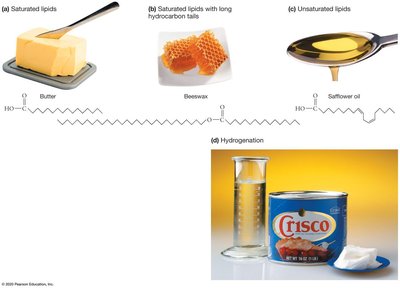
Types of Lipids in Cells
Major Classes of Lipids
Steroids: Characterized by a bulky, four-ring structure. Examples include cholesterol (a component of plasma membranes) and hormones such as estrogen and testosterone.
Fats (Triacylglycerols/Triglycerides): Composed of three fatty acids linked to glycerol. Their primary role is energy storage, as they contain many high-energy bonds.
Phospholipids: Consist of glycerol linked to a phosphate group and two hydrocarbon chains. They are the main component of cell membranes.
6.2 Phospholipid Bilayers
Amphipathic Nature of Membrane Lipids
Lipids have both hydrophobic (nonpolar) and hydrophilic (polar) regions.
The hydrophilic head contains glycerol, a negatively charged phosphate group, and a charged or polar group.
The hydrophobic tail is nonpolar and does not interact with water.
Amphipathic molecules, such as phospholipids and cholesterol, have both hydrophilic and hydrophobic regions, which is crucial for membrane formation.
Micelles and Lipid Bilayers
Micelles: Spherical aggregates formed by free fatty acids in water.
Lipid bilayers: Structures formed when phospholipids align in paired sheets, with hydrophilic heads facing water and hydrophobic tails facing inward.
Bilayers form spontaneously in water without energy input, driven by the amphipathic nature of phospholipids.
Artificial Membranes and Vesicles
Vesicles are small, bubble-like structures surrounded by phospholipids. Artificial vesicles are called liposomes.
Selective Permeability of Lipid Bilayers
Membrane Permeability
Phospholipid bilayers are selectively permeable: small or nonpolar molecules cross quickly, while large or charged molecules cross slowly or not at all.
Examples: Oxygen (O2) crosses quickly; glucose crosses slowly.
Factors Affecting Membrane Permeability
Length and saturation of hydrocarbon tails: Unsaturated tails (with double bonds) increase permeability; saturated, longer tails decrease permeability.
Presence of cholesterol: Increases membrane density and decreases permeability by packing phospholipid tails more tightly.
Temperature: Lower temperatures decrease membrane fluidity and permeability.
6.3 How Substances Move Across Lipid Bilayers: Diffusion and Osmosis
Diffusion
Diffusion is the spontaneous movement of molecules from regions of high concentration to low concentration, increasing entropy.
Equilibrium is reached when molecules are evenly distributed, but they continue to move randomly.
Passive transport occurs when substances diffuse across a membrane without energy input.
Osmosis
Osmosis is the diffusion of water across a selectively permeable membrane from regions of low solute concentration to high solute concentration, equalizing solute concentrations on both sides.
Hypertonic solution: Higher solute concentration outside the cell; water moves out, and the cell shrinks.
Hypotonic solution: Lower solute concentration outside the cell; water moves in, and the cell swells.
Isotonic solution: Equal solute concentrations; no net water movement, and cell size remains the same.
6.4 Proteins Alter Membrane Structure and Function
Membrane Proteins
Membranes contain both phospholipids and proteins in roughly equal amounts.
Proteins can be amphipathic, allowing them to insert into membranes and form passageways for substances.
Fluid-Mosaic Model
The fluid-mosaic model describes the membrane as a dynamic mosaic of phospholipids and proteins.
Integral (transmembrane) proteins span the membrane, with segments facing both the interior and exterior.
Peripheral membrane proteins bind to the membrane surface without passing through it.
Transport Proteins
Channel proteins form pores in the membrane, allowing ions to cross according to their electrochemical gradients.
Carrier proteins facilitate diffusion by binding to specific molecules and changing shape to transport them across the membrane (e.g., GLUT-1 for glucose).
Pumps perform active transport, moving substances against their concentration gradients using energy from ATP (e.g., sodium–potassium pump).
Secondary active transport (co-transport) uses the energy stored in electrochemical gradients to move other substances against their gradients without direct ATP use.
Summary Table: Types of Membrane Transport
Transport Type | Energy Requirement | Direction Relative to Gradient | Example |
|---|---|---|---|
Simple Diffusion | No | Down | O2, CO2 |
Facilitated Diffusion (Channel/Carrier) | No | Down | Glucose (GLUT-1), Ions (Ion channels) |
Active Transport (Pump) | Yes (ATP) | Against | Sodium–Potassium Pump |
Secondary Active Transport | Indirect (uses gradient) | Against (for one molecule) | Co-transporters |
Conclusion
Biological membranes are essential for maintaining the internal environment of cells. Their structure—composed of lipids and proteins—enables selective permeability, passive and active transport, and the compartmentalization necessary for life. The evolution of efficient and selective membranes was a key step in the origin of the first cells.
