 Back
Chapter 6
Study Guide - Smart Notes
 Tailored notes based on your materials, expanded with key definitions, examples, and context.
Chapter 6: Lipids, Membranes, and the First Cells
Introduction to Biological Membranes
The plasma (cell) membrane is a fundamental feature that separates living cells from their external environment. It acts as a selective barrier, regulating the entry and exit of substances, and facilitates the chemical reactions necessary for life by maintaining proximity of reactants.
Key Functions: Protection from harmful substances, selective import of nutrients, and support for cellular reactions.
Section 6.1: Lipid Structure
Lipids are a diverse group of carbon-containing compounds that are largely nonpolar (shared equally) and hydrophobic. They play critical roles in energy storage, membrane structure, and signaling.
Functional Groups: Important chemical groups in biological molecules include amino (-NH2), carboxyl (-COOH), carbonyl (C=O), hydroxyl (-OH), phosphate (OPO32-), and sulfhydryl (-SH).
Hydrocarbons: Molecules containing only carbon and hydrogen; hydrophobic due to nonpolar C-H bonds.
Hydrocarbon Chains and Isoprenoids
Hydrocarbons can form long chains (tails) or branched structures called isoprenoids, which serve as building blocks for complex lipids and function as pigments, vitamins, and hormone precursors.
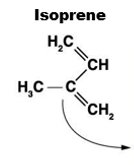
Fatty Acids
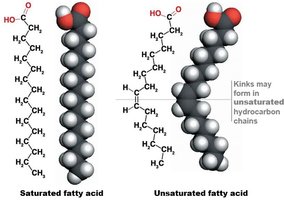
A fatty acid consists of a hydrocarbon chain bonded to a carboxyl group (-COOH). Fatty acids can be saturated (no double bonds) or unsaturated (one or more double bonds).
Saturated fatty acids: Only single C–C bonds; maximum hydrogen atoms; typically solid at room temperature.
Unsaturated fatty acids: One or more C=C double bonds; causes kinks in the chain; usually liquid at room temperature.
Polyunsaturated: Multiple double bonds.
saturated vs unsaturated = double bond/shape
How Bond Saturation Affects Structure and Properties
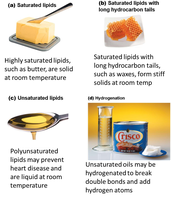
Saturation and chain length influence the physical properties of lipids, such as melting point and fluidity.
Saturated fats: Solid at room temperature (e.g., butter).
Unsaturated fats: Liquid at room temperature (e.g., oils).
Types of Lipids in Cells
There are three major types of lipids found in cells: steroids, fats (triglycerides), and phospholipids. These are grouped based on their insolubility in water rather than a shared chemical structure.
Steroids
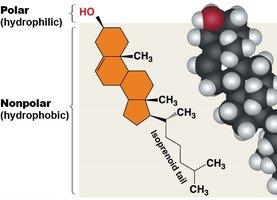
Steroids are characterized by a bulky, four-ring structure. They differ by the functional groups attached to the rings. Examples include cholesterol (a membrane component) and sex hormones (estrogen, testosterone).
Fats (Triglycerides)
Fats are composed of three fatty acids linked to a glycerol molecule via ester linkages, formed by dehydration reactions. Their primary role is energy storage. Fats are not polymers.
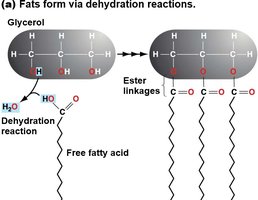
Phospholipids - diglyceride
Phospholipids consist of two fatty acids and a phosphate group attached to glycerol. The phosphate group is often bonded to a charged or polar molecule. Phospholipids are the main building blocks of cell membranes.
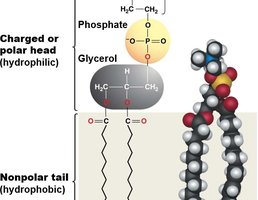 Has oxygen = hydrophilic
Amphipathic Nature of Phospholipids
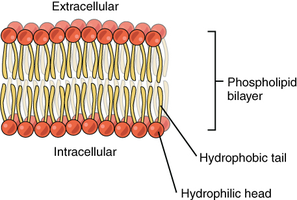
Phospholipids are amphipathic, meaning they have both hydrophilic (water-loving) and hydrophobic (water-fearing) regions. The hydrophilic head contains glycerol, a phosphate group, and a charged or polar group, while the hydrophobic tail consists of two nonpolar fatty acid chains.
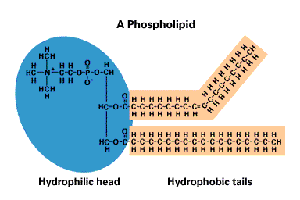 Amphipathic = dual symmetry
Section 6.2: Phospholipid Bilayers
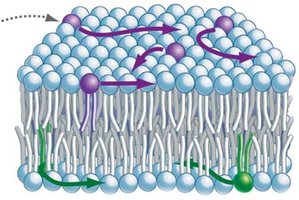
In aqueous environments, phospholipids spontaneously form bilayers, which are the foundation of biological membranes. The hydrophilic heads face outward toward water, while the hydrophobic tails face inward, away from water. This arrangement forms the plasma membrane and other cellular membranes.
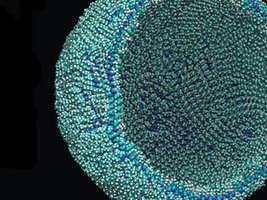
Vesicles and Liposomes
Phospholipids can also form vesicles—small, bubble-like structures surrounded by a lipid bilayer. Artificial vesicles are called liposomes and are used in laboratory studies of membrane properties.
 Think about drinking water: The head/top brings it in while the end/bottom lets it out
Selective Permeability of Lipid Bilayers
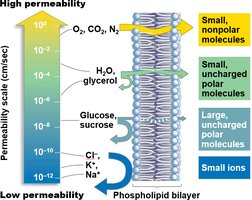
Lipid bilayers are selectively permeable, allowing some substances to cross more easily than others. Small, nonpolar molecules (e.g., O2, CO2) pass through easily, while large or charged molecules (e.g., ions, glucose) cross less readily.
Experimental Measurement of Membrane Permeability
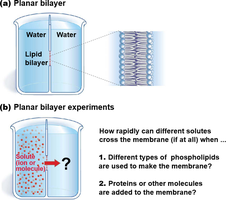
Planar bilayers are used in experiments to measure the permeability of membranes to various substances. By placing a substance on one side and measuring its movement to the other, researchers can assess how different lipid compositions affect permeability.
Factors Affecting Membrane Permeability
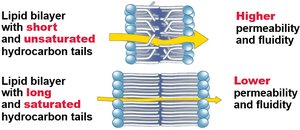
1. Tail Length: Longer hydrocarbon tails reduce membrane permeability due to increased hydrophobic interactions.
2. Saturation: Saturated tails pack more tightly, decreasing permeability; unsaturated tails increase fluidity and permeability.
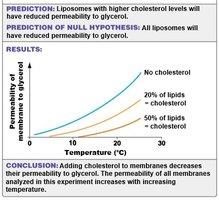
3. Temperature: Lower temperatures decrease membrane fluidity and permeability.
4. Cholesterol: Adding cholesterol increases membrane density and decreases permeability.
Lipids and Chemical Evolution
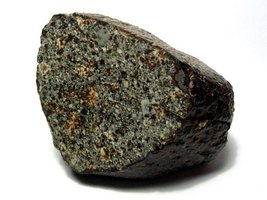
Evidence suggests that simple lipids, such as fatty acids, could have formed under early Earth conditions and may have played a role in the origin of life (along side amino acids). Modern meteorites contain lipids, supporting the idea that these molecules were present during chemical evolution.

Chapter Roadmap
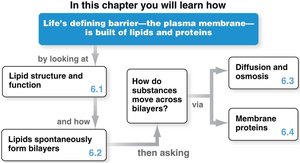
This chapter covers lipid structure and function, spontaneous formation of bilayers, movement of substances across membranes, and the roles of diffusion, osmosis, and membrane proteins in these processes.
Summary Table: Types of Lipids and Their Functions
Lipid Type | Structure | Main Function | Example |
|---|---|---|---|
Steroids | Four-ring structure | Membrane component, signaling | Cholesterol, hormones |
Fats (Triglycerides) | Three fatty acids + glycerol | Energy storage | Butter, oils |
Phospholipids | Two fatty acids + glycerol + phosphate | Membrane structure | Cell membranes |
Additional info: The chapter also introduces the concept of membrane proteins and their role in facilitating the movement of substances across the membrane, which will be covered in subsequent sections.
