 Back
Lipids, Membranes, and the First Cells: Structure, Function, and Transport
Study Guide - Smart Notes
 Tailored notes based on your materials, expanded with key definitions, examples, and context.
Chapter 6: Lipids, Membranes, and the First Cells
Introduction to Membranes and Lipids
Biological membranes are essential structures that separate the internal environment of the cell from the external environment. They are primarily composed of lipids and proteins, and their unique properties enable selective permeability, compartmentalization, and efficient cellular processes.
Plasma membrane: A lipid-rich boundary that regulates the passage of molecules and ions into and out of the cell.
Membrane function: Maintains distinct internal conditions, maximizes chemical reaction efficiency, and acts as a selective barrier.
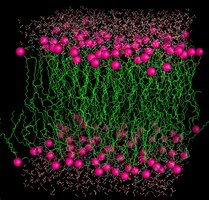
What is a Lipid?
Lipids are a diverse group of hydrophobic, mostly nonpolar molecules with major roles in energy storage, membrane structure, and signaling. Unlike amino acids, nucleotides, and monosaccharides, lipids are defined by their solubility rather than a shared chemical structure.
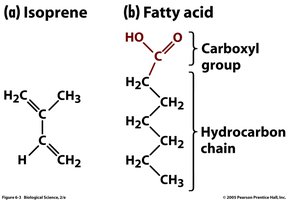
Isoprenoids: Five-carbon units that can be linked to form longer hydrocarbon chains; serve as pigments, vitamins, and hormone precursors.
Fatty acids: Hydrocarbon chains (14–20 carbons) with a terminal carboxyl group; can be saturated (no double bonds) or unsaturated (one or more C=C double bonds).
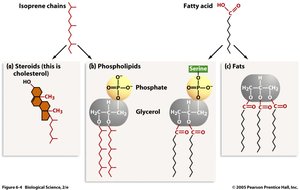
Major Types of Lipids in Cells
Cellular lipids are classified based on their structure and function:
Steroids: Four-ring structures (e.g., cholesterol) that are amphipathic and function in signaling and as membrane components.
Fats (Triglycerides): Three fatty acids linked to glycerol via ester linkages; serve as energy storage molecules.
Phospholipids: Two fatty acids and a phosphate group attached to glycerol; primary components of cell membranes.
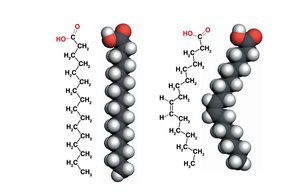
Structure and Properties of Fatty Acids
The physical properties of fatty acids depend on their saturation:
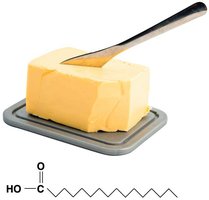
Saturated fatty acids: No double bonds; straight chains allow tight packing, making them solid at room temperature (e.g., butter).
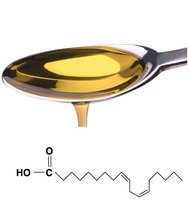
Unsaturated fatty acids: One or more double bonds; kinks prevent tight packing, making them liquid at room temperature (e.g., oils).
Phospholipids and Membrane Structure
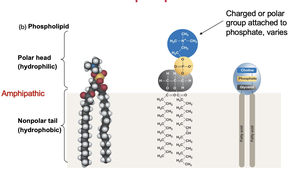
Phospholipids are amphipathic molecules with hydrophilic (polar) heads and hydrophobic (nonpolar) tails. This dual nature drives the spontaneous formation of bilayers in aqueous environments, which is the foundation of biological membranes.
Amphipathic: Having both hydrophilic and hydrophobic regions.
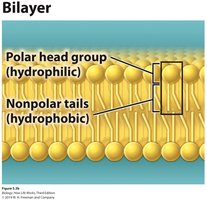
Bilayer formation: Hydrophilic heads face water; hydrophobic tails face inward, away from water.
Micelles, Lipid Bilayers, and Liposomes
In water, amphipathic lipids can form:
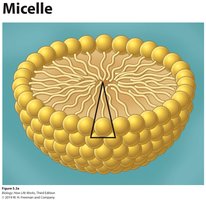
Micelles: Spherical structures with hydrophobic tails inward and hydrophilic heads outward (formed by single-chain lipids).
Lipid bilayers: Double-layered sheets with hydrophobic tails sandwiched between hydrophilic heads (formed by phospholipids).
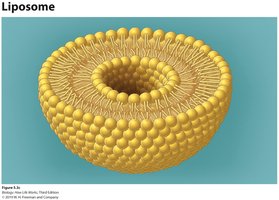
Liposomes: Spherical vesicles with a lipid bilayer enclosing an aqueous compartment.
Selective Permeability of Membranes
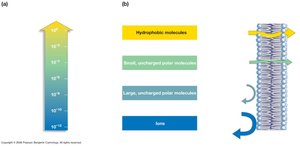
Biological membranes are selectively permeable, allowing some substances to cross more easily than others. This property is critical for maintaining cellular homeostasis.
High permeability: Small, nonpolar molecules (e.g., O2, CO2).
Moderate permeability: Small, uncharged polar molecules (e.g., H2O).
Low permeability: Large, uncharged polar molecules (e.g., glucose) and ions (e.g., Na+, Cl–).
Factors Affecting Membrane Permeability and Fluidity
Membrane permeability and fluidity are influenced by:
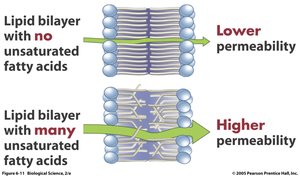
Lipid structure: Unsaturated fatty acids (with double bonds) increase fluidity and permeability; saturated fatty acids decrease them.
Hydrocarbon chain length: Shorter chains increase fluidity and permeability.
Cholesterol content: At normal temperatures, cholesterol decreases fluidity; at low temperatures, it prevents tight packing and increases fluidity.
Temperature: Higher temperatures increase fluidity; lower temperatures decrease it.
The Fluid Mosaic Model
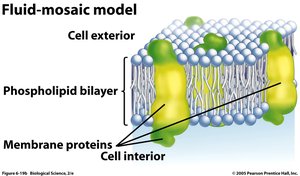
The fluid mosaic model describes the dynamic and heterogeneous nature of biological membranes. Membranes are composed of a phospholipid bilayer with proteins embedded or associated with the surface, allowing lateral movement but rarely flipping between layers.
Integral proteins: Span the membrane and are amphipathic.
Peripheral proteins: Temporarily associated with the membrane surface.
Asymmetry: The two leaflets of the bilayer have different compositions.
Membrane Proteins: Types and Functions
Membrane proteins are essential for communication, transport, and structural support. They are classified as:
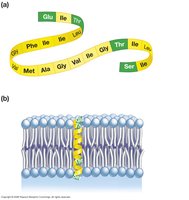
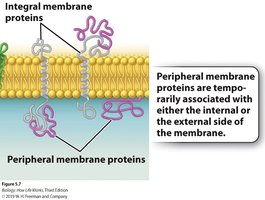
Integral (transmembrane) proteins: Span the lipid bilayer, often with amphipathic regions.
Peripheral proteins: Attach to the membrane surface or to integral proteins.
Carbohydrates in Membranes
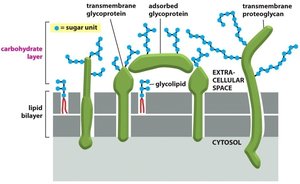
Carbohydrates are present on the extracellular surface of membranes, attached to proteins (glycoproteins) or lipids (glycolipids). They play roles in cell recognition, signaling, and protection.
Glycosylation: The process of adding carbohydrate groups to proteins or lipids.
Membrane Transport Mechanisms
Materials move across membranes by passive or active processes:
Passive transport: Does not require energy; includes simple diffusion and facilitated diffusion (via channels or carriers).
Active transport: Requires energy (usually ATP) to move substances against their concentration gradient.
Simple Diffusion
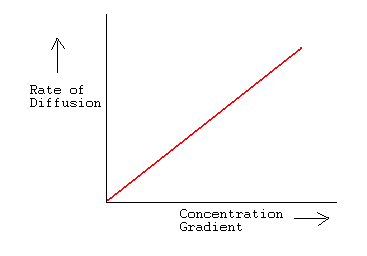
Movement of molecules from high to low concentration directly through the lipid bilayer.
Facilitated Diffusion
Transport of molecules down their concentration gradient via membrane proteins (channels or carriers). No energy input is required.
Ion channels: Allow specific ions to pass through; may be gated.
Aquaporins: Water channels that facilitate rapid water movement.
Carrier proteins: Undergo conformational changes to transport molecules like glucose.
Osmosis
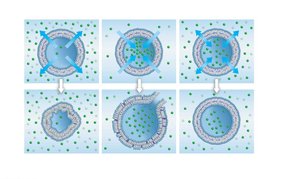
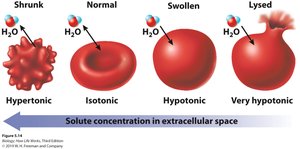
Osmosis is the diffusion of water across a selectively permeable membrane toward a higher solute concentration. It is crucial for maintaining cell volume and shape.
Hypertonic solution: Higher solute concentration outside; water leaves the cell, causing it to shrink.
Hypotonic solution: Lower solute concentration outside; water enters the cell, causing it to swell.
Isotonic solution: Equal solute concentrations; no net water movement.
Active Transport
Active transport moves substances against their concentration gradient using energy, often via ATP hydrolysis. The sodium-potassium pump (Na+/K+-ATPase) is a classic example, maintaining electrochemical gradients essential for cell function.
Primary active transport: Direct use of ATP (e.g., Na+/K+ pump).
Secondary active transport: Uses energy stored in electrochemical gradients to drive transport of other molecules.
Summary Table: Types of Membrane Transport
Transport Type | Energy Required? | Direction | Example |
|---|---|---|---|
Simple Diffusion | No | Down gradient | O2, CO2 |
Facilitated Diffusion | No | Down gradient | Glucose via GLUT-1, ions via channels |
Active Transport | Yes (ATP or gradient) | Against gradient | Na+/K+ pump |
Key Equations
Diffusion rate (Fick's Law):
Osmotic pressure:
where is the flux, is the diffusion coefficient, is the concentration gradient, is osmotic pressure, is the van 't Hoff factor, is molarity, is the gas constant, and is temperature.
Conclusion
Membranes are dynamic, selectively permeable structures composed of lipids, proteins, and carbohydrates. Their composition and structure determine their fluidity, permeability, and the mechanisms by which substances are transported, all of which are essential for cellular life.
