 Back
Lipids: Structure, Types, and Biological Roles
Study Guide - Smart Notes
 Tailored notes based on your materials, expanded with key definitions, examples, and context.
Lipids: Structure, Types, and Biological Roles
Introduction to Lipids
Lipids are a diverse group of hydrophobic molecules that play essential roles in biological systems. Unlike proteins or nucleic acids, lipids are not true polymers because they are not composed of repeating monomer subunits. Their hydrophobic nature is due to their nonpolar hydrocarbon chains, making them insoluble in water.
Definition: Lipids are organic compounds that are insoluble in water but soluble in nonpolar solvents.
Key property: Hydrophobicity, due to nonpolar covalent bonds.
Diversity: Lipids vary widely in structure and function, including energy storage, membrane structure, and signaling.
Types of Biologically Important Lipids
Fats – Energy storage molecules.
Phospholipids – Major components of cell membranes.
Steroids – Hormones and structural molecules (e.g., cholesterol).
Fats (Triacylglycerols)
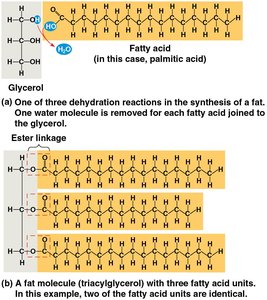
Fats are large molecules assembled from smaller components by dehydration reactions. They are primarily used for long-term energy storage in animals and plants.
Composition: One glycerol molecule and three fatty acids joined by ester linkages.
Glycerol: A three-carbon alcohol with a hydroxyl group attached to each carbon.
Fatty Acid: A long hydrocarbon chain (usually 16–18 carbons) with a carboxyl group at one end.
Formation: Each fatty acid is joined to glycerol by a dehydration reaction, forming an ester linkage.
Variation in Fatty Acids
Fatty acids can differ in length and in the presence or absence of double bonds, leading to two main categories:
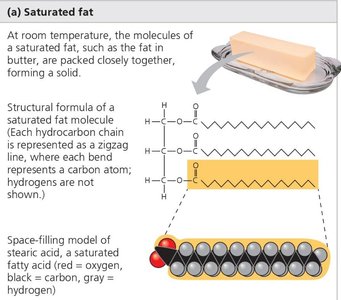
Saturated fatty acids: No double bonds between carbon atoms; straight chains allow tight packing, making them solid at room temperature.
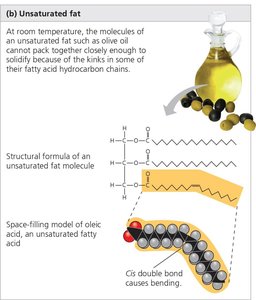
Unsaturated fatty acids: One or more cis double bonds introduce kinks, preventing tight packing and making them liquid at room temperature.
Saturated vs. Unsaturated Fats
Saturated fats: Common in animal fats; solid at room temperature.
Unsaturated fats: Common in plant and fish oils; liquid at room temperature.
Health implications: Diets high in saturated fats are linked to cardiovascular disease due to plaque formation in arteries. Some unsaturated fatty acids (e.g., omega-3) are essential and must be obtained from the diet.
Functions of Fats
Energy storage: Fats store more than twice as much energy per gram as polysaccharides.
Fat storage in animals: Stored in adipose cells, which also cushion organs and provide insulation (especially in marine mammals).
Phospholipids
Structure and Properties
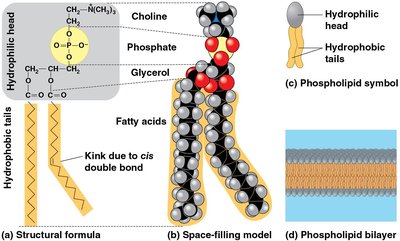
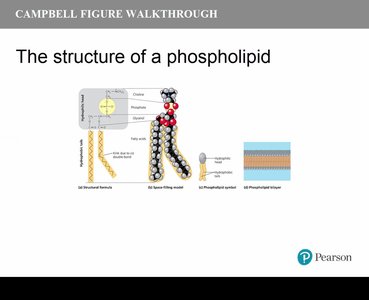
Phospholipids are essential components of cell membranes, characterized by their amphipathic nature (having both hydrophobic and hydrophilic regions).
Structure: Two fatty acid tails (hydrophobic) and a phosphate group (hydrophilic) attached to a glycerol backbone.
Phosphate group: Negatively charged; often modified with additional polar or charged groups, creating diversity among phospholipids.
Amphipathic nature: Hydrophobic tails and hydrophilic head allow unique interactions with water.
Behavior in Water and Biological Importance
Bilayer formation: In aqueous environments, phospholipids self-assemble into bilayers, with hydrophilic heads facing water and hydrophobic tails shielded inside.
Cell membranes: The phospholipid bilayer forms the fundamental structure of all cell membranes, providing compartmentalization, fluidity, and selective permeability.
Steroids
Structure and Function
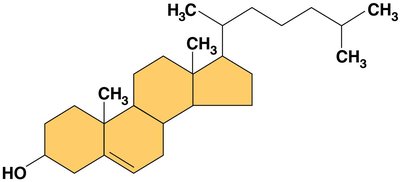
Steroids are a class of lipids characterized by a core structure of four fused carbon rings. They serve as hormones and structural components in cell membranes.
Structure: Four fused carbon rings with various functional groups attached.
Cholesterol: A key steroid found in animal cell membranes; precursor for other steroids, including hormones.
Health impact: High cholesterol levels are associated with cardiovascular disease. Both saturated and trans fats can negatively affect cholesterol levels.
Summary Table: Types of Lipids and Their Functions
Lipid Type | Structure | Main Function | Example |
|---|---|---|---|
Fats (Triacylglycerols) | Glycerol + 3 fatty acids | Energy storage, insulation, cushioning | Butter, oil, adipose tissue |
Phospholipids | Glycerol + 2 fatty acids + phosphate group | Cell membrane structure | Cell membrane bilayer |
Steroids | Four fused carbon rings | Hormones, membrane structure | Cholesterol, testosterone |
Key Terms and Concepts
Hydrophobic: Repelled by water; nonpolar.
Ester linkage: Bond formed between glycerol and fatty acids in fats.
Amphipathic: Molecule with both hydrophobic and hydrophilic regions (e.g., phospholipids).
Bilayer: Double layer of phospholipids forming the basic structure of cell membranes.
Saturated/Unsaturated: Refers to the presence or absence of double bonds in fatty acid chains.
Relevant Equations and Chemical Structures
General formula for a fat (triacylglycerol) synthesis:
General structure of a fatty acid:
General structure of a phospholipid:
Sample Exam Questions
Lipids cannot be considered polymers because
e) they are not composed of monomer subunits.
Unsaturated lipids are generally liquid at room temperature because their hydrocarbons are loosely packed because of their double bonds.
Which is not true about carbon bonds in fatty acids?
d) Saturated fats are those that have carbon-to-carbon double bonds and are associated with good health. (This is incorrect; saturated fats have no double bonds.)
If you were designing a cell to store a large amount of energy, which molecule(s) would you pack into it?
e) b and c (lipid and carbohydrate)
Bilayer formation is seen in
d) Phospholipids
If you wanted to extract the heaviest component of a membrane, you would need a protocol to extract
b) phospholipids.
What is the hydrophobic region in phospholipid?
b) Fatty acid tails
What makes up the cell membrane?
d) Phospholipids
