 Back
Lophotrochozoans: Flatworms, Mollusks, and Annelids – Structure, Diversity, and Evolution
Study Guide - Smart Notes
 Tailored notes based on your materials, expanded with key definitions, examples, and context.
Lophotrochozoans: Bilateria & Flatworms
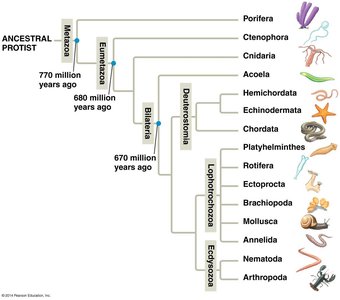
Introduction to Lophotrochozoa
Lophotrochozoa is a major clade within the protostome branch of Bilateria, encompassing diverse animal groups such as flatworms, mollusks, and annelids. These organisms share developmental and anatomical features that distinguish them from other animal clades.
Bilateria: Animals with bilateral symmetry and three germ layers (triploblastic).
Protostomia: Mouth develops from the blastopore during embryogenesis.
Lophotrochozoa: Includes flatworms, lophophorates, mollusks, and annelids.
Cephalization
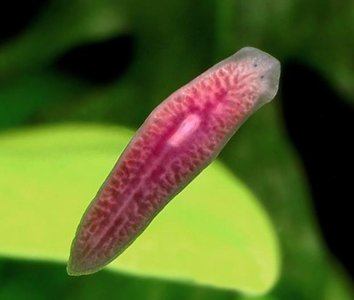
Cephalization refers to the evolutionary development of a head region where sensory organs and nervous tissue are concentrated. This adaptation is beneficial for motile animals, allowing them to interact with their environment efficiently.
Head region: Contains brain and sensory organs.
Directional movement: Head contacts environment first, facilitating navigation and feeding.
Special senses: Enhanced sensory processing.
Protostomia vs. Deuterostomia
Developmental Differences
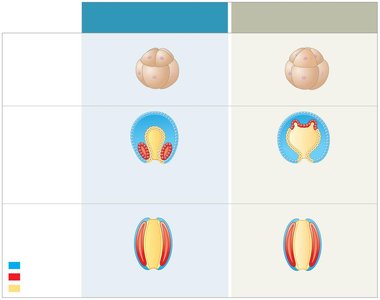
Protostomes and deuterostomes differ in their embryonic development, particularly in cleavage patterns, coelom formation, and the fate of the blastopore.
Protostome: Spiral and determinate cleavage; coelom forms by splitting mesoderm; mouth develops from blastopore.
Deuterostome: Radial and indeterminate cleavage; coelom forms by outpocketing of archenteron; anus develops from blastopore.
Anatomical Differences
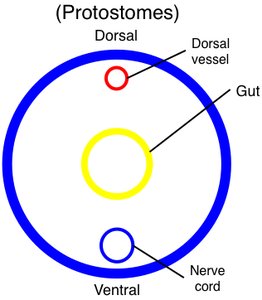
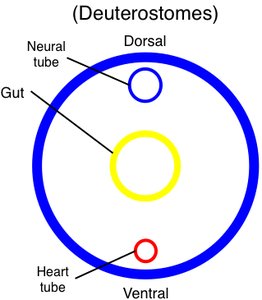
The position of the nerve cord and major blood vessel differs between protostomes and deuterostomes.
Protostomes: Ventral nerve cord, dorsal blood vessel.
Deuterostomes: Dorsal nerve cord, ventral heart tube.
Platyhelminthes (Flatworms)
Overview and Diversity
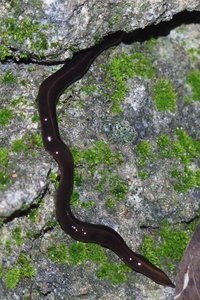
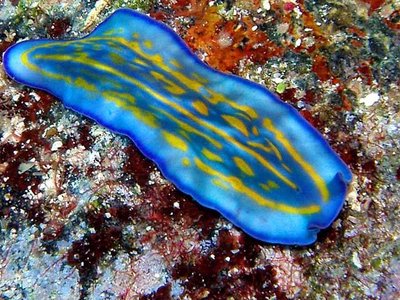
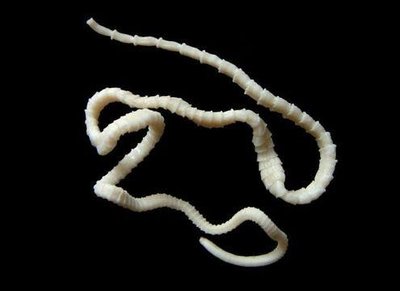
Platyhelminthes, or flatworms, are a diverse group of bilaterian animals characterized by their flattened bodies. They can be free-living or parasitic, and are classified into four major groups.
Turbellaria: Free-living flatworms (non-monophyletic).
Trematoda: Endoparasitic flukes (internal parasites).
Monogenea: Ectoparasitic flukes (external parasites).
Cestoda: Endoparasitic tapeworms.
Symbiosis and Parasitism
Flatworms exhibit various forms of symbiosis, including mutualism, commensalism, and parasitism. Many are parasites that infect humans and other animals.
Mutualism: Both species benefit.
Commensalism: One benefits, other unaffected.
Parasitism: One benefits, other is harmed.
Endoparasitic: Live inside host.
Ectoparasitic: Live on host surface.
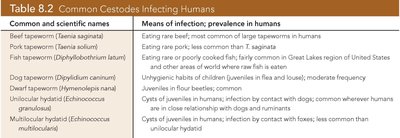
Flatworm Anatomy and Physiology
Flatworms possess a simple body plan with an incomplete digestive system, paired nerve cords, and a brain (ganglia). They lack a true coelom and have specialized reproductive systems.
Incomplete gut: Mouth present, no anus.
Paired nerve cords: Centralized nervous system.
Eyespots: Simple light-detecting organs.
Reproduction: Both sexual (mostly monoecious) and asexual (budding, fission).
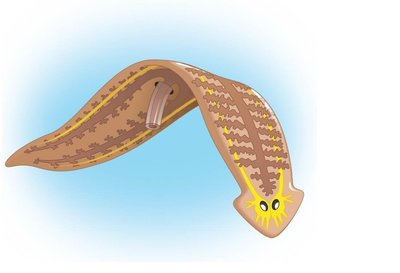
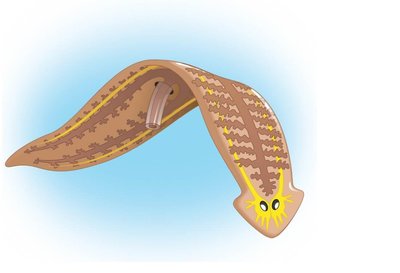
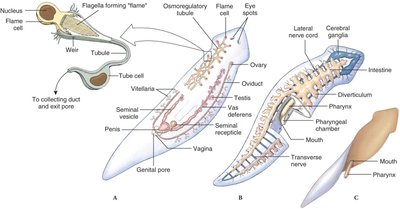
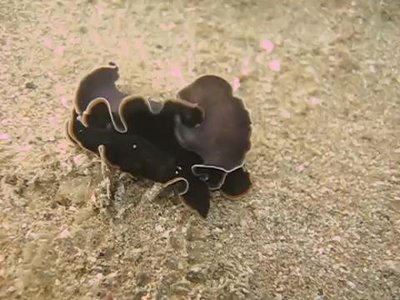
Table: Common Cestodes Infecting Humans
This table summarizes major tapeworm species, their means of infection, and prevalence in humans.
Common and scientific names | Means of infection; prevalence in humans |
|---|---|
Beef tapeworm (Taenia saginata) | Eating rare beef; most common of large tapeworms in humans |
Pork tapeworm (Taenia solium) | Eating rare pork; less common than T. saginata |
Fish tapeworm (Diphyllobothrium latum) | Eating raw or poorly cooked fish; fairly common in Great Lakes region of United States and other areas of world where raw fish is eaten |
Dog tapeworm (Dipylidium caninum) | Unhygienic habits of children (juveniles in flea and louse); moderate frequency |
Dwarf tapeworm (Hymenolepis nana) | Juveniles in flour beetles; common |
Unilocular hydatid (Echinococcus granulosus) | Cysts of juveniles in humans; infection by contact with dogs; common wherever humans are in close relationship with dogs and ruminants |
Multilocular hydatid (Echinococcus multilocularis) | Cysts of juveniles in humans; infection by contact with foxes; less common than unilocular hydatid |
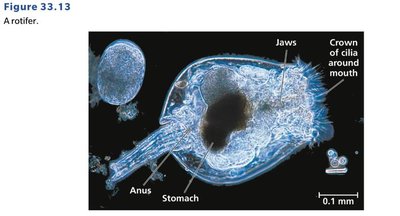
Rotifers and Acanthocephalans
Rotifers
Rotifers are microscopic aquatic animals with a complete digestive tract and a hydrostatic skeleton. They reproduce asexually via parthenogenesis.
Alimentary canal: Digestive tube with mouth and anus.
Hemocoel: Fluid-filled cavity serving as hydrostatic skeleton.
Cilia: Creates vortex for feeding.
Parthenogenesis: Females produce offspring from unfertilized eggs.
Acanthocephalans
Acanthocephalans are sexually reproducing parasites with a proboscis bearing hooks. They lack a complete digestive tract and manipulate host behavior to facilitate transmission.
Proboscis: Curved hooks for attachment.
Triploblastic: Three germ layers.
Hemocoel: Fluid-filled cavity.
Host manipulation: Alters invertebrate behavior to infect vertebrates.
Ectoprocta and Brachiopoda
Characteristics
Ectoprocts and brachiopods possess a lophophore, a crown of ciliated tentacles used for filter feeding. They are sessile, have a coelom, and are important reef builders.
Lophophore: Crown of ciliated tentacles around mouth.
U-shaped alimentary canal: Digestive system with two openings.
Colonial (Ectoprocts): Bryozoans encased in exoskeleton.
Brachiopods: Resemble clams but have dorsal/ventral shells.
Mollusca
Overview and Diversity
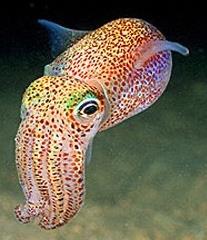
Mollusks are a highly diverse clade of protostome animals, including chitons, snails, clams, squids, and octopuses. Most secrete a calcium carbonate shell and exhibit a wide range of feeding strategies and habitats.
Soft body: Most secrete a shell (valve).
Diversity: ~90,000 living species, ~70,000 extinct species.
Size range: Under 5 cm to over 20 m.
Feeding: Carnivorous, herbivorous, filter feeders, some parasitic.
Habitat: Marine, freshwater, terrestrial.
Economic importance: Food, pearls, shells.
Synapomorphies and Body Plan
Mollusks share several key features, including the mantle, calcareous shell, muscular foot, and radula. Their body plan consists of a head-foot region and a visceral mass.
Mantle: Dorsal layer secreting shell.
Calcareous valve: Shell composed of calcium carbonate.
Muscular foot: Locomotion, varies in shape.
Radula: Rasping, tongue-like organ for feeding (absent in bivalves).
Visceral mass: Contains internal organs.
Reproduction and Extinction
All mollusks reproduce sexually, with most being dioecious. Mollusks have the highest number of documented animal extinctions, primarily due to habitat loss, pollution, invasive species, and overharvesting.
Sexual reproduction: Most are dioecious (separate sexes).
Extinction threats: Habitat loss, pollution, invasive species, overharvesting.
Annelida
Overview and Diversity
Annelids are segmented protostome animals, including earthworms, leeches, and polychaetes. They are ecologically important and exhibit metameric segmentation and setae for movement.
Metamerism: Body composed of serial segments separated by septa.
Setae: Chitinous bristles for stabilization and movement.
Hydrostatic skeleton: Fluid-filled coelom for movement.
Complete gut: Mouth and anus present.
Earthworms (Lumbricidae)
Earthworms are freshwater and terrestrial annelids with setae but no parapodia. They are monoecious and possess a clitellum for reproduction. Earthworms play a crucial role in soil enrichment and aeration.
Monoecious: Both sexes in one individual.
Clitellum: Secretory organ for reproduction.
Ecological importance: Mix and aerate soil, ingest large amounts of soil.
Polychaetes
Polychaetes are marine annelids, some of which are motile predators with jaws, while others are scavengers living on whale falls. They possess parapodia and setae for movement.
Motile predators: E.g., Bobbit worm (Eunice aphroditois).
Scavengers: E.g., Osedax (bone-eating worm).
Parapodia: Lateral appendages for movement (not in earthworms or leeches).
Summary Table: Lophotrochozoan Diversity
Clade | Key Features | Examples |
|---|---|---|
Platyhelminthes | Flat body, incomplete gut, parasitic/free-living | Planarians, flukes, tapeworms |
Rotifera | Microscopic, complete gut, parthenogenesis | Rotifers |
Mollusca | Soft body, shell, foot, radula | Snails, clams, squids |
Annelida | Segmented body, setae, hydrostatic skeleton | Earthworms, leeches, polychaetes |
Additional info: Academic context was added to clarify developmental differences, anatomical features, and ecological importance of each clade. All images included are directly relevant to the explanation of the adjacent paragraph.
