 Back
BackMacroevolution, Speciation, and Mechanisms of Evolution
Study Guide - Smart Notes
 Tailored notes based on your materials, expanded with key definitions, examples, and context.
Macroevolution and Microevolution
Definitions and Scope
Evolutionary biology distinguishes between microevolution and macroevolution, which describe changes at different biological scales.
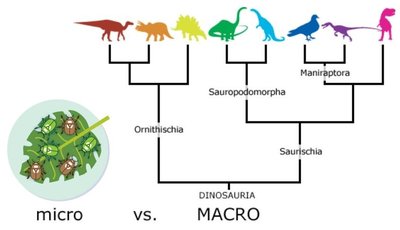
Microevolution: Refers to changes in allele frequencies within a population over time, often observable across a few generations.
Macroevolution: Involves large-scale evolutionary changes that result in the formation of new species or higher taxonomic groups.
Example: Microevolution might involve color changes in a beetle population, while macroevolution could involve the divergence of dinosaurs into birds.
Species and Classification
What is a Species?
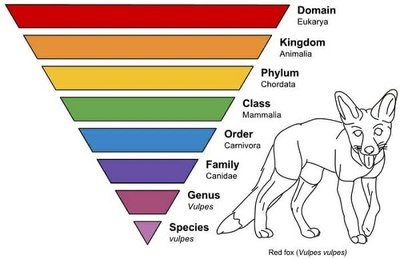
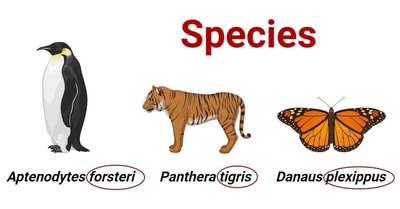
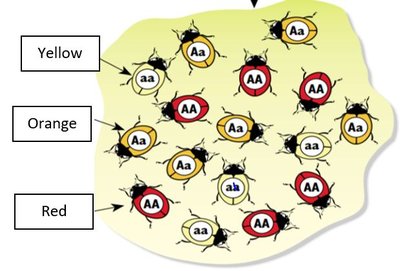
A species is a group of similarly constructed organisms capable of interbreeding and producing fertile offspring. Members of a species share a common gene pool.
Gene Pool: The total of all alleles present in all individuals of a population.
Allele Frequency: The proportion of a specific allele among all alleles of a gene in a population.
Biological and Evolutionary Species Concepts
Biological Species Concept: Defines species based on the ability to interbreed and produce fertile offspring. Relies on reproductive isolation but is limited for fossils, asexual organisms, or geographically isolated populations.
Evolutionary Species Concept: Defines species as distinct lineages with their own evolutionary history. Useful for fossils and asexual organisms but can be subjective regarding when lineages diverge.
Fitness and Genetic Diversity
Fitness
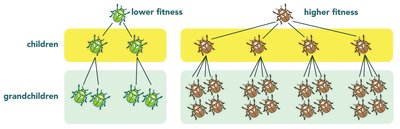
Fitness is the ability of an organism to survive, reproduce, and pass its genes to the next generation. Higher fitness means more offspring and greater genetic contribution to future generations.
Gene Pool Diversity
Genetic diversity within a population's gene pool is crucial for adaptability and long-term survival. Populations with greater diversity are more resilient to environmental changes.
Mechanisms of Evolution
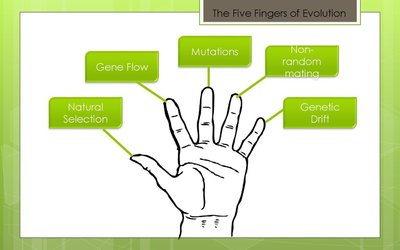
Five Mechanisms of Evolution
Natural Selection: Differential survival and reproduction based on heritable traits.
Mutations: Random changes in DNA that introduce new genetic variation.
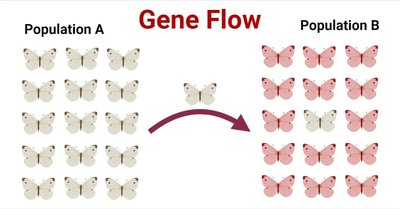
Gene Flow: Movement of alleles between populations through migration.
Genetic Drift: Random changes in allele frequencies, especially in small populations.
Non-random Mating: Mating patterns that are not random can affect genotype frequencies.
Genetic Drift
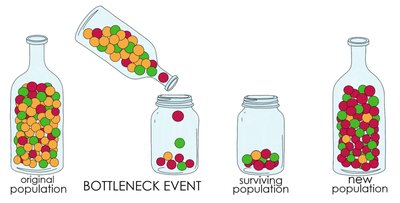
Bottleneck Effect
The bottleneck effect occurs when a population is drastically reduced in size due to a disaster, resulting in a loss of genetic diversity.
Examples: Hurricanes, fires, overhunting, habitat loss.
Founder Effect
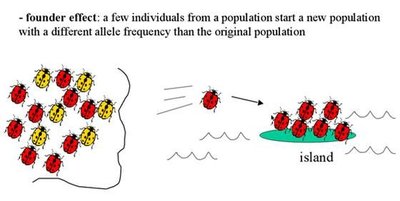
The founder effect occurs when a small group from a population establishes a new population with a different allele frequency than the original.
Example: High frequency of polydactylism in Amish populations due to small founding group.
Gene Flow
Gene flow is the transfer of alleles from one population to another, which can increase genetic diversity and reduce differences between populations.
Speciation and Reproductive Isolation
Speciation
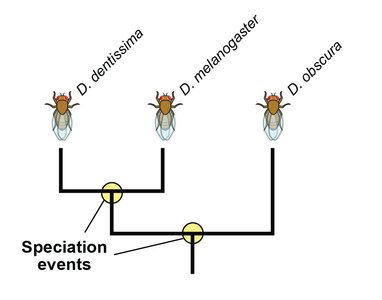
Speciation is the process by which new species arise, typically through reproductive isolation and genetic divergence.
Allopatric Speciation: Occurs when populations are geographically separated.
Sympatric Speciation: Occurs without geographic separation, often through ecological or behavioral differences.
Isolating Mechanisms
Prezygotic Mechanisms: Prevent mating or fertilization
Sympatric
Habitat - organisms live in different habitat (in the same area) preventing meeting and mating
Temporal - differences in breeding times or seasons prevent mating
Behavioral - different techniques for attracting mates prevent mating
Mechanical - reproductive organs are not compatible
Gamete - differences in sperm and egg prevent fertilization
Allopatric
Geographic - ecological conditions physically keep the organisms apart
Both
Reproductive - something that prevent 2 populations from succesfully mating and producing fertile offspring
Postzygotic Mechanisms: Prevent hybrid offspring from surviving or reproducing (e.g., hybrid sterility, hybrid breakdown).
Zygote mortality - a hybrid zygote is inviable and dies before developing
Hybrid mortality - a hybrid offspring dies shortly before or after birth (prior to reaching productive age)
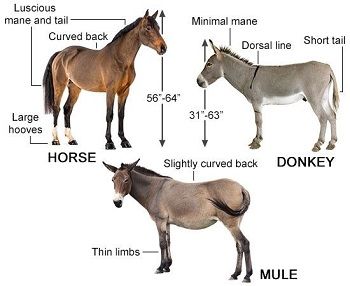
Hybrid sterility - the hybrid zygote develops into a sterile adult (unable to reproduce)
Hybrid Breakdown - hybrid offspring survive and reproduce, F2 generation is sterile
Example: Horse and donkey produce a sterile mule (hybrid sterility).
Rates of Evolution
Gradualism vs. Punctuated Equilibrium
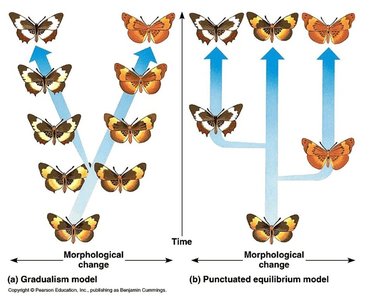
Two models describe the tempo of evolutionary change:
Gradualism: Evolution occurs slowly and steadily over long periods.
Punctuated Equilibrium: Long periods of stability are interrupted by brief periods of rapid change, often due to environmental shifts or new ecological opportunities.
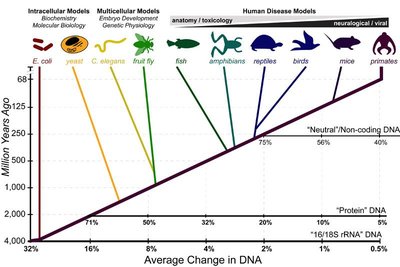
Molecular Clock
The molecular clock uses the rate of neutral mutations in DNA to estimate the time of divergence between species, assuming a relatively constant rate of molecular change.
Helps determine evolutionary relationships and timing of speciation events.
Coevolution
Definition and Examples
Coevolution is the process by which two or more species reciprocally affect each other's evolution. This often occurs in ecological relationships such as predator-prey, parasite-host, or mutualistic interactions.
Example: Flowers and their pollinators evolve traits in response to each other.
Summary Table: Mechanisms of Evolution
Mechanism | Description | Effect on Population |
|---|---|---|
Natural Selection | Favors traits that increase fitness | Adaptive change |
Mutation | Random changes in DNA | Introduces new alleles |
Gene Flow | Movement of alleles between populations | Increases genetic diversity |
Genetic Drift | Random changes in allele frequencies | Reduces genetic diversity, especially in small populations |
Non-random Mating | Mate choice affects genotype frequencies | Can increase homozygosity or heterozygosity |
