 Back
Macromolecules I: Carbohydrates and Lipids
Study Guide - Smart Notes
 Tailored notes based on your materials, expanded with key definitions, examples, and context.
Macromolecules: An Overview
Definition and Importance
Macromolecules are large, complex molecules essential for life, typically composed of thousands of atoms. They include carbohydrates, lipids, proteins, and nucleic acids. Except for some lipids, most macromolecules are polymers, which are long chains of repeating subunits called monomers linked by covalent bonds.
Polymer: A long molecule consisting of many similar or identical building blocks (monomers) joined by covalent bonds.
Monomer: The repeating subunit that serves as the building block of a polymer.

Additional info: Macromolecules are fundamental to cell structure and function, forming the basis of biological processes.
Synthesis and Breakdown of Macromolecules
Polymerization and Depolymerization
Macromolecules are synthesized and broken down by specific chemical reactions:
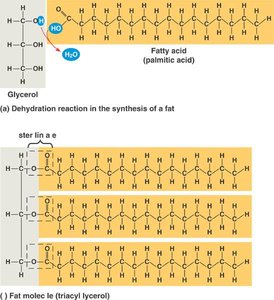
Dehydration Reaction (Condensation): Monomers are joined together by covalent bonds through the removal of a water molecule. This process builds polymers.
Hydrolysis: Polymers are broken down into monomers by the addition of a water molecule, splitting the covalent bond.
Both reactions are catalyzed by enzymes.

Major Classes of Macromolecules
General Structural Features
The four major classes of macromolecules differ in their monomers and functions:
Macromolecule | Monomer (Subunit) |
|---|---|
Carbohydrate | Monosaccharides (simple sugars) |
Lipid | Fatty acids (some lipids are not true polymers) |
Protein | Amino acids |
Nucleic Acids | Nucleotides (with nitrogenous bases: G, A, T, C, or U) |
Additional info: Each class of macromolecule has unique properties and biological roles.
Carbohydrates
Monosaccharides
Monosaccharides are the simplest carbohydrates, serving as the monomers for more complex carbohydrates. They are classified based on the location of their carbonyl group and the number of carbons in the skeleton.
Aldose: Carbonyl group at the end of the carbon skeleton (e.g., glucose).
Ketose: Carbonyl group within the carbon skeleton (e.g., fructose).
Diversity also arises from the spatial arrangement of atoms around asymmetric carbons (e.g., glucose vs. galactose).

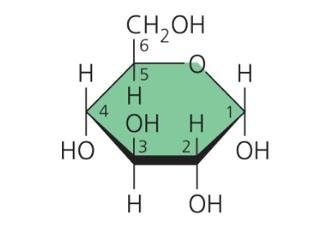
Pentoses and Hexoses
Pentoses (five-carbon sugars) and hexoses (six-carbon sugars) are common monosaccharides with important biological roles.
Ribose: A component of RNA (pentose).
Ribulose: An intermediate in photosynthesis (pentose).
Glucose, Galactose, Fructose: Energy sources for organisms (hexoses).

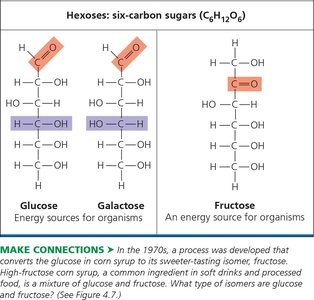
Disaccharides
Disaccharides are formed when two monosaccharides are joined by a glycosidic bond through a dehydration reaction. Examples include maltose (glucose + glucose) and sucrose (glucose + fructose).
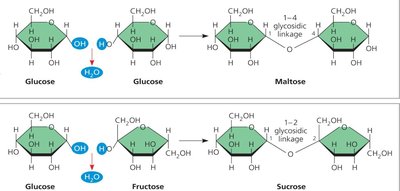
Polysaccharides
Polysaccharides are large polymers of monosaccharides joined by glycosidic bonds. They serve as storage or structural molecules.
Storage Polysaccharides:
Starch: Stored by plants as granules; composed of glucose monomers.
Glycogen: Stored by animals in liver and muscle cells; highly branched polymer of glucose.
Structural Polysaccharides:
Cellulose: Major component of plant cell walls; polymer of glucose.
Chitin: Found in exoskeletons of arthropods; polymer of glucose with nitrogen groups.


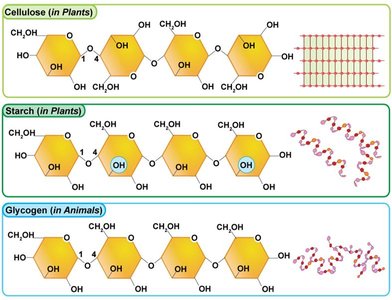
Lipids
General Features
Lipids are a diverse group of hydrophobic molecules that are not true polymers. They are characterized by their insolubility in water and serve various biological functions:
Energy Storage and Transport: Fats (triacylglycerols or TAGs).
Structure: Phospholipids, sterols.
Chemical Messengers: Steroids (e.g., cholesterol), glycolipids.
Photoreceptors: Carotenoids.
Coverings: Waxes.
Fats: Triacylglycerols
Fats are constructed from glycerol and fatty acids. Three fatty acids join to one glycerol molecule by ester bonds, forming a triacylglycerol (TAG) or triglyceride.
Saturated Fatty Acids: No double bonds in the hydrocarbon chain; typically solid at room temperature (e.g., butter).
Unsaturated Fatty Acids: One or more double bonds, causing kinks; typically liquid at room temperature (e.g., olive oil).
Phospholipids
Phospholipids are essential components of cell membranes. They consist of a hydrophilic (polar) head and two hydrophobic tails. Structurally, they are similar to TAGs, but one fatty acid is replaced by a phosphate group and a polar group (e.g., choline).
Steroids
Steroids are lipids with a carbon skeleton consisting of four fused rings. Cholesterol is a key steroid found in animal cell membranes and serves as a precursor for other steroids.
Summary Table: Carbohydrates and Lipids
Macromolecule | Monomer | Examples | Key Functions |
|---|---|---|---|
Carbohydrate | Monosaccharide | Glucose, Starch, Glycogen, Cellulose, Chitin | Energy storage, structural support |
Lipid | Fatty acid (not always a true polymer) | Fats, Phospholipids, Steroids, Waxes | Energy storage, membrane structure, signaling |
