 Back
Macromolecules of Life: Lipids, Proteins, and Nucleic Acids
Study Guide - Smart Notes
 Tailored notes based on your materials, expanded with key definitions, examples, and context.
Review of Lipids and Proteins
Lipids: Structure and Function
Lipids are a diverse group of hydrophobic, non-polymeric macromolecules primarily composed of hydrocarbon chains. They play essential roles in energy storage, membrane structure, and signaling.
Fatty acids: Long hydrocarbon chains with a carboxyl group; building blocks of fats and oils.
Phospholipids: Major components of cell membranes, containing hydrophilic heads and hydrophobic tails.
Steroids: Lipids with a characteristic four-ring structure, such as cholesterol and hormones.
Note: Lipids are not true polymers because they are not composed of repeating monomeric units.
Proteins: Structure and Function
Proteins are polymers made of amino acid monomers linked by peptide bonds. Their structure determines their function, and they are sensitive to changes in primary sequence and environmental conditions.
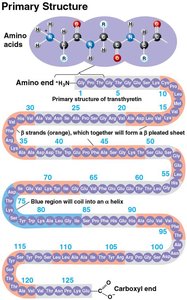
Primary structure: The unique sequence of amino acids in a polypeptide chain.
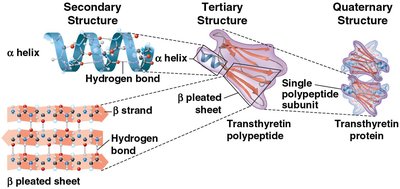
Secondary structure: Local folding into alpha helices and beta sheets stabilized by hydrogen bonds.
Tertiary structure: The overall 3D shape of a polypeptide, stabilized by interactions among side chains.
Quaternary structure: The association of multiple polypeptide subunits into a functional protein.
Protein Functions
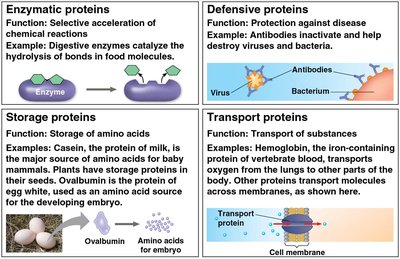
Proteins perform a wide variety of functions in living organisms, including catalysis, defense, storage, transport, signaling, movement, and structural support.
Enzymatic proteins: Accelerate chemical reactions (e.g., digestive enzymes).
Defensive proteins: Protect against disease (e.g., antibodies).
Storage proteins: Store amino acids (e.g., casein, ovalbumin).
Transport proteins: Move substances across membranes (e.g., hemoglobin).
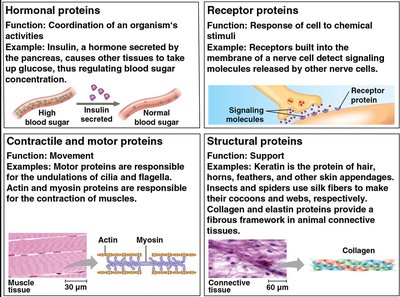
Hormonal proteins: Coordinate organismal activities (e.g., insulin).
Receptor proteins: Respond to chemical stimuli (e.g., nerve cell receptors).
Contractile and motor proteins: Enable movement (e.g., actin, myosin).
Structural proteins: Provide support (e.g., collagen, keratin).
Macromolecule #4: Nucleic Acids
Introduction to Nucleic Acids
Nucleic acids are polymers that store and transmit genetic information. The sequence of amino acids in a protein is determined by the genetic code, which is encoded in DNA and transcribed into RNA.
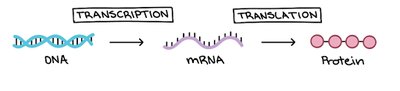
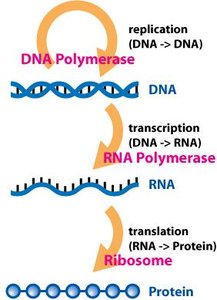
Central Dogma: DNA is transcribed into RNA, which is translated into protein.
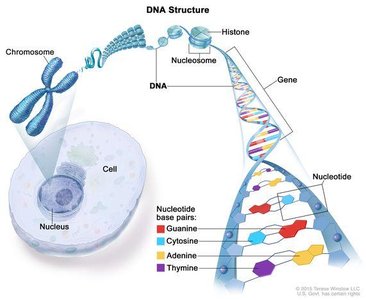
Genes: Units of inheritance made of DNA, which is composed of nucleic acids.
Types of Nucleic Acids
There are two major types of nucleic acids:
Deoxyribonucleic acid (DNA): Stores genetic information and directs its own replication.
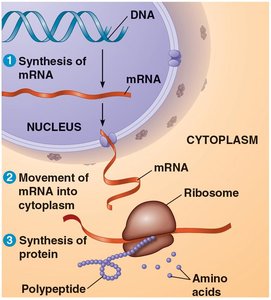
Ribonucleic acid (RNA): Functions in gene expression, including messenger RNA (mRNA), which directs protein synthesis.
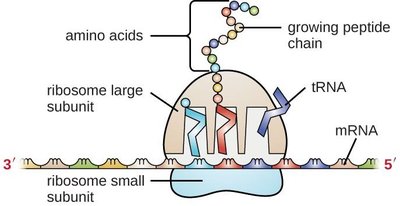
The process of gene expression involves transcription (DNA to RNA) and translation (RNA to protein).
Nucleic Acid Structure: Monomers and Polymers
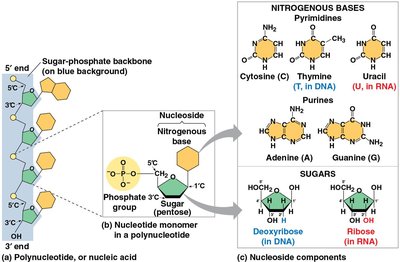
Nucleic acids are polymers (polynucleotides) made up of nucleotide monomers. Each nucleotide consists of three components:
Nitrogenous base
Pentose sugar (deoxyribose in DNA, ribose in RNA)
One or more phosphate groups
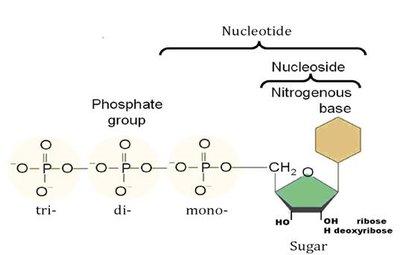
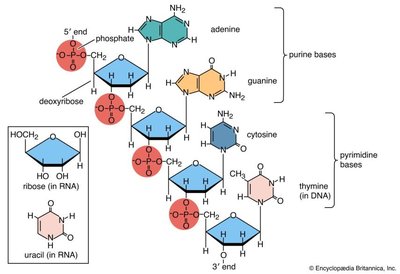
Nucleosides and Nitrogenous Bases
A nucleoside consists of a nitrogenous base and a pentose sugar, lacking the phosphate group found in nucleotides. There are two families of nitrogenous bases:
Pyrimidines: Single six-membered ring (cytosine, thymine, uracil)
Purines: Double ring structure (adenine, guanine)
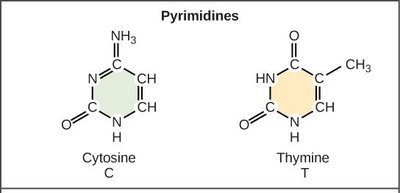
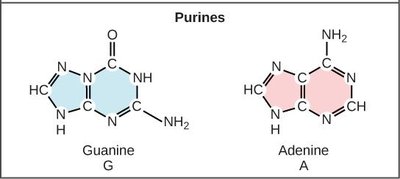
Formation of DNA: Phosphodiester Bonds and Backbone
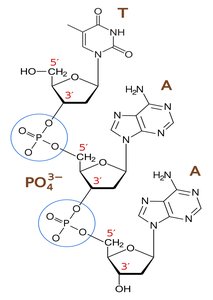
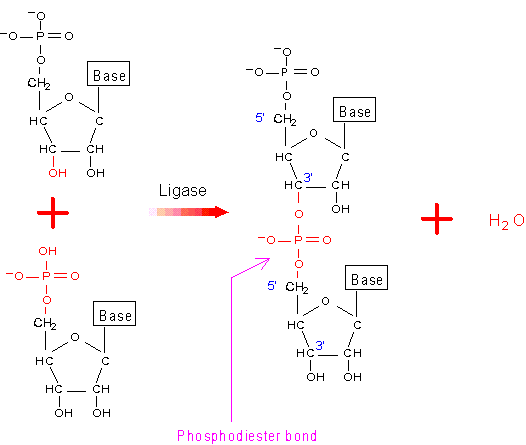
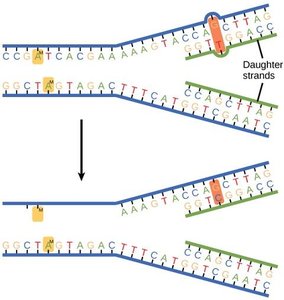
Nucleotide polymers are linked by phosphodiester bonds between the phosphate group of one nucleotide and the hydroxyl group of the next. This forms the sugar-phosphate backbone of DNA, which stabilizes the structure of each strand. The formation of these bonds is a dehydration reaction.
Complementary Base Pairing and Double Helix
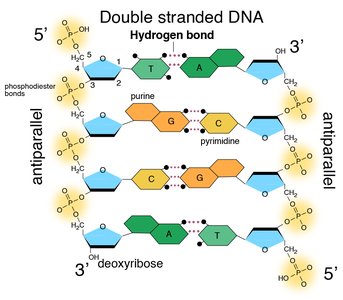
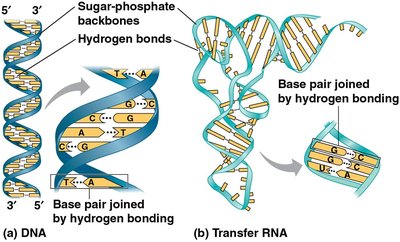
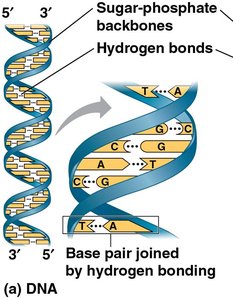
In double-stranded DNA, nitrogenous bases pair via hydrogen bonds in a specific manner (A with T, G with C), known as complementary base pairing. This allows for the faithful replication of DNA and is essential for cell division. RNA also exhibits base pairing, but uses uracil instead of thymine and ribose as its sugar.
Base pairing: Adenine (A) pairs with Thymine (T) in DNA, or Uracil (U) in RNA; Guanine (G) pairs with Cytosine (C).
Antiparallel Structure and tRNA Function
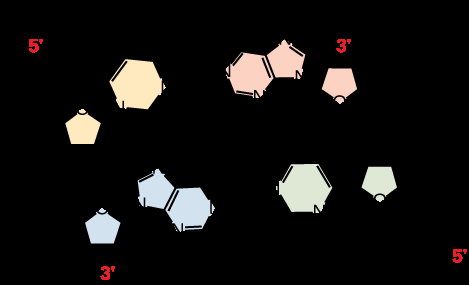
The two strands of DNA run in opposite directions, described as antiparallel. Transfer RNA (tRNA) molecules read the mRNA sequence during translation and bring the appropriate amino acids to the ribosome for protein synthesis.
Ends of DNA Molecules
DNA strands have directionality, with a 5' phosphate end and a 3' hydroxyl end. This polarity is crucial for replication and transcription.
Genomics, Proteomics, and Bioinformatics
DNA Sequencing and Its Importance
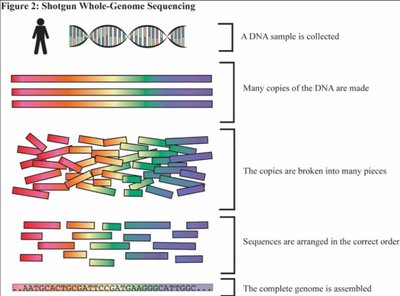
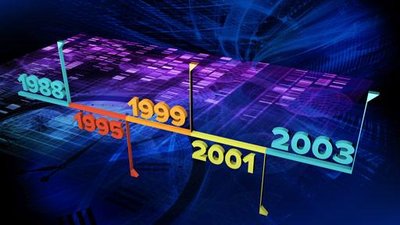
DNA sequencing began in the 1970s and has enabled scientists to decode the genetic information of organisms. The Human Genome Project (1990s–2000s) sequenced the entire human genome, revolutionizing biology and medicine.

Modern Genomics and Proteomics
Genomics is the study of entire genomes, comparing genes within and between species. Proteomics analyzes the full set of proteins encoded by a genome. Bioinformatics applies computational tools to analyze and interpret large biological datasets.
Applications: Disease screening, evolutionary studies, personalized medicine.
Summary of Nucleic Acid Macromolecules
Nucleotides are composed of a pentose sugar, one or more phosphate groups, and a nitrogenous base.
Nucleotides are assembled into nucleic acid polymers, forming the genetic material of cells.
DNA structure is stabilized by covalent bonds within strands and hydrogen bonds between strands.
Genomics and proteomics are rapidly advancing fields that help us understand heredity, evolution, and disease.
