 Back
BackMacromolecules: Structure, Formation, and Biological Roles
Study Guide - Smart Notes
 Tailored notes based on your materials, expanded with key definitions, examples, and context.
Macromolecules
Definition and Importance
Macromolecules are large, complex molecules essential for life, composed of thousands or millions of smaller subunits. They are fundamental to the structure and function of cells and organisms.
Definition: Macromolecules are organic compounds made primarily of carbon, hydrogen, oxygen, and other elements, held together by covalent bonds.
Classes: The four main classes are carbohydrates, lipids, proteins, and nucleic acids.
Diversity: Differences in macromolecules, especially proteins and nucleic acids, account for the diversity among species.
Formation of Macromolecules
Macromolecules are synthesized within cells through specific chemical reactions.
Dehydration Synthesis (Condensation Reaction): Subunits are joined together, and a water molecule is removed for each bond formed. This process requires energy, which is stored in the bonds.
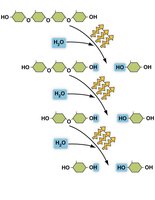
Hydrolysis Reaction: The reverse process, where water is added to break bonds between subunits, releasing stored energy.
Example: Formation and breakdown of carbohydrates through dehydration synthesis and hydrolysis. 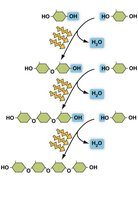
Carbohydrates
Structure and Function
Carbohydrates are organic molecules with a carbon backbone, hydrogen, and oxygen in a 2:1 ratio. They serve as energy sources and structural components.
Structure: Carbon is "hydrated" (bound to water-like proportions of hydrogen and oxygen).
Uses: Energy storage and structural support in plants and some organisms.
Classification of Carbohydrates
Monosaccharides: Simplest sugars, typically with five or six carbons in a ring structure. Examples: glucose, fructose, ribose, deoxyribose.
Disaccharides: Two monosaccharides joined by dehydration synthesis. Examples: sucrose (glucose + fructose), lactose (glucose + galactose), maltose (glucose + glucose).
Oligosaccharides: Short chains of monosaccharides. Often bind to proteins to form glycoproteins, important for cell recognition and communication.
Polysaccharides: Long chains of monosaccharides, used for energy storage and structural support. Examples: glycogen (animal storage), starch (plant storage), chitin (animal structure), cellulose (plant structure).
Lipids
Structure and Biological Roles
Lipids are hydrophobic molecules, insoluble in water, and crucial for energy storage, membrane structure, and signaling.
Sub-classes: Triglycerides, phospholipids, and steroids.
Triglycerides
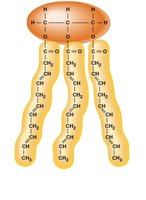
Structure: Composed of a glycerol molecule (head) and three fatty acids (tails), formed by dehydration synthesis.
Function: Stored in adipose tissue as an energy reserve.
Types: Saturated and unsaturated fats.
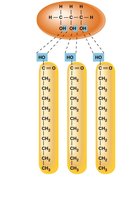
Saturated Fats
Each carbon in the fatty acid tail has two hydrogen atoms.
Single bonds between carbons (C-C), resulting in straight tails that pack tightly.
Solid at room temperature; examples include animal fats like butter.
High intake is associated with cardiovascular disease risk.
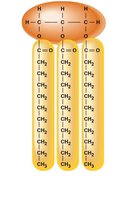
Unsaturated Fats
At least one double bond between carbons (C=C), resulting in "kinked" tails.
Liquid at room temperature; examples include vegetable oils.
Phospholipids
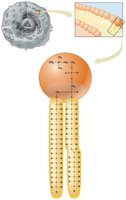
Structure: Modified lipid with two fatty acid tails and a negatively charged phosphate group attached to glycerol.
Function: Primary structural component of cell membranes.
Properties: The phosphate group is polar and hydrophilic (water-soluble), while the fatty acid tails are nonpolar and hydrophobic (water-insoluble).
Steroids
Structure: Backbone of three six-membered carbon rings and one five-membered ring, with various side groups.
Function: Important for cell signaling and membrane structure; example: cholesterol.
Summary Table: Macromolecule Classes
Class | Structure | Main Functions | Examples |
|---|---|---|---|
Carbohydrates | Carbon backbone, C:H:O ratio 1:2:1 | Energy, structure | Glucose, starch, cellulose |
Lipids | Hydrocarbon chains, glycerol, phosphate (phospholipids) | Energy storage, membranes, signaling | Triglycerides, phospholipids, cholesterol |
Proteins | Amino acid chains | Enzymes, structure, transport | Hemoglobin, collagen |
Nucleic acids | Nucleotide chains | Genetic information | DNA, RNA |
Key Chemical Reactions
Dehydration Synthesis
Joins subunits by removing water.
Requires energy input.
Hydrolysis
Breaks polymers into subunits by adding water.
Releases energy.
Conclusion
Understanding macromolecules, their structure, formation, and functions is fundamental to biology. These molecules are the basis for cellular processes, energy storage, and structural integrity in living organisms. Additional info: Academic context was added to clarify the chemical reactions and biological significance of macromolecules, as well as to provide a summary table for comparison.
