 Back
Macromolecules: Structure, Function, and Biological Importance
Study Guide - Smart Notes
 Tailored notes based on your materials, expanded with key definitions, examples, and context.
Macromolecules and the Chemical Context of Life
Organic Compounds and Carbon
Organic compounds are fundamental to life, with carbon atoms forming the backbone of these molecules. Carbon's ability to form four covalent bonds allows for a diversity of molecular structures, which are further modified by functional groups that determine molecular properties and reactivity.
Organic compounds: Molecules primarily composed of carbon and hydrogen, often with oxygen, nitrogen, sulfur, and phosphorus.
Functional groups: Specific groups of atoms attached to the carbon skeleton, influencing the chemical behavior of molecules.
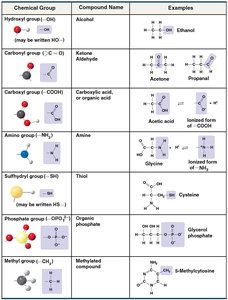
Examples of functional groups: Hydroxyl, carbonyl, carboxyl, amino, sulfhydryl, phosphate, and methyl groups. Each group imparts distinct properties to organic molecules, such as solubility, acidity, or reactivity.
Emergent Properties and Levels of Biological Organization
Biological systems exhibit emergent properties, where complex functions arise from the interaction of simpler components. Life is organized hierarchically, from atoms to molecules, organelles, cells, tissues, organs, organ systems, and organisms.
Emergent properties: New characteristics that arise at each level of biological organization due to interactions among components.
Levels of organization: Atomic → molecular → organelle → cellular → tissue → organ → organ system → organism.
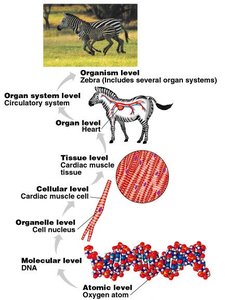
Classes of Macromolecules
Overview of Macromolecules
Macromolecules are large biological molecules essential for life. There are four major classes: carbohydrates, lipids, proteins, and nucleic acids. These molecules are found in all living organisms and serve various structural and functional roles.
Carbohydrates: Energy storage and structural support.
Lipids: Energy storage, membrane structure, and signaling.
Proteins: Catalysis, structure, transport, and regulation.
Nucleic acids: Information storage and transfer.
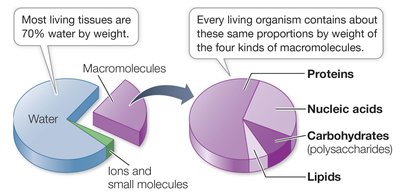
Most living tissues are composed of water, but macromolecules make up a significant portion of the dry weight, with proteins being the most abundant.
Polymers and Monomers
Three classes of macromolecules (carbohydrates, proteins, nucleic acids) are polymers, composed of repeating monomer units. Lipids are not true polymers.
Polymer: A long molecule consisting of many similar or identical monomers linked together.
Monomer: The basic building block of a polymer.
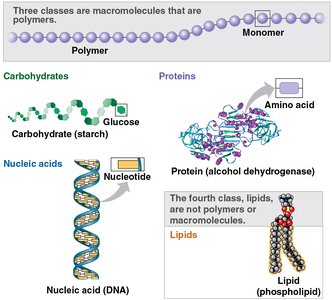
Examples: Glucose (monomer) forms starch (polymer); amino acids (monomers) form proteins; nucleotides (monomers) form nucleic acids.
Polymer Synthesis and Breakdown
Dehydration Reaction (Polymerization)
Polymers are synthesized by linking monomers through dehydration reactions, which remove a water molecule to form a new covalent bond.
Dehydration reaction: A chemical reaction in which two molecules are covalently bonded with the loss of a water molecule.
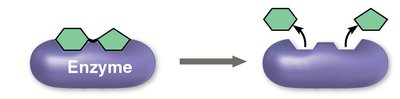
Enzymes catalyze these reactions, increasing their efficiency.
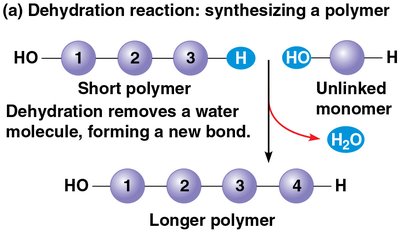
Example: Formation of a longer polymer from a short polymer and an unlinked monomer.
Hydrolysis (Polymer Breakdown)
Polymers are broken down into monomers by hydrolysis, a reaction that adds a water molecule to break a covalent bond.
Hydrolysis: The process of breaking a bond in a polymer by adding water.
Enzymes facilitate hydrolysis reactions.
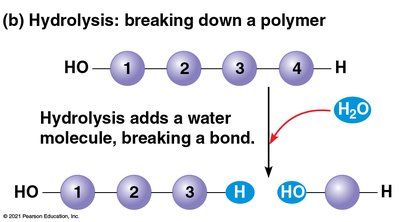
Example: Breakdown of a polymer into monomers by the addition of water.
Carbohydrates: Structure and Function
Carbohydrate Overview
Carbohydrates are macromolecules composed of carbon, hydrogen, and oxygen. They serve as energy sources, structural materials, and precursors for other biomolecules.
Monosaccharides: Simple sugars, the monomers of carbohydrates.
Disaccharides: Two monosaccharides joined by a glycosidic bond.
Polysaccharides: Long chains of monosaccharides linked by glycosidic bonds.
Monosaccharides: Classification and Structure
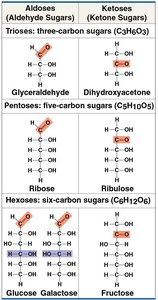
Monosaccharides are classified by the number of carbons, the location of the carbonyl group, and the arrangement around asymmetric carbons. The generic formula is CnH2nOn.
Triose: 3 carbons (e.g., glyceraldehyde)
Pentose: 5 carbons (e.g., ribose)
Hexose: 6 carbons (e.g., glucose, fructose)
Aldose: Carbonyl group at the end
Ketose: Carbonyl group within the carbon skeleton
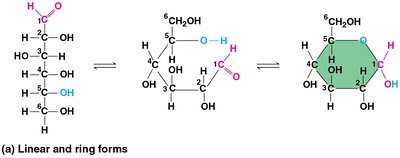
Monosaccharides often form ring structures in aqueous solutions, such as glucose.
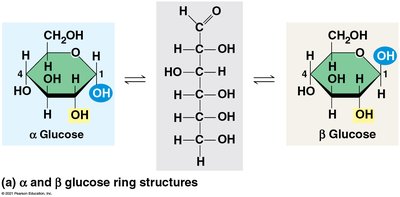
Glucose exists in two ring forms: alpha (⍺) and beta (β), depending on the position of the hydroxyl group on carbon 1.
Disaccharides: Formation and Examples
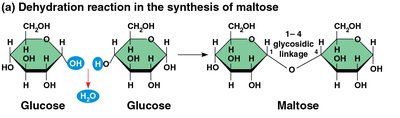
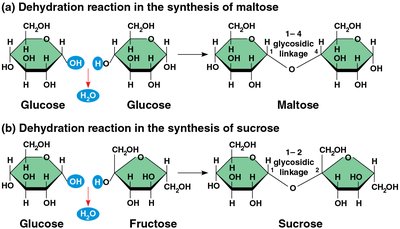
Disaccharides are formed by joining two monosaccharides via a glycosidic bond, which is created through a dehydration reaction.
Glycosidic bond: Covalent bond between two monosaccharides.
Examples: Maltose (glucose + glucose), sucrose (glucose + fructose).
Polysaccharides: Storage and Structural Roles
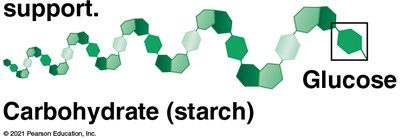
Polysaccharides are polymers of monosaccharides and serve as storage or structural molecules. Their properties depend on the type of monomer and the glycosidic linkage.
Storage polysaccharides: Starch (plants), glycogen (animals)
Structural polysaccharides: Cellulose (plants), chitin (arthropods, fungi), peptidoglycan (bacteria)
Starch
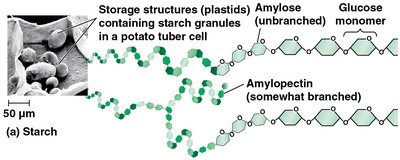
Starch is a plant storage polysaccharide composed of glucose monomers linked by ⍺-glycosidic bonds. It exists as amylose (unbranched) and amylopectin (branched), and is stored in plastids.
Glycogen
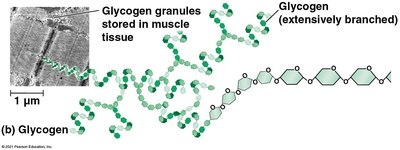
Glycogen is an animal storage polysaccharide, also composed of glucose monomers linked by ⍺-glycosidic bonds. It is highly branched and stored mainly in liver and muscle cells.
Cellulose
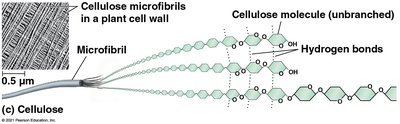
Cellulose is a structural polysaccharide in plants, composed of glucose monomers linked by β-glycosidic bonds. It is unbranched and forms hydrogen bonds, making it a major component of plant cell walls.
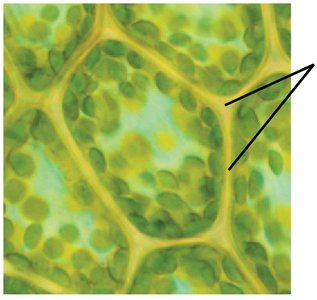
Digestion of Cellulose
Few organisms can digest cellulose due to the β-glycosidic bonds. Some microbes possess the necessary enzymes, and ruminant animals rely on these microbes for cellulose digestion. Humans cannot digest cellulose but benefit from it as dietary fiber.

Chitin
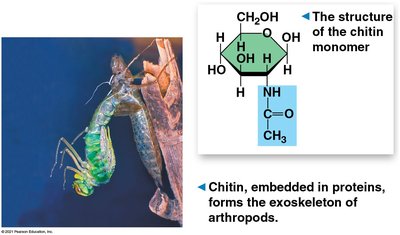
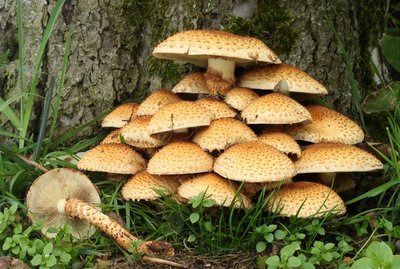
Chitin is a structural polysaccharide found in arthropod exoskeletons and fungal cell walls. It consists of glucose monomers with nitrogen attachments, linked by β-glycosidic bonds.
Summary Table: Macromolecule Classes and Their Monomers
Macromolecule | Monomer | Polymer Example | Main Function |
|---|---|---|---|
Carbohydrate | Monosaccharide (e.g., glucose) | Starch, cellulose, glycogen | Energy storage, structural support |
Protein | Amino acid | Enzymes, structural proteins | Catalysis, structure, transport |
Nucleic acid | Nucleotide | DNA, RNA | Information storage and transfer |
Lipid | Fatty acid, glycerol (not a true polymer) | Phospholipids, triglycerides | Membrane structure, energy storage |
Key Equations and Concepts
Generic formula for monosaccharides:
Dehydration reaction:
Hydrolysis reaction:
