 Back
Macromolecules: Structure, Function, and Examples
Study Guide - Smart Notes
 Tailored notes based on your materials, expanded with key definitions, examples, and context.
Macromolecules at a Glance
Overview
Macromolecules are large, complex molecules essential for life. The four main types—carbohydrates, lipids, nucleic acids, and proteins—each have unique structures, functions, and building blocks. Understanding their properties is fundamental to General Biology.
Carbohydrates
Structure and Elements
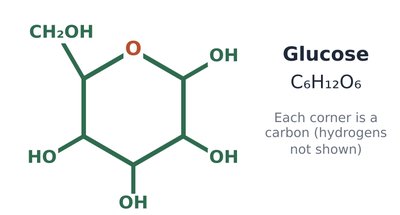
Carbohydrates are composed of carbon (C), hydrogen (H), and oxygen (O), typically with a ratio of about 2 H for every 1 O. Their basic building block is the monosaccharide, such as glucose.
True polymer: Yes. Polysaccharides (e.g., starch, glycogen, cellulose) are chains of sugars.
Bond: Glycosidic bond, formed by dehydration synthesis.
Structure: Rings of carbon with many polar –OH groups. Starch and glycogen are coiled or branched; cellulose is straight and forms strong fibers.
Function: Quick energy (glucose), short-term energy storage (starch, glycogen), structural support (cellulose).
Examples: Pasta, bread, potatoes (starch); table sugar (sucrose); vegetable fiber (cellulose); glycogen in muscles and liver.
Lipids
Structure and Elements
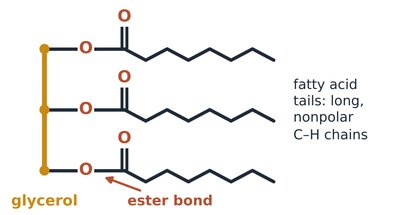
Lipids are mostly carbon and hydrogen, with very little oxygen. Phospholipids also contain phosphorus (P). Their basic building blocks are glycerol and fatty acids.
True polymer: No. Lipids are built from a few pieces, not a long chain of repeating units.
Bond: Ester bonds, formed by dehydration synthesis (three waters released per triglyceride).
Structure: Long, nonpolar C–H tails. Saturated tails are straight; unsaturated tails have C=C bonds that create kinks. Phospholipids have a polar head and two nonpolar tails. Steroids (e.g., cholesterol) have four rings.
Function: Long-term energy storage (9 kcal/g), cell membranes, insulation, protection, some hormones (steroids).
Examples: Butter (saturated, solid), olive oil (unsaturated, liquid), cell membranes, fat in fish skin.
Nucleic Acids
Structure and Elements
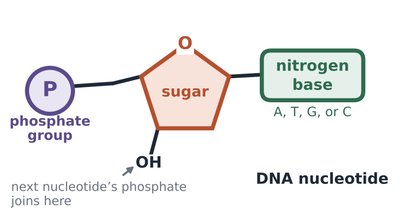
Nucleic acids are composed of carbon (C), hydrogen (H), oxygen (O), nitrogen (N), and phosphorus (P). Their building block is the nucleotide, which consists of a phosphate group, a 5-carbon sugar, and a nitrogen base.
True polymer: Yes. Chains of nucleotides form DNA and RNA.
Bond: Phosphodiester bonds create the sugar–phosphate backbone. In DNA, hydrogen bonds between bases hold the two strands together.
Structure: DNA is a double helix with base pairs (A–T, G–C); RNA is usually single-stranded with U instead of T.
Function: Store and transmit genetic information. DNA holds instructions; RNA copies and uses them to build proteins.
Examples: DNA in cells, cheek-swab ancestry tests, DNA evidence in forensics, mRNA vaccines.
Proteins
Structure and Elements
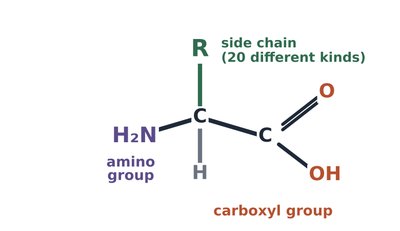
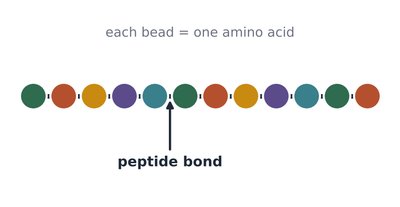
Proteins are made of carbon (C), hydrogen (H), oxygen (O), nitrogen (N), and sometimes sulfur (S). The building block is the amino acid, which contains a central carbon, an amino group, a carboxyl group, and a variable R group (side chain).
True polymer: Yes. Amino acids join to form polypeptides via peptide bonds (dehydration synthesis).
Bond: Peptide bond links amino acids.
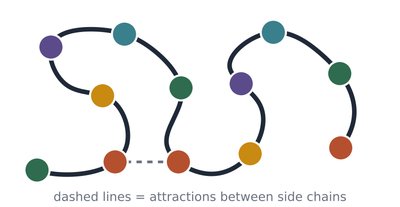
Structure: Proteins fold into specific 3-D shapes, stabilized by attractions between R groups. Shape determines function; denaturation (by heat, pH, or heavy metals) disrupts function.
Function: Proteins perform diverse roles: structural support, transport, catalysis (enzymes), signaling (receptors, hormones), defense, and movement.
Examples: Collagen, keratin, hemoglobin, catalase, sucrase, insulin, antibodies, actin, myosin.
Types of Proteins and Their Functions
Type of Protein | Function | Examples | Real-world Connection |
|---|---|---|---|
Structural | Strength and support | Collagen, keratin | Gelatin, hair, fingernails |
Transport | Carry molecules | Hemoglobin, carrier proteins | Oxygen delivery in blood |
Enzyme | Speed up reactions | Catalase, sucrase, lactase | Digestion, cellular reactions |
Receptor | Detect signals | T1R2/T1R3 | Taste perception |
Hormone | Messenger | Insulin | Blood sugar regulation |
Defense | Immune response | Antibodies | Vaccines, immunity |
Movement | Muscle contraction | Actin, myosin | Heartbeats, movement |
Polymer Formation and Breakdown
Dehydration Synthesis and Hydrolysis
Dehydration synthesis: Monomers join to form polymers, releasing a water molecule.
Hydrolysis: Polymers break apart into monomers, adding a water molecule.
Summary Table: Macromolecule Comparison
Macromolecule | Elements | Building Block | Polymer? | Bond | Structure | Function | Examples |
|---|---|---|---|---|---|---|---|
Carbohydrates | C, H, O | Monosaccharide | Yes | Glycosidic | Rings, chains | Energy, support | Glucose, starch, cellulose |
Lipids | C, H, (O, P) | Glycerol + fatty acids | No | Ester | Long tails, rings | Energy, membranes | Triglyceride, phospholipid |
Nucleic Acids | C, H, O, N, P | Nucleotide | Yes | Phosphodiester | Helix, strand | Information | DNA, RNA |
Proteins | C, H, O, N, (S) | Amino acid | Yes | Peptide | Folded chains | Many jobs | Collagen, hemoglobin |
Additional info: All macromolecules are assembled by dehydration synthesis and broken down by hydrolysis. The structure of each macromolecule determines its function in living organisms.
