 Back
BackMajor Themes in Biology & The Chemical Context of Life (Ch. 1 & 2.1–2.2) – Study Notes
Study Guide - Smart Notes
 Tailored notes based on your materials, expanded with key definitions, examples, and context.
The Chemical Context of Life (Ch. 2.1 & 2.2)
2.1 Matter Consists of Chemical Elements in Pure Form and in Combinations Called Compounds
All matter is composed of elements, which are substances that cannot be broken down by chemical reactions. Compounds are substances formed by two or more elements in fixed ratios.
Matter: Anything that takes up space and has mass.
Element: Pure substance consisting of one type of atom.
Compound: Substance formed from two or more different elements in a fixed ratio (e.g., H2O, NaCl).
Emergent Properties: Compounds have properties different from their constituent elements.
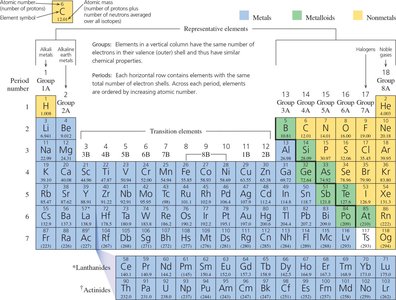
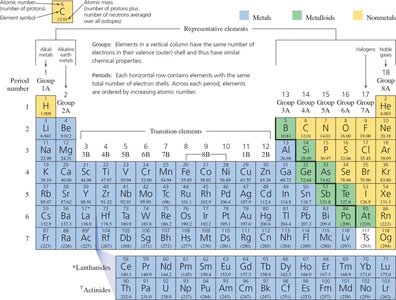
Essential and Trace Elements
Living organisms require certain elements for survival, growth, and reproduction. Four elements—carbon, hydrogen, oxygen, and nitrogen—make up 96% of living matter. Other elements are needed in smaller amounts.
Essential Elements: Required in large amounts (e.g., O, C, H, N).
Trace Elements: Required in minute quantities (e.g., Iodine).
Example: Iodine is essential for thyroid function in humans.
Element | Role in Biology |
|---|---|
Oxygen (O) | Component of water, cellular respiration |
Carbon (C) | Backbone of organic molecules |
Hydrogen (H) | Component of water, organic molecules |
Nitrogen (N) | Component of proteins and nucleic acids |
Iodine (I) | Required for thyroid hormones |
Phosphorus (P) | Component of nucleic acids and ATP |
2.2 An Element’s Properties Depend on the Structure of Its Atoms
The properties of an element are determined by the structure of its atoms, which consist of subatomic particles: protons, neutrons, and electrons.
Proton: Positively charged, located in the nucleus; determines atomic number and identity of the element.
Neutron: Neutral, located in the nucleus; contributes to atomic mass.
Electron: Negatively charged, found in orbitals around the nucleus; involved in chemical bonding.
Atomic Number: Number of protons in the nucleus.
Mass Number: Number of protons plus neutrons.
Isotopes: Atoms of the same element with different numbers of neutrons.
Subatomic Particle | Charge | Location |
|---|---|---|
Proton | +1 | Nucleus |
Neutron | 0 | Nucleus |
Electron | -1 | Electron cloud |
Electron Orbitals and Shells
Electrons are arranged in shells around the nucleus. The distribution of electrons in these shells determines the chemical behavior of an atom.
First shell: Holds up to 2 electrons.
Second shell: Holds up to 8 electrons.
Third shell: Holds up to 8 electrons.
Valence Electrons: Electrons in the outermost shell; important for chemical bonding.
Full Valence Shell: Atoms with full outer shells are chemically inert.
Isotopes and Atomic Mass
Isotopes are variants of elements with different numbers of neutrons. The atomic mass is the weighted average of all isotopes of an element.
Example: Carbon has three isotopes: 12C, 13C, and 14C.
Radioactive Isotopes: Unstable isotopes that decay over time; used in biomedical applications.
Isotope | Protons | Neutrons | Electrons |
|---|---|---|---|
12C | 6 | 6 | 6 |
13C | 6 | 7 | 6 |
14C | 6 | 8 | 6 |
Summary of Atomic Structure
Atoms contain protons, neutrons, and electrons.
Protons determine the element's identity; neutrons determine isotopes; electrons determine chemical behavior.
Isotopes have biomedical applications due to their radioactive properties.
Electrons in outer orbitals participate in chemical reactions.
