 Back
Making Measurements: Units, Precision, and Dimensional Analysis
Study Guide - Smart Notes
 Tailored notes based on your materials, expanded with key definitions, examples, and context.
Making Measurements in Chemistry
Importance of Measurements
Accurate measurements are fundamental in chemistry, as they ensure reliable data and prevent costly mistakes. Measurements can be qualitative (descriptive, non-numerical) or quantitative (numerical, requiring units).
Qualitative data: Observations without numbers (e.g., color, texture).
Quantitative data: Observations with numbers and units (e.g., 15.2 mL of water).
Scientific Notation and Calculators
Scientific notation simplifies the expression of very large or small numbers. It consists of a coefficient (number between 1 and 10) and a power of 10.
Format:
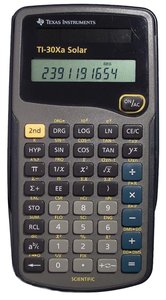
Calculator usage: Use "EE" or "EXP" buttons to enter scientific notation.
Calculations with Scientific Notation
Operations with scientific notation follow exponent rules:
Multiplication: Multiply coefficients, add exponents.
Division: Divide coefficients, subtract exponents.
Addition/Subtraction: Convert to same exponent before combining.
Measurements and Units
SI Units and Prefixes
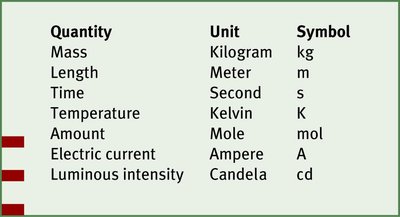
The International System of Units (SI) standardizes measurements in science. Each physical quantity has a base unit and symbol.
Quantity | Unit | Symbol |
|---|---|---|
Mass | Kilogram | kg |
Length | Meter | m |
Time | Second | s |
Temperature | Kelvin | K |
Amount | Mole | mol |
Electric current | Ampere | A |
Luminous intensity | Candela | cd |
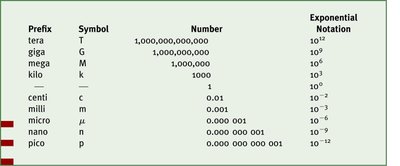
SI prefixes allow expression of multiples or fractions of units:
Prefix | Symbol | Number | Exponential Notation |
|---|---|---|---|
kilo | k | 1,000 | |
centi | c | 0.01 | |
milli | m | 0.001 | |
micro | μ | 0.000001 | |
nano | n | 0.000000001 | |
pico | p | 0.000000000001 |
Common Units: Mass and Temperature
Mass is the amount of matter in an object, measured in kilograms (kg). Weight is the force of gravity on mass, often confused with mass in chemistry.
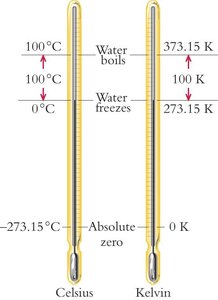
Temperature is measured in Celsius (°C) and Kelvin (K). The Kelvin scale starts at absolute zero (-273.15°C).
Derived Units: Area, Volume, and Density
Area and volume are derived from length:
Area: ,
Volume: , , ,
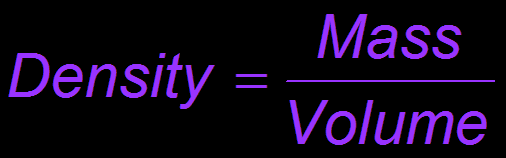
Density is the ratio of mass to volume, an important property for identifying substances.
Units: solids (), liquids (), gases ()
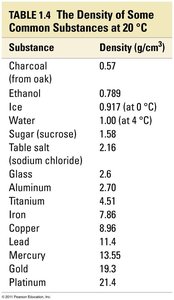
Substance | Density (g/cm3) |
|---|---|
Water | 1.00 |
Ice | 0.917 |
Gold | 19.3 |
Platinum | 21.4 |
Charcoal | 0.57 |
Lead | 11.4 |
Mercury | 13.55 |
Aluminum | 2.70 |
Iron | 7.86 |
Precision, Accuracy, and Errors
Precision vs. Accuracy
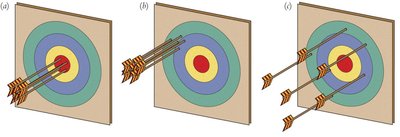
Accuracy refers to how close a measurement is to the true value. Precision refers to the reproducibility of measurements.
Accurate data are always precise, but precise data may not be accurate.
Types of Errors
Random errors: Caused by limitations in measurement technique; results vary unpredictably.
Systematic errors: Consistent errors due to faulty instruments or procedures.
Estimating the Last Digit
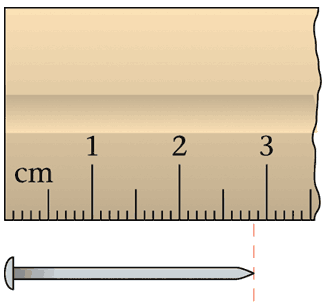
When using instruments with scales, estimate the last digit by mentally dividing the space between marks. This increases measurement precision.
Uncertainty and Significant Figures
Significant Figures
Significant figures express the uncertainty in measurements. Record all certain digits plus one uncertain digit.
All non-zero digits are significant.
Leading zeros are not significant.
Captive (interior) zeros are significant.
Trailing zeros are significant only if a decimal point is present.
Exact numbers (from counting or definitions) have unlimited significant figures.
Rounding Rules
If the digit to be removed is ≥ 5, round up.
If the digit to be removed is < 5, round down.
Significant Figures in Calculations
Multiplication/Division: Result has the same number of significant figures as the measurement with the least number.
Addition/Subtraction: Result has the same number of decimal places as the measurement with the least decimal places.
Unit Conversions and Dimensional Analysis
Dimensional Analysis
Dimensional analysis uses conversion factors to change units. Arrange conversion factors so unwanted units cancel.
General formula:
Example:

Density as a Conversion Factor
Density can convert between mass and volume:
For water:
For lead:
Practice Problems
Calculate mass, volume, or density using appropriate conversion factors and significant figures.
Example: What is the mass in kg of 173,231 L of jet fuel (density = 0.768 g/mL)?
Additional info: These concepts are foundational for all laboratory and quantitative work in chemistry and biology, ensuring data integrity and scientific validity.
