 Back
BackMatter and Energy: Classification, Properties, and Changes
Study Guide - Smart Notes
 Tailored notes based on your materials, expanded with key definitions, examples, and context.
Matter: Classification and Properties
Classification of Matter
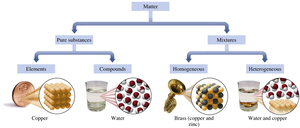
Matter is defined as anything that has mass and occupies space. It can be classified based on its composition and physical state. The two main categories are pure substances and mixtures.
Pure Substances: Have a fixed or definite composition. They are further divided into elements and compounds.
Mixtures: Contain two or more substances physically mixed but not chemically combined. Mixtures can be homogeneous (uniform composition) or heterogeneous (non-uniform composition).
Pure Substances: Elements and Compounds
A pure substance is a type of matter with a fixed composition. Elements are composed of one type of atom, while compounds consist of two or more elements combined in a definite ratio.
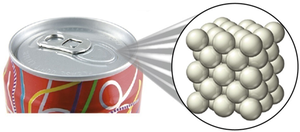
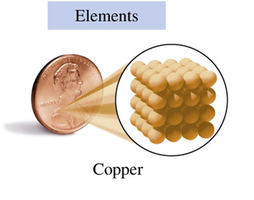
Element: A substance made of only one kind of atom (e.g., copper, aluminum).
Compound: A substance made of two or more elements chemically combined in a fixed proportion (e.g., water, hydrogen peroxide).
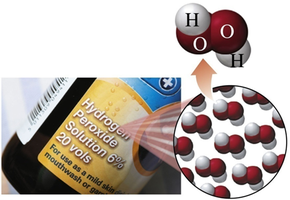
Compounds Contain Elements
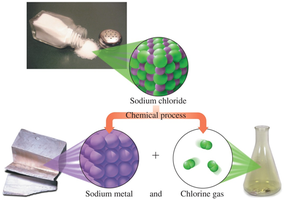
Compounds can be broken down into their constituent elements by chemical processes. For example, sodium chloride (table salt) can be decomposed into sodium and chlorine.
Example: Sodium chloride (NaCl) decomposes to sodium metal and chlorine gas.
Mixtures: Homogeneous and Heterogeneous
A mixture consists of two or more substances physically mixed. Mixtures can be separated by physical methods and exist in varying proportions.
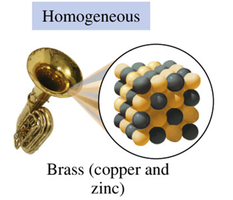
Homogeneous Mixture: Uniform composition throughout; also called a solution (e.g., brass, sugar water).
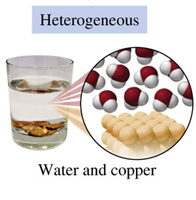
Heterogeneous Mixture: Non-uniform composition; different parts are visible (e.g., water and copper, peach pie).
Physical States of Matter
Solids
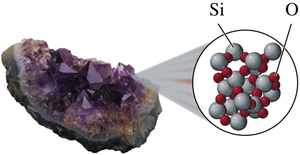
Solids have a definite shape and volume. Their particles are held close together by strong attractive forces and arranged in a rigid pattern, allowing only slow vibration in fixed positions.
Example: Amethyst (quartz, SiO2) is a solid mineral.
Liquids
Liquids have a definite volume but no definite shape. They take the shape of their container, and their particles move slowly in random directions.
Example: Water as a liquid adapts to the shape of its container.
*Additional info: Image not included as per relevance requirement.*
Gases
Gases have neither definite shape nor volume. They fill the shape and volume of their container, with particles far apart and moving at high speeds.
Example: Air is a mixture of gases.
*Additional info: Image not included as per relevance requirement.*
Physical and Chemical Properties
Physical Properties
Physical properties are characteristics observed or measured without changing the identity of a substance. These include shape, state, boiling and freezing points, density, and color.
Example: Copper is reddish-orange, shiny, and a good conductor of heat and electricity.
*Additional info: Image not included as per relevance requirement.*
Physical Changes
Physical changes occur when matter changes state or appearance, but its composition remains the same. Examples include melting, freezing, and dissolving.
Example: Water exists as ice, liquid, and steam.
Chemical Properties and Changes
Chemical properties describe a substance's ability to interact and change into new substances. Chemical changes result in new substances with new properties.
Example: Iron corrodes to form rust (Fe2O3), and sugar caramelizes at high temperature.
Specific Heat and Heat Calculations
Specific Heat
Specific heat (SH) is the amount of heat required to raise the temperature of 1 g of a substance by 1°C. It is different for each substance and measured in J/g°C or cal/g°C.
Formula:
Example: Calculating the specific heat of a metal given mass, heat absorbed, and temperature change.
*Additional info: Example calculation not shown due to missing image and data.*
Heat Equation
The heat equation allows calculation of heat lost or gained by a substance:
Formula:
Application: Used to determine energy needed to heat a substance over a temperature range.
*Additional info: Example calculation not shown due to missing image and data.*
Changes of State
Melting and Freezing
Melting is the change from solid to liquid at the melting point, while freezing is the change from liquid to solid at the freezing point. These processes are reversible.
Example: Water melts and freezes at 0°C.
*Additional info: Image not included as per relevance requirement.*
Sublimation and Deposition
Sublimation is the direct change from solid to gas without passing through the liquid state. Deposition is the reverse process, from gas to solid. Both are reversible.
Example: Dry ice (solid CO2) sublimates to gas.
*Additional info: Image not included as per relevance requirement.*
Evaporation, Boiling, and Condensation
Evaporation occurs when molecules at the surface of a liquid gain enough energy to become gas. Boiling happens when molecules throughout the liquid become gas at the boiling point. Condensation is the reverse, where gas becomes liquid as molecules lose energy.
Example: Water boils at 100°C and condenses at the same temperature.
*Additional info: Images not included as per relevance requirement.*
Heating and Cooling Curves
Heating and cooling curves show temperature changes and changes of state as heat is added or removed. Diagonal lines indicate temperature changes; plateaus indicate changes of state.
Example: Heating curve for water shows melting, boiling, and temperature increases.
*Additional info: Images not included as per relevance requirement.*
Summary Table: Classification of Matter
Type | Definition | Example |
|---|---|---|
Element | Pure substance, one type of atom | Copper (Cu) |
Compound | Pure substance, two or more elements chemically combined | Water (H2O), Hydrogen peroxide (H2O2) |
Homogeneous Mixture | Uniform composition throughout | Brass (copper and zinc) |
Heterogeneous Mixture | Non-uniform composition, visible parts | Water and copper |
