 Back
BackMatter and Measurement: Foundations of Chemistry for Biology Students
Study Guide - Smart Notes
 Tailored notes based on your materials, expanded with key definitions, examples, and context.
Matter and Measurement
Introduction to Chemistry
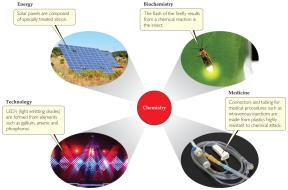
Chemistry is the study of the properties and behavior of matter, forming the basis for understanding biological processes at the molecular level. It is central to many science-related fields, including biochemistry, medicine, and environmental science.
Matter: Anything that has mass and occupies space.
Atoms: Fundamental building blocks of matter.
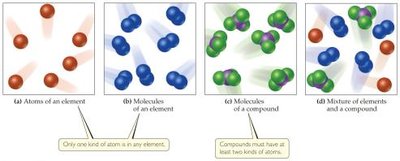
Elements: Substances made of one type of atom.
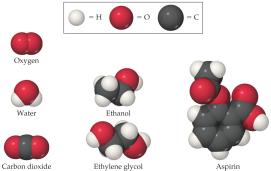
Compounds: Substances composed of two or more different elements chemically bonded.
Molecules: Groups of atoms bonded together, representing the smallest unit of a compound.
Classification of Matter
Matter can be classified based on its physical state and composition. Understanding these classifications is essential for studying biological molecules and cellular structures.
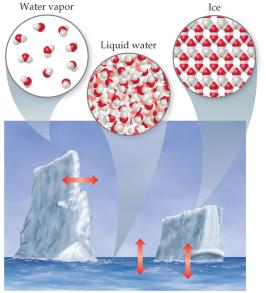
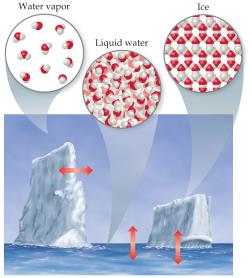
States of Matter: Solid, liquid, and gas. Example: Ice (solid), liquid water, and water vapor (gas).
Composition of Matter: Matter can be an element, compound, or mixture.
Mixtures: Can be homogeneous (uniform composition, also called solutions) or heterogeneous (variable composition).
Substances: Have distinct properties and consistent composition; classified as elements or compounds.
Methods of Classification
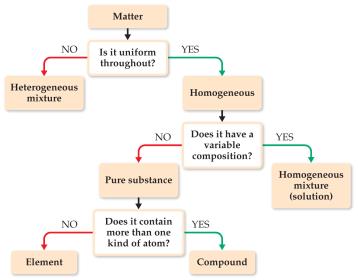
Classification schemes help identify and categorize types of matter, which is fundamental in biological and chemical analysis.
Homogeneous Mixture: Uniform throughout; also called a solution.
Heterogeneous Mixture: Not uniform throughout.
Element: Pure substance with only one kind of atom.
Compound: Pure substance with more than one kind of atom.
States of Matter
The physical state of matter is determined by the arrangement and movement of its particles. Biological systems often involve transitions between these states.
Solid: Definite shape and volume.
Liquid: Definite volume, indefinite shape.
Gas: Indefinite shape and volume.
Physical and Chemical Properties
Properties of matter are used to identify substances and predict their behavior in biological systems.
Physical Properties: Can be observed without changing the substance (e.g., boiling point, density).
Chemical Properties: Observed when a substance undergoes a chemical change (e.g., flammability, reactivity).
Intensive Properties: Independent of the amount of substance (e.g., density, color).
Extensive Properties: Depend on the amount of substance (e.g., mass, volume).
Types of Changes
Understanding physical and chemical changes is crucial for studying metabolic reactions and cellular processes.
Physical Changes: Do not alter the composition of the substance (e.g., changes of state, temperature).
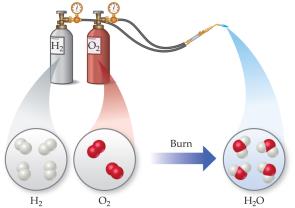
Chemical Changes: Result in the formation of new substances (e.g., combustion, oxidation).
Separating Mixtures
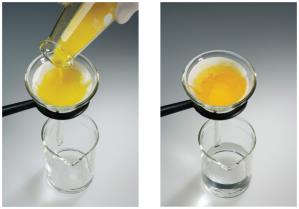
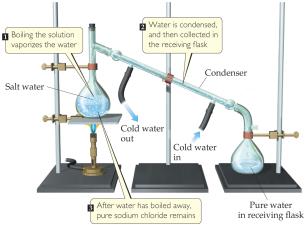
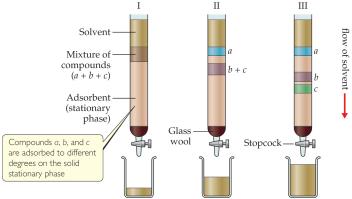
Mixtures can be separated using physical methods, which are widely used in laboratory and industrial settings.
Filtration: Separates solids from liquids.
Distillation: Separates components based on differences in boiling points.
Chromatography: Separates substances based on their ability to adhere to a solid surface.
Measurement in Chemistry
Units of Measurement
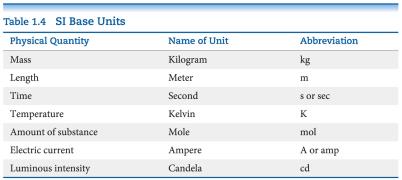
Quantitative measurements are fundamental in chemistry and biology. The International System of Units (SI) provides standard units for scientific measurements.
SI Base Units: Mass (kilogram), length (meter), time (second), temperature (kelvin), amount of substance (mole), electric current (ampere), luminous intensity (candela).
Physical Quantity | Name of Unit | Abbreviation |
|---|---|---|
Mass | Kilogram | kg |
Length | Meter | m |
Time | Second | s or sec |
Temperature | Kelvin | K |
Amount of substance | Mole | mol |
Electric current | Ampere | A or amp |
Luminous intensity | Candela | cd |
Metric System Prefixes
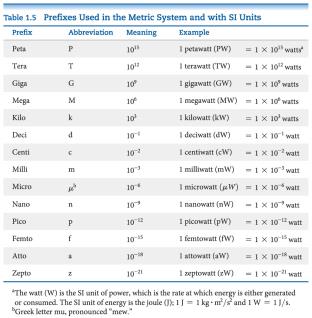
Prefixes are used to express quantities in units appropriate for measurement.
Prefix | Abbreviation | Meaning | Example |
|---|---|---|---|
Kilo | k | 1 kilometer (km) = meters | |
Milli | m | 1 milliliter (mL) = liters | |
Micro | \mu | 1 micrometer (\mu m) = meters | |
Nano | n | 1 nanometer (nm) = meters | |
Pico | p | 1 picometer (pm) = meters | |
Additional info: See full table for more prefixes. |
Mass, Length, and Volume
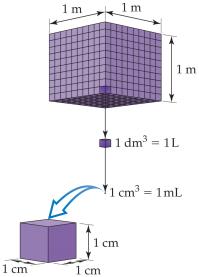
Mass and length are fundamental measurements in science. Volume is derived from length and is commonly measured in liters and milliliters.
Mass: Measured in kilograms (SI) or grams (metric).
Length: Measured in meters.
Volume: ,
Temperature
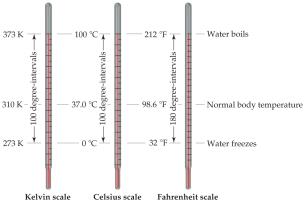
Temperature is a measure of the thermal energy of a substance. The Celsius and Kelvin scales are most commonly used in scientific measurements.
Celsius scale: Based on water properties; 0°C (freezing), 100°C (boiling).
Kelvin scale: SI unit; absolute zero is 0 K.
Conversion:
Fahrenheit scale: Used in weather reports; not scientific.
Conversion equations: ,
Density
Density is a physical property defined as mass per unit volume. It is used to identify substances and predict their behavior in biological systems.
Formula:
Units: g/mL or g/cm3
Numbers in Science: Accuracy, Precision, and Significant Figures
Scientific measurements involve uncertainty. Understanding accuracy, precision, and significant figures is essential for reliable data analysis.
Accuracy: Closeness to the true value.
Precision: Closeness of repeated measurements to each other.
Significant Figures: Digits that reflect the precision of a measurement.
Rules for Significant Figures:
All nonzero digits are significant.
Zeroes between significant digits are significant.
Leading zeroes are not significant.
Trailing zeroes are significant if a decimal point is present.
Rounding: Addition/subtraction—least significant decimal place; multiplication/division—least number of significant figures.
Dimensional Analysis
Dimensional analysis is used to convert between units using conversion factors. It is a fundamental skill in both chemistry and biology for quantitative analysis.
Conversion factor example:
Set up ratios to cancel units and convert quantities.
