 Back
Matter, Elements, Chemical Bonds, and Isotopes: Foundations for General Biology
Study Guide - Smart Notes
 Tailored notes based on your materials, expanded with key definitions, examples, and context.
Matter and Its Classification
Definition and Properties of Matter
Matter is anything that has mass and occupies space. All living and non-living things are composed of matter, which can be classified based on its composition and properties.
Mass: The amount of matter in an object.
Volume: The amount of space an object occupies.
Elements and Compounds
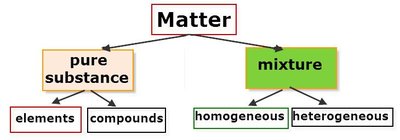
Elements are pure substances consisting of only one type of atom. Compounds are substances formed from two or more elements chemically bonded in fixed ratios.
Elements: 92 naturally occurring; 25 are essential for life. Four elements—carbon, hydrogen, oxygen, and nitrogen—make up about 96% of living matter.
Compounds: Examples include water (H2O), DNA, and proteins.
Atoms and the Periodic Table
Atomic Structure
Atoms are the basic units of matter, consisting of protons, neutrons, and electrons. The number of protons defines the element, while the number of neutrons can vary, resulting in isotopes.
Protons: Positively charged particles in the nucleus.
Neutrons: Neutral particles in the nucleus.
Electrons: Negatively charged particles orbiting the nucleus.
Chemical Properties and Bonding
Electron Configuration and Stability
The chemical properties of an atom depend on the number and arrangement of electrons, especially those in the outermost shell (valence electrons). Atoms are most stable when their outer energy levels are full (the "octet rule").
Magic Number: 8 electrons in the outer shell (except for hydrogen and helium, which are stable with 2).
Ionic Bonding
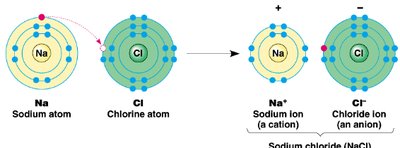
Ionic bonds form when electrons are transferred from one atom to another, resulting in charged ions that attract each other.
Cation: Positively charged ion (loss of electrons).
Anion: Negatively charged ion (gain of electrons).
Example: Sodium (Na) transfers an electron to chlorine (Cl), forming Na+ and Cl-, which combine to make sodium chloride (NaCl).
Covalent Bonding
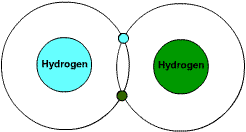
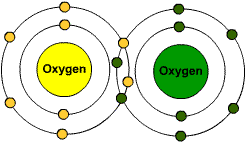
Covalent bonds form when two atoms share one or more pairs of electrons to achieve full outer energy levels. These bonds are crucial for the structure of biological molecules.
Single Bond: One pair of shared electrons (e.g., H2).
Double Bond: Two pairs of shared electrons (e.g., O2).
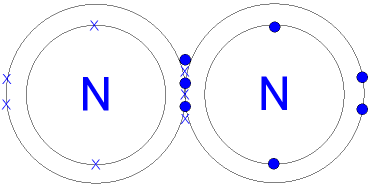
Triple Bond: Three pairs of shared electrons (e.g., N2).
Hydrogen Bonds
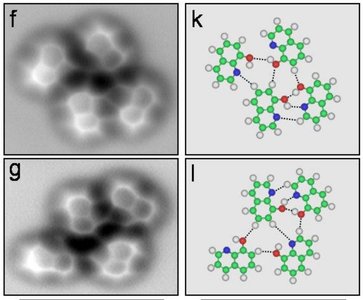
Hydrogen bonds are weak attractions between a hydrogen atom covalently bonded to a highly electronegative atom (like oxygen or nitrogen) and another electronegative atom. They are essential for the structure of water, DNA, and proteins.
Not true bonds: No electron sharing or transfer; purely electrical attraction.
Importance: Stabilize the structures of large biological molecules.
Chemical Reactions and Metabolism
Chemical Reactions
Chemical reactions involve the making and breaking of chemical bonds, transforming reactants into products. The law of conservation of mass states that matter is neither created nor destroyed in a chemical reaction.
General Equation: Reactant + Reactant → Product
Metabolism: The sum of all chemical reactions in a cell.
Isotopes and Atomic Mass
Isotopes
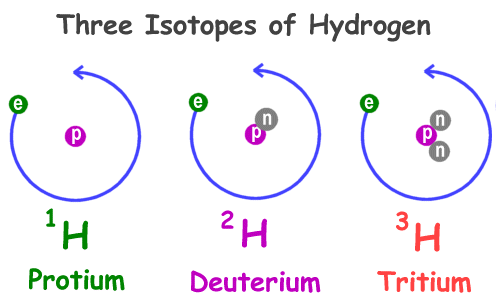
Isotopes are atoms of the same element with the same number of protons but different numbers of neutrons, resulting in different masses.
Example: Hydrogen has three isotopes—protium, deuterium, and tritium.
Atomic Mass: Calculated as the weighted average of all naturally occurring isotopes.
Radioactive Decay and Types of Radiation
Radioactive Decay
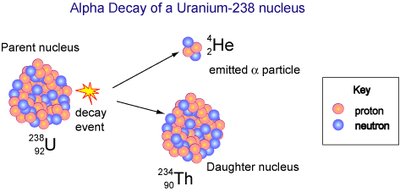
Some isotopes have unstable nuclei that break down, releasing energy and particles in a process called radioactive decay. This process can change one element into another.
Alpha (α) Decay: Emission of two protons and two neutrons (a helium nucleus).
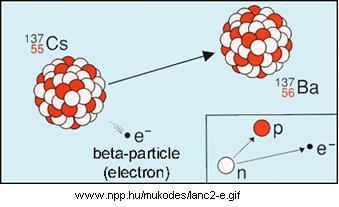
Beta (β) Decay: Conversion of a neutron into a proton and an electron; the electron is emitted.
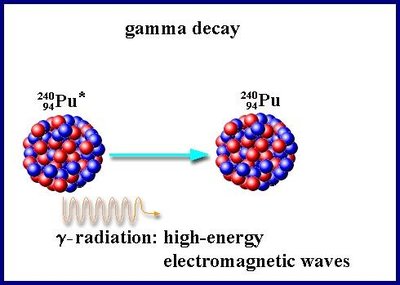
Gamma (γ) Decay: Release of high-energy electromagnetic waves.
Penetration of Radiation
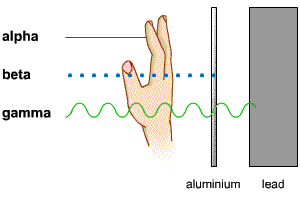
Different types of radiation have varying abilities to penetrate materials:
Alpha: Stopped by paper or skin.
Beta: Penetrates skin but stopped by aluminum.
Gamma: Highly penetrating; requires lead or thick concrete for shielding.
Half-Life
The half-life of a radioactive isotope is the time required for half of the atoms in a sample to decay into a stable form. This property is used in radiometric dating, such as carbon-14 dating.
Example: Carbon-14 has a half-life of 5,730 years.
Applications: Carbon-14 Dating
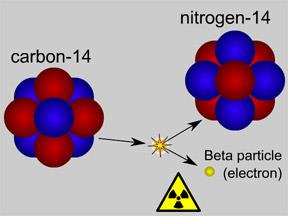
Carbon-14 is a radioactive isotope used to date formerly living materials. It decays to nitrogen-14 via beta decay, allowing scientists to estimate the age of fossils and archaeological samples.
Additional info: The concepts of matter, elements, chemical bonding, isotopes, and radioactive decay are foundational for understanding the chemical basis of life, which is essential for all biological processes.
