 Back
Matter, Energy, and Measurement: Foundations for Biology and Chemistry
Study Guide - Smart Notes
 Tailored notes based on your materials, expanded with key definitions, examples, and context.
Introduction to Chemistry and Its Relevance to Biology
The Central Science
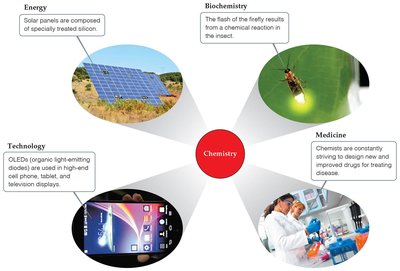
Chemistry is the study of matter, its properties, and the changes it undergoes. It is foundational to understanding biological processes, as all living organisms are composed of matter and depend on chemical reactions for life functions. Chemistry connects with fields such as biochemistry, medicine, technology, and energy.
Matter and Its Properties
Definition and Examples
Matter is anything that has mass and occupies space. Examples include air, water, books, and living tissues. The properties of matter allow us to distinguish between different types of substances.
Property: Any characteristic that helps identify or distinguish a type of matter.
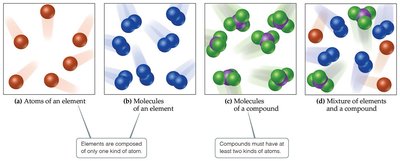
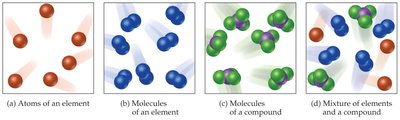
Element: A pure substance made of only one kind of atom.
Atom: The smallest unit of an element that retains its identity.
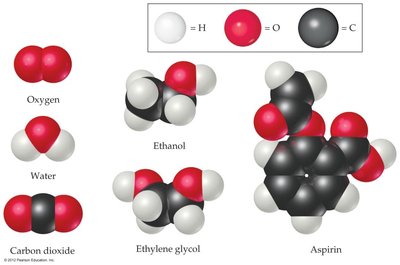
Molecule: Two or more atoms joined together in a specific arrangement.
Compound: A substance composed of two or more different elements chemically combined in fixed proportions.
Elements and Compounds
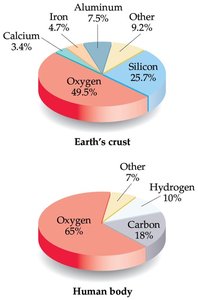
There are currently 118 named elements, but only a few make up most of the Earth's crust and the human body. Compounds have a definite composition, as described by the Law of Constant Composition (Law of Definite Proportions).
Law of Constant Composition: The relative number of atoms of each element in a compound is the same in any sample.
Representing Elements
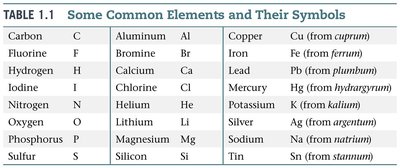
Chemists use symbols to represent elements. These symbols are usually one or two letters, with the first letter capitalized. Some symbols are derived from Latin or Greek names.
Element | Symbol | Latin Name |
|---|---|---|
Antimony | Sb | Stibium |
Copper | Cu | Cuprum |
Gold | Au | Aurum |
Iron | Fe | Ferrum |
Lead | Pb | Plumbum |
Mercury | Hg | Hydrargyrum |
Potassium | K | Kalium |
Silver | Ag | Argentum |
Sodium | Na | Natrium |
Tin | Sn | Stannum |
Tungsten | W | Wolfram |
Classification of Matter
States of Matter
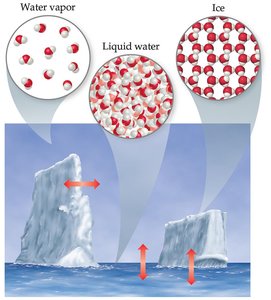
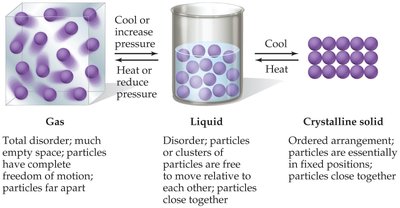
Matter exists in three primary physical states: solid, liquid, and gas. The arrangement and movement of particles differ in each state.
Solid: Definite shape and volume; particles are closely packed in a fixed arrangement.
Liquid: Definite volume but no fixed shape; particles are close but can move past one another.
Gas: No definite shape or volume; particles are far apart and move freely.
Classification by Composition
Matter can also be classified based on composition:
Pure Substance: Has distinct properties and a composition that does not vary from sample to sample. Includes elements and compounds.
Mixture: Combinations of two or more substances in which each retains its own identity and properties. Mixtures can be homogeneous (uniform, also called solutions) or heterogeneous (not uniform).
Mixtures and Pure Substances
Most matter in nature exists as mixtures. The composition of a mixture can vary, while pure substances have fixed compositions.
Homogeneous Mixture (Solution): Uniform composition throughout (e.g., air, saltwater).
Heterogeneous Mixture: Non-uniform composition (e.g., granite, wood).
Properties and Changes of Matter
Physical and Chemical Properties
Properties of matter are categorized as physical or chemical:
Physical Properties: Can be observed without changing the substance's identity (e.g., color, boiling point, density).
Chemical Properties: Describe how a substance reacts to form other substances (e.g., flammability, reactivity).
Physical properties are further divided into:
Intensive Properties: Independent of the amount of substance (e.g., density, temperature).
Extensive Properties: Depend on the amount of substance (e.g., mass, volume).
Physical and Chemical Changes
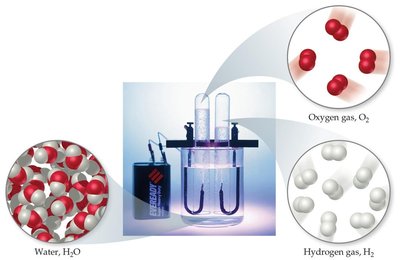
Physical Changes do not alter the composition of a substance (e.g., melting, boiling). Chemical Changes (chemical reactions) result in the formation of new substances (e.g., combustion, oxidation).
Separation of Mixtures
Methods of Separation
Mixtures can be separated based on differences in physical or chemical properties:
Filtration: Separates solids from liquids in heterogeneous mixtures.
Distillation: Separates substances based on differences in boiling points.
Chromatography: Separates substances based on their ability to adhere to a solid surface.
Energy and Its Forms
Kinetic and Potential Energy
Energy is the capacity to do work or transfer heat. It exists in two fundamental forms:
Kinetic Energy (KE): Energy of motion.
Potential Energy: Energy due to position or arrangement.
The SI unit of energy is the joule (J):
Measurement and Units
SI Units and Metric System
Scientific measurements use the International System of Units (SI). Each physical quantity has a base unit (e.g., meter for length, kilogram for mass, second for time).
Length: Meter (m)
Mass: Kilogram (kg)
Volume: Cubic meter (m3), liter (L), milliliter (mL)
Temperature: Kelvin (K), Celsius (°C)
Metric prefixes are used to express multiples or fractions of units (e.g., milli-, centi-, kilo-).
Temperature Scales
Celsius (°C): Based on water's freezing (0°C) and boiling points (100°C).
Kelvin (K): SI unit;
Fahrenheit (°F): Not used in scientific work;
Derived Units: Volume and Density
Volume:
Density (d): (mass per unit volume), units: g/cm3 or g/mL
Uncertainty in Measurement
Accuracy, Precision, and Significant Figures
Accuracy: How close a measurement is to the true value.
Precision: How close repeated measurements are to each other.
Significant Figures: All digits in a measurement, including the uncertain one. Rules for counting significant figures depend on the position of zeros and decimal points.
Dimensional Analysis
Dimensional analysis is a method for converting one unit to another using conversion factors. It ensures that calculations are consistent with the units involved.
Example: To convert 8.00 m to inches:
Summary Table: Classification of Matter
Type | Description | Example |
|---|---|---|
Element | One kind of atom | O2, Fe |
Compound | Two or more elements chemically combined | H2O, CO2 |
Homogeneous Mixture | Uniform composition | Air, saltwater |
Heterogeneous Mixture | Non-uniform composition | Granite, salad |
Key Molecular Models
Conclusion
Understanding matter, energy, and measurement is essential for studying biology and chemistry. These concepts provide the foundation for exploring the structure and function of living systems at the molecular level.
