 Back
Matter, Properties, and Measurement: Foundations for General Biology
Study Guide - Smart Notes
 Tailored notes based on your materials, expanded with key definitions, examples, and context.
Matter
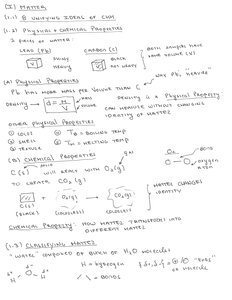
Physical and Chemical Properties
Matter is anything that has mass and occupies space. Understanding its properties is fundamental to biology and chemistry.
Physical Properties: Characteristics that can be observed or measured without changing the substance's identity (e.g., mass, volume, density, melting point).
Chemical Properties: Describe a substance's ability to undergo changes that transform it into different substances (e.g., reactivity, flammability).
Example: Water (H2O) and carbon (C) have distinct physical and chemical properties.
Physical vs. Chemical Changes
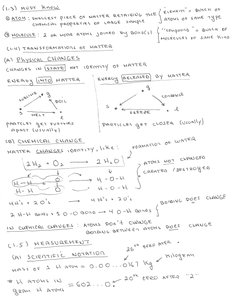
Changes in matter can be classified as physical or chemical, depending on whether the identity of the substance is altered.
Physical Change: Alters the form or appearance but not the identity (e.g., melting, boiling, dissolving).
Chemical Change: Results in the formation of new substances (e.g., burning, rusting).
Example: Water boiling is a physical change; water reacting with sodium is a chemical change.
Measurement and Scientific Method
Scientific Notation
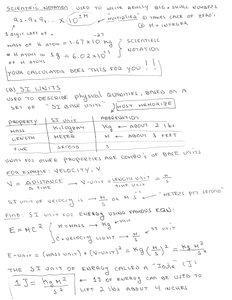
Scientific notation is used to express very large or very small numbers efficiently, which is essential in scientific calculations.
Format: where a is a number and n is an integer.
Example: The mass of an atom: kg.
SI Units
The International System of Units (SI) standardizes measurements for scientific communication.
Base Units: Meter (length), kilogram (mass), second (time), ampere (electric current), kelvin (temperature), mole (amount of substance), candela (luminous intensity).
Example Table:
Property | SI Unit | Abbreviation |
|---|---|---|
Length | Meter | m |
Mass | Kilogram | kg |
Time | Second | s |
Amount | Mole | mol |
Energy and Its Measurement
Energy is a fundamental concept in biology, measured in joules (J).
Energy Equation: (Einstein's equation for mass-energy equivalence).
Planck's Equation: where h is Planck's constant and \nu is frequency.
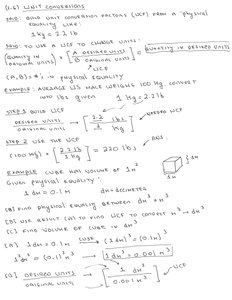
Unit Conversions
Conversion Factors and Methods
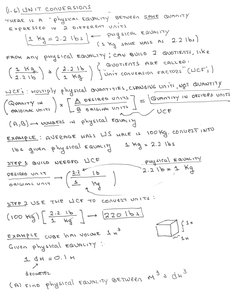
Unit conversions are essential for comparing and analyzing scientific data.
Conversion Factor: A ratio expressing how many of one unit equals another (e.g., 1 kg = 2.2 lb).
Steps:
Identify the conversion factor (UCF).
Multiply the original quantity by the UCF.
Ensure units cancel appropriately.
Example: Converting 100 kg to pounds: lb.
Atomic Theory and Structure
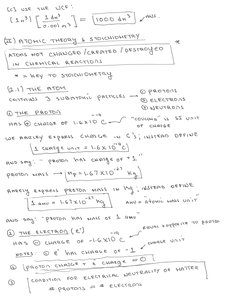
The Atom and Subatomic Particles
Atoms are the basic units of matter, composed of protons, neutrons, and electrons.
Proton: Positively charged particle in the nucleus.
Neutron: Neutral particle in the nucleus.
Electron: Negatively charged particle orbiting the nucleus.
Atomic Number: Number of protons in the nucleus, defines the element.
Mass Number: Sum of protons and neutrons.
States of Matter
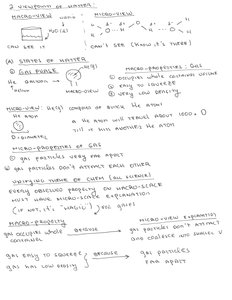
Macroscopic and Microscopic Views
Matter exists in different states: solid, liquid, and gas. These can be described at both macroscopic (observable) and microscopic (particle-level) scales.
Macroscopic: Observable properties like shape and volume.
Microscopic: Arrangement and movement of particles.
Example: Gas particles move freely and are far apart; solids have tightly packed particles.
Properties of Gases
Gases have unique properties due to the freedom of movement of their particles.
Compressibility: Gases can be compressed because particles are far apart.
Expansion: Gases expand to fill their container.
Low Density: Gases have lower density compared to solids and liquids.
Additional info: These foundational concepts are essential for understanding biological systems, as all living organisms are composed of matter and rely on chemical and physical properties for their structure and function.
