 Back
MCDB 1A Midterm 2 Study Guidance – General Biology (Biochemistry, Genetics, Cell Biology)
Study Guide - Smart Notes
 Tailored notes based on your materials, expanded with key definitions, examples, and context.
Q1. Where are the hydrophilic regions of a transmembrane protein most likely found?
Background
Topic: Membrane Structure and Protein Localization
This question tests your understanding of how proteins are oriented within biological membranes, specifically the distribution of hydrophilic and hydrophobic regions.
Key Terms:
Hydrophilic: Water-loving; interacts well with water.
Transmembrane protein: A protein that spans the entire membrane.
Membrane: The lipid bilayer that surrounds cells and organelles.
Step-by-Step Guidance
Recall that cell membranes are composed of a phospholipid bilayer, with hydrophilic heads facing outward and hydrophobic tails facing inward.
Transmembrane proteins have regions that interact with both the hydrophobic interior and the hydrophilic exterior of the membrane.
Hydrophilic regions of these proteins are typically exposed to the aqueous environments on either side of the membrane (inside and outside the cell).
Think about how the protein must be structured to allow its hydrophilic regions to interact with water, while its hydrophobic regions are embedded in the membrane.
Try solving on your own before revealing the answer!
Final Answer: D) Exposed on the inner and outer surfaces of the membrane
The hydrophilic regions of a transmembrane protein are exposed to the aqueous environments on both sides of the membrane, allowing interaction with water.
Q2. Hershey-Chase experiment: If both 35S and 32P are found in the pellet, what would you conclude?
Background
Topic: Molecular Genetics – Discovery of Genetic Material
This question tests your understanding of the classic Hershey-Chase experiment, which distinguished DNA from protein as the genetic material.
Key Terms:
35S: Radioactive sulfur, labels protein.
32P: Radioactive phosphorus, labels DNA.
Pellet: Contains the bacterial cells after centrifugation.
Step-by-Step Guidance
Recall the purpose of the Hershey-Chase experiment: to determine whether DNA or protein is the genetic material.
Normally, only 32P (DNA) is found in the pellet, indicating DNA enters the cell.
If both 35S and 32P are found in the pellet, it suggests both protein and DNA entered the cells.
Consider whether this result supports the hypothesis or indicates a problem with the experiment.
Try solving on your own before revealing the answer!
Final Answer: C) There must be something wrong with the experiment because my hypothesis based on earlier work was that DNA is the genetic material.
This result contradicts the expected outcome, suggesting an error or unexpected process in the experiment.
Q3. How many amino acids are encoded by the given mRNA sequence?
Background
Topic: Translation – mRNA to Protein
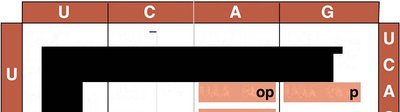
This question tests your ability to interpret an mRNA sequence and determine the number of amino acids in the resulting protein.
Key Terms and Formula:
Codon: A sequence of three nucleotides that codes for an amino acid.
Start codon: Usually AUG, signals the beginning of translation.
Stop codon: Signals the end of translation.
Step-by-Step Guidance
Identify the start codon (AUG) in the sequence.
Count the codons from the start codon to the first stop codon (UAA, UAG, or UGA).
Each codon between the start and stop codons represents one amino acid.
Do not count the stop codon as an amino acid.
Try solving on your own before revealing the answer!
Final Answer: C) 6 amino acids
There are 6 codons between the start and stop codons, so the protein will have 6 amino acids.
Q4. Why are hydrocarbons insoluble in water?
Background
Topic: Chemical Properties – Solubility and Bond Types
This question tests your understanding of why certain molecules (hydrocarbons) do not dissolve in water.
Key Terms:
Hydrocarbon: Molecule made of carbon and hydrogen.
Polar covalent bond: Unequal sharing of electrons.
Nonpolar covalent bond: Equal sharing of electrons.
Step-by-Step Guidance
Recall that water is a polar molecule.
Hydrocarbons have bonds between carbon and hydrogen, which are nonpolar.
Nonpolar molecules do not interact well with polar molecules like water.
Think about the principle "like dissolves like" in chemistry.
Try solving on your own before revealing the answer!
Final Answer: B) The majority of their bonds are nonpolar covalent carbon-to-hydrogen linkages.
Hydrocarbons are insoluble in water because their nonpolar bonds do not interact with water's polarity.
Q5. Why can humans digest starch but not cellulose?
Background
Topic: Carbohydrate Structure and Enzyme Specificity
This question tests your understanding of the structural differences between starch and cellulose and the enzymes that digest them.
Key Terms:
Starch: Polysaccharide with α-glycosidic linkages.
Cellulose: Polysaccharide with β-glycosidic linkages.
Enzyme specificity: Enzymes recognize specific bond types.
Step-by-Step Guidance
Recall the structural difference: starch has α-glycosidic bonds, cellulose has β-glycosidic bonds.
Human digestive enzymes (like amylase) can hydrolyze α-glycosidic bonds.
Humans lack enzymes to hydrolyze β-glycosidic bonds in cellulose.
Consider how this affects digestion of these carbohydrates.
Try solving on your own before revealing the answer!
Final Answer: A) Humans have enzymes that can hydrolyze the α-glycosidic linkages of starch but not the β-glycosidic linkages of cellulose.
Enzyme specificity explains why starch is digestible but cellulose is not.
