 Back
Mechanisms of Evolution: Genetic Drift, Bottlenecks, and Gene Flow
Study Guide - Smart Notes
 Tailored notes based on your materials, expanded with key definitions, examples, and context.
Genetic Drift and Evolution in Populations
Introduction to Evolutionary Mechanisms
Evolution in populations is driven by several mechanisms that alter allele frequencies over time. These include natural selection, genetic drift, and gene flow. Understanding these processes is essential for explaining patterns of genetic variation and adaptation in nature.
Genetic Drift
Definition and Overview
Genetic drift refers to random changes in allele frequencies that occur in small populations due to chance events. Unlike natural selection, which is non-random and adaptive, genetic drift is a stochastic process that can lead to significant evolutionary changes, especially in small populations.
Random Sampling: In each generation, some individuals may leave more offspring than others by chance, not because of their traits.
Loss of Alleles: Genetic drift can result in the loss of alleles from the gene pool, reducing genetic variation.
Founder Effect: When a small group becomes isolated from a larger population, the new population's gene pool may not reflect the original population's diversity.
Example: Genetic Drift in a Wildflower Population
The process of genetic drift can be illustrated using a hypothetical wildflower population. Over successive generations, random events can drastically alter allele frequencies, sometimes leading to the fixation or loss of certain alleles.
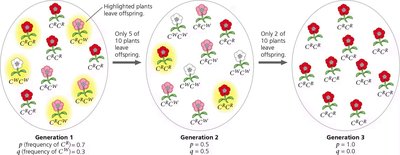
Key Points from the Diagram:
Generation 1 starts with a mix of alleles (CR and CW).
By chance, only some plants leave offspring, changing allele frequencies in Generation 2.
Further random sampling in Generation 3 can lead to the loss of one allele entirely.
Bottleneck Effect
Definition and Consequences
The bottleneck effect occurs when a population's size is drastically reduced by a sudden event (e.g., natural disaster), causing a loss of genetic diversity. The surviving population may have allele frequencies that differ from the original population, and rare alleles may be lost entirely.
Reduced Genetic Variation: The new population is less genetically diverse, which can affect its ability to adapt to environmental changes.
Overrepresentation of Certain Alleles: Some alleles may become much more common simply by chance.
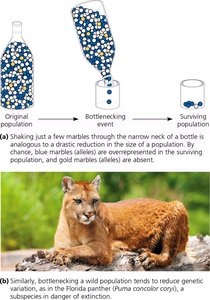
Example: The Florida panther (Puma concolor coryi) is an example of a population that has experienced a genetic bottleneck, resulting in reduced genetic variation and increased risk of extinction.
Case Study: Greater Prairie Chicken
The bottleneck effect is well illustrated by the decline of the Illinois greater prairie chicken population. Habitat loss reduced the population size, leading to a dramatic loss of genetic diversity and lower hatching rates.
Table: Population Size, Genetic Variation, and Hatching Success
Location | Population Size | Number of Alleles per Locus | Percentage of Eggs Hatched |
|---|---|---|---|
Illinois (1930s–1960s) | 1,000–25,000 | 5.2 | 93 |
Illinois (1993) | 50 | 2.9 | <50 |
Kansas (no bottleneck) | 750,000 | 5.7 | 99 |
Nebraska (no bottleneck) | 75,000 | 5.8 | 96 |
Interpretation: The Illinois population experienced a severe reduction in both genetic diversity and reproductive success compared to populations that did not undergo a bottleneck.
Gene Flow
Definition and Effects
Gene flow is the transfer of alleles between populations due to the movement of individuals or their gametes (e.g., pollen). Gene flow tends to reduce genetic differences between populations and can introduce new genetic variation.
Homogenizing Effect: Gene flow makes populations more genetically similar to each other.
Potential to Counteract Drift: In small populations, gene flow can restore lost alleles and increase genetic diversity.
Example: Banding Patterns in Lake Erie Water Snakes
Lake Erie water snakes (Nerodia sipedon) show variation in banding patterns due to both natural selection and gene flow. On islands, unbanded snakes are favored, but gene flow from mainland populations maintains the presence of banded individuals.
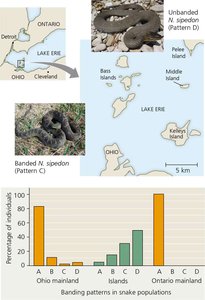
Key Points:
Strong banding is common on the mainland, while unbanded snakes are more frequent on islands.
Gene flow prevents complete adaptation to local environments by continually introducing alleles from other populations.
Summary of Genetic Drift
Key Points
Genetic drift is significant in small populations.
Genetic drift can lead to a loss of genetic variation within populations.
Genetic drift can cause harmful alleles to become fixed.
Gene flow can counteract the effects of drift by introducing new alleles.
Conclusion
Understanding the mechanisms of genetic drift, bottlenecks, and gene flow is crucial for explaining patterns of genetic diversity and adaptation in natural populations. These processes interact with natural selection to shape the evolutionary trajectories of species.
