 Back
Mechanisms of Evolution: Natural Selection, Genetic Drift, and Gene Flow
Study Guide - Smart Notes
 Tailored notes based on your materials, expanded with key definitions, examples, and context.
Mechanisms of Evolution
Introduction to Evolutionary Mechanisms
Evolution is the process by which populations of organisms change over generations. The main mechanisms driving evolution are natural selection, genetic drift, and gene flow. These processes alter allele frequencies within populations and contribute to the diversity of life.
Natural Selection
Historical Perspectives on Evolution
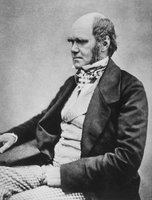
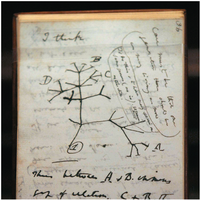
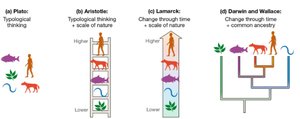
Before Darwin, many biologists and philosophers proposed theories of evolution, often viewing it as a linear process. Charles Darwin's major contribution was to describe natural selection as the mechanism that explains the pattern of descent with modification.
Darwin’s Inspiration
Artificial Selection: Darwin observed pigeon breeding, noting that diverse breeds descended from a common ancestor through selective breeding.
Malthus’ Principle: Thomas Malthus described the 'struggle for existence,' where more individuals are born than can survive, leading to competition for resources.
Darwin’s Four Postulates
Darwin outlined four criteria for evolution by natural selection:
Variation: Individuals in a population vary in their traits.
Heritability: Some trait differences are heritable and passed to offspring.
Variable Reproductive Success: Survival and reproduction vary among individuals.
Non-random Survival: Individuals with traits best suited to the environment are more likely to survive and reproduce.
Modern biologists condense these into: Heritable variation leads to differential reproductive success.
Key Evolutionary Terms
Fitness: The ability of an individual to produce surviving, fertile offspring relative to others in the population.
Adaptation: A heritable trait that increases fitness in a particular environment.
Selection: Differential reproduction as a result of heritable variation.
Adaptation vs. Acclimatization
Adaptation: Genetic change in a population over generations; irreversible for individuals.
Acclimatization (Phenotypic Plasticity): Temporary, reversible changes in an individual in response to the environment.
Darwin’s Finches: A Case Study
Darwin observed finches on the Galápagos Islands, noting that beak variations were adaptations to different diets. Peter and Rosemary Grant later confirmed that beak size changes in response to environmental conditions, demonstrating evolution in action.
Natural Selection and Genetic Variation
Natural selection acts on existing genetic variation.
Beneficial variation increases in frequency; harmful variation is eliminated; neutral variation may persist.
Evolution is not progressive—complexity does not always increase, and traits can be lost or simplified.
Fitness Trade-Offs and Constraints
Fitness trade-off: Adaptations may improve fitness in one aspect but reduce it in another.
Genetic constraints: Pleiotropy and lack of genetic variation can limit evolutionary outcomes.
Environmental constraints: Changing environments can alter which traits are favored.
Modes of Natural Selection
Natural selection can act in different patterns:
Directional Selection: Favors one extreme phenotype, shifting the population mean. Reduces genetic diversity.
Stabilizing Selection: Favors intermediate phenotypes, reducing variation but not changing the mean.
Disruptive Selection: Favors extreme phenotypes at both ends, increasing variation and potentially leading to speciation.
Balancing Selection: Maintains multiple alleles in the population (e.g., heterozygote advantage).
Genetic Drift
Definition and Effects
Genetic drift is the random change in allele frequencies due to chance events, especially in small populations. It is not adaptive and can lead to the loss or fixation of alleles, reducing genetic variation.
Bottleneck Effect: A sudden reduction in population size leads to a loss of genetic diversity.
Founder Effect: When a new population is established by a small number of individuals, the gene pool may differ from the original population.
Gene Flow
Definition and Consequences
Gene flow is the movement of alleles between populations through migration and breeding. It tends to homogenize allele frequencies between populations and can increase or decrease fitness depending on the context.
Gene flow can counteract the effects of genetic drift and selection by introducing new alleles.
It is important for maintaining genetic diversity, especially in small or isolated populations.
Summary Table: Modes of Selection
Mode of Selection | Effect on Trait Distribution | Effect on Genetic Variation | Example |
|---|---|---|---|
Directional | Shifts mean phenotype in one direction | Reduces | Finch beak size after drought |
Stabilizing | Favors intermediate phenotypes | Reduces | Human birth weight |
Disruptive | Favors extreme phenotypes | Increases | British land snails |
Balancing | Maintains multiple phenotypes | Maintains | Sickle cell allele in malaria regions |
Key Equations
Allele Frequency Change (Genetic Drift):
Hardy-Weinberg Principle (for reference):
where p and q are allele frequencies.
Summary
Evolution is driven by natural selection, genetic drift, gene flow, and mutation.
Natural selection is the only mechanism that consistently leads to adaptation.
Genetic drift and gene flow are random with respect to fitness and can increase or decrease genetic variation.
Understanding these mechanisms is essential for studying population genetics, adaptation, and speciation.
