 Back
BackMechanisms of Transcription and Translation
Study Guide - Smart Notes
 Tailored notes based on your materials, expanded with key definitions, examples, and context.
Mechanisms of Transcription and Translation
Overview of Gene Expression
Gene expression is the process by which information encoded in DNA is used to direct the synthesis of RNA and proteins, the molecules responsible for cellular structure and function. This process occurs in two main stages: transcription (DNA to RNA) and translation (RNA to protein).
Transcription
Definition and Directionality
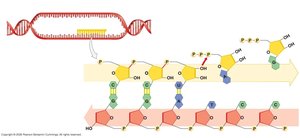
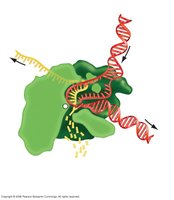
Transcription is the synthesis of RNA from a DNA template, catalyzed by the enzyme RNA polymerase. The process proceeds in the 5' to 3' direction, meaning that nucleotides are added to the 3' end of the growing RNA strand. Only one of the two DNA strands (the template strand) is transcribed for a given gene; the other is called the non-template (coding) strand.
Template strand: Serves as the pattern for RNA synthesis.
Non-template (coding) strand: Has the same sequence as the RNA (except T is replaced by U in RNA).
RNA polymerase: Catalyzes the formation of phosphodiester bonds after complementary base pairing.
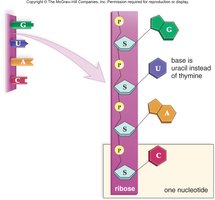
Base pairing: In RNA, uracil (U) replaces thymine (T), so A (DNA) pairs with U (RNA).
Products of Transcription
Transcription produces several types of RNA:
Messenger RNA (mRNA): Carries genetic information from DNA to ribosomes for protein synthesis.
Transfer RNA (tRNA): Serves as an interpreter, bringing amino acids to the ribosome.
Ribosomal RNA (rRNA): Structural and catalytic component of ribosomes.
Ribozymes: RNA molecules with catalytic activity.
Initiation of Transcription
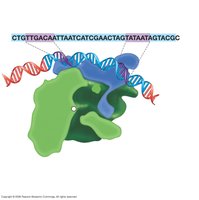
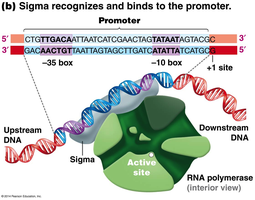
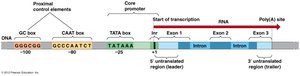
Transcription begins at a specific DNA sequence called the promoter, located upstream of the gene. The promoter facilitates the binding of RNA polymerase and signals the start of transcription.
Prokaryotic promoters: Contain conserved sequences (e.g., -35 and -10 boxes) recognized by sigma factors.
Initiation complex: In prokaryotes, sigma factor binds to the promoter, recruiting RNA polymerase.
Elongation and Termination in Prokaryotes
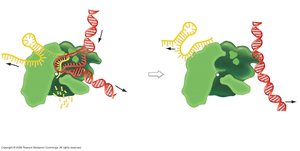
During elongation, RNA polymerase moves along the DNA template, synthesizing RNA in the 5' to 3' direction. Sigma factor is released after initiation. Termination occurs when RNA polymerase encounters a stop sequence, resulting in the formation of a hairpin loop in the RNA, which causes the polymerase to dissociate from the DNA.
Transcription in Eukaryotes
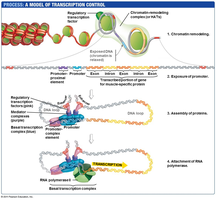
Eukaryotic promoters are more complex, often containing a TATA box and other regulatory elements. Initiation requires the assembly of basal and regulatory transcription factors, forming a transcription initiation complex with RNA polymerase II.
Basal transcription factors: Required for the initiation of transcription in all genes.
Regulatory transcription factors: Bind to specific DNA sequences to regulate gene expression.
Termination and mRNA Processing in Eukaryotes
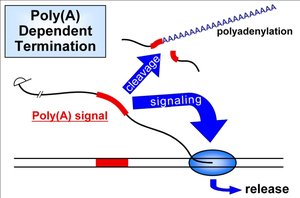
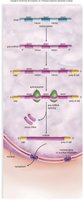
In eukaryotes, transcription termination is triggered by a poly(A) signal sequence. The resulting pre-mRNA undergoes several processing steps before translation:
5' cap addition: Modified guanine nucleotide added to the 5' end for ribosome recognition.
3' poly(A) tail: 100-250 adenine nucleotides added to the 3' end for stability and export.
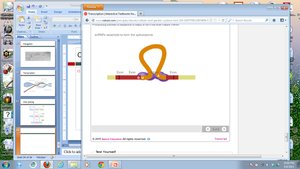
Splicing: Removal of noncoding introns and joining of coding exons, catalyzed by the spliceosome (snRNAs and snRNPs).
Translation
Definition and Overview
Translation is the process by which proteins are synthesized from mRNA templates. This occurs at ribosomes and requires tRNA molecules to interpret the genetic code.
Ribosomes: Composed of rRNA and proteins; site of protein synthesis.
tRNA: Adapter molecule with an anticodon (complementary to mRNA codon) and an amino acid attachment site.
Coupling of Transcription and Translation
In prokaryotes, transcription and translation are coupled, meaning translation can begin before transcription is complete. In eukaryotes, these processes are separated by the nuclear envelope.
tRNA Structure and Function
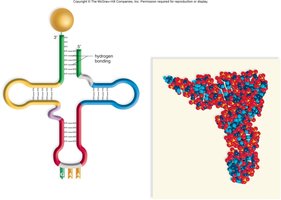
tRNAs have a cloverleaf structure due to internal base pairing. Each tRNA is charged with a specific amino acid by an aminoacyl-tRNA synthetase, which recognizes the correct anticodon and amino acid.
Wobble hypothesis: Non-standard base pairing is allowed at the third codon position, enabling fewer tRNAs to recognize multiple codons.
Ribosome Structure and Function
Ribosomes have two subunits (large and small) and three tRNA binding sites:
A site (Aminoacyl): Binds incoming aminoacyl-tRNA.
P site (Peptidyl): Holds tRNA with growing polypeptide chain.
E site (Exit): Holds tRNA about to exit the ribosome.
Stages of Translation
Initiation: Small ribosomal subunit binds mRNA; initiator tRNA binds start codon; large subunit joins.
Elongation: tRNA brings amino acids to A site; peptide bond forms; ribosome translocates along mRNA.
Termination: Stop codon is reached; release factor binds; polypeptide is released and ribosome dissociates.
Summary Table: Comparison of Transcription and Translation in Prokaryotes vs. Eukaryotes
Feature | Prokaryotes | Eukaryotes |
|---|---|---|
Location of Transcription | Cytoplasm | Nucleus |
Location of Translation | Cytoplasm | Cytoplasm |
Coupling of Processes | Yes | No |
RNA Processing | Minimal | Extensive (capping, polyadenylation, splicing) |
Key Terms and Concepts
Promoter: DNA sequence where RNA polymerase binds to initiate transcription.
RNA polymerase: Enzyme that synthesizes RNA from a DNA template.
Spliceosome: Complex of snRNAs and proteins that removes introns from pre-mRNA.
Codon: Three-nucleotide sequence in mRNA that specifies an amino acid.
Anticodon: Three-nucleotide sequence in tRNA complementary to an mRNA codon.
Polyribosome: Multiple ribosomes translating a single mRNA simultaneously.
Summary of Gene Expression
Gene expression involves the transcription of DNA into RNA and the translation of RNA into protein. The processes are regulated at multiple levels and differ between prokaryotes and eukaryotes, particularly in the complexity of RNA processing and the spatial separation of transcription and translation in eukaryotic cells.
