 Back
Medical Terminology: Root Elements and Their Meanings
Study Guide - Smart Notes
 Tailored notes based on your materials, expanded with key definitions, examples, and context.
Medical Terminology: Root Elements and Their Meanings
Introduction
Understanding the root elements of medical terminology is essential for students studying General Biology, especially when learning about human anatomy and physiology. Root elements are the foundational parts of medical words, often derived from Latin or Greek, and they indicate the main subject or organ involved. This guide provides a structured overview of common root elements and their meanings, which are frequently encountered in biological and medical contexts.
Root Elements Related to Human Anatomy
Many medical terms are constructed from root elements that refer to specific organs, tissues, or anatomical structures. Recognizing these roots helps in deciphering complex terminology and understanding biological systems.
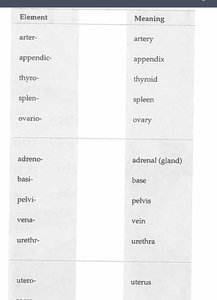
arter-: Refers to the artery, a blood vessel that carries blood away from the heart.
appendic-: Refers to the appendix, a small tube attached to the large intestine.
thyro-: Refers to the thyroid, a gland in the neck involved in hormone production.
splen-: Refers to the spleen, an organ involved in blood filtration and immune response.
ovario-: Refers to the ovary, a female reproductive organ.
adreno-: Refers to the adrenal (gland), which produces hormones like adrenaline.
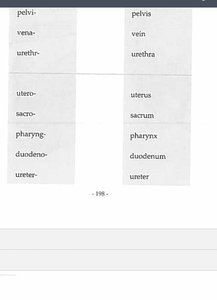
pelvi-: Refers to the pelvis, the lower part of the torso.
vena-: Refers to the vein, a blood vessel that carries blood toward the heart.
urethr-: Refers to the urethra, the tube that carries urine from the bladder to the outside.
utero-: Refers to the uterus, a female reproductive organ.
sacro-: Refers to the sacrum, a bone at the base of the spine.
pharyng-: Refers to the pharynx, the throat region.
duodeno-: Refers to the duodenum, the first part of the small intestine.
ureter-: Refers to the ureter, the tube that carries urine from the kidney to the bladder.
Root Elements Related to Other Biological Structures and Concepts
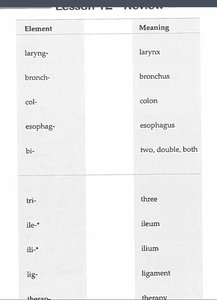
laryng-: Refers to the larynx, the voice box.
bronch-: Refers to the bronchus, a major air passage of the lungs.
col-: Refers to the colon, part of the large intestine.
esophag-: Refers to the esophagus, the tube connecting the throat to the stomach.
bi-: Means two, double, both.
tri-: Means three.
ile-*: Refers to the ileum, the lowest part of the small intestine.
ili-*: Refers to the ilium, the uppermost portion of the hipbone.
lig-: Refers to ligament, a connective tissue.
therap-: Refers to therapy, treatment of disease.

Distinguishing Between Similar Terms
Some root elements are similar in spelling but refer to different anatomical structures. For example, ile- (ileum) and ili- (ilium) are often confused. The ileum is part of the small intestine, while the ilium is part of the hipbone. A helpful mnemonic is:
"ile-" relates to the "e" in enter (intestines).
"ili-" relates to the "i" in hip (hipbone).
Summary Table of Root Elements and Their Meanings
Element | Meaning |
|---|---|
arter- | artery |
appendic- | appendix |
thyro- | thyroid |
splen- | spleen |
ovario- | ovary |
adreno- | adrenal (gland) |
pelvi- | pelvis |
vena- | vein |
urethr- | urethra |
utero- | uterus |
sacro- | sacrum |
pharyng- | pharynx |
duodeno- | duodenum |
ureter- | ureter |
laryng- | larynx |
bronch- | bronchus |
col- | colon |
esophag- | esophagus |
bi- | two, double, both |
tri- | three |
ile-* | ileum |
ili-* | ilium |
lig- | ligament |
therap- | therapy |
Example Application
When encountering a term like bronchitis, knowing that "bronch-" refers to the bronchus and "-itis" means inflammation, you can deduce that bronchitis is inflammation of the bronchus. This approach is useful for understanding medical and biological terminology throughout General Biology.
Additional info: These root elements are foundational for learning about the structure and function of the human body, and are directly relevant to chapters such as Digestive System, Circulatory System, Endocrine System, Animal Form and Function, and others in General Biology.
