 Back
Meiosis and Genetic Variation: Principles of Biology Study Guide
Study Guide - Smart Notes
 Tailored notes based on your materials, expanded with key definitions, examples, and context.
Meiosis: Principles and Key Concepts
Overview of Meiosis
Meiosis is a specialized type of cell division that reduces the chromosome number from diploid (2n) to haploid (n), resulting in four genetically unique cells. This process is essential for sexual reproduction and ensures genetic diversity among offspring.
Reduction Division: Meiosis consists of two consecutive divisions (Meiosis I and II) but only one round of DNA replication.
Genetic Variation: Arises through crossing over, independent assortment, and fertilization.
Chromosome Separation: Proper separation is crucial; errors (nondisjunction) can lead to abnormal chromosome numbers and genetic disorders.
Asexual vs. Sexual Reproduction
Organisms can reproduce either asexually or sexually, each method having distinct consequences for genetic diversity and evolutionary fitness.
Asexual Reproduction: Involves one parent; offspring are genetically identical (clones). Efficient but passes all genes, including harmful ones.
Sexual Reproduction: Involves two parents; offspring are genetically unique. Increases diversity but is energetically costly.
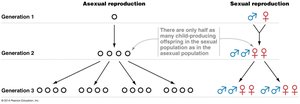
Evolutionary Significance of Genetic Variation
Genetic variation is the foundation of evolution, allowing populations to adapt to changing environments. Meiosis and sexual reproduction play a central role in generating this variation.
Natural Selection: Favors beneficial genetic variations.
Mutations: Create new alleles, serving as raw material for evolution.
Meiosis: Reshuffles alleles, increasing diversity.
Examples: Most animals reproduce sexually; some asexual species (e.g., bdelloid rotifers) gain diversity by absorbing foreign DNA.
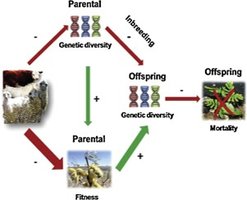
Mechanisms Creating Genetic Diversity in Sexual Reproduction
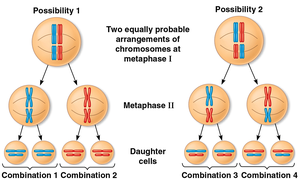
Independent Assortment
During meiosis, chromosomes are randomly distributed to gametes, resulting in numerous possible combinations.
Random Distribution: Maternal and paternal chromosomes are assorted independently.
Possible Gametes: In humans, independent assortment can produce 8.4 million possible gametes.
Crossing Over
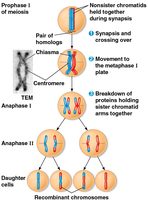
Crossing over occurs during Prophase I of meiosis, where homologous chromosomes exchange DNA, creating new allele combinations.
Exchange of DNA: Non-sister chromatids swap genetic material.
Result: New combinations of alleles beyond those produced by independent assortment.
Outcrossing (Fertilization)
Fusion of gametes from different individuals further increases genetic diversity, resulting in trillions of possible offspring combinations.
Gamete Fusion: Combines genetic material from two parents.
Offspring Diversity: Over 70 trillion possible combinations in humans.
Organization of Genetic Material
Chromosomes and Karyotype
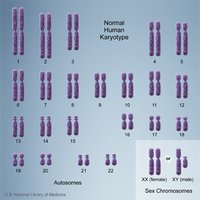
Chromosomes are long DNA molecules containing genes. The karyotype is the complete set of chromosomes in an organism.
Human Karyotype: 46 chromosomes (22 pairs of autosomes, 1 pair of sex chromosomes).
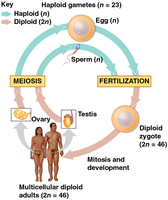
Gametes: Sperm and egg each carry 23 chromosomes.
Meiosis and Fertilization
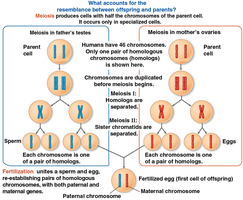
Meiosis produces gametes with half the chromosome number, ensuring genetic stability across generations. Fertilization restores the diploid state.
Meiosis: Halves chromosome number; usually followed by cytokinesis.
Fertilization: Union of sperm and egg forms a new individual.
Homologous Chromosomes
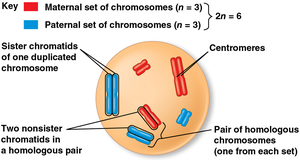
Homologous chromosomes (homologs) are pairs of chromosomes carrying the same genes in the same locations, but may have different alleles.
Homologs: Same type, same gene locations, different alleles.
Meiosis: Process and Phases
Vocabulary and Chromosome Terms
Understanding key terms is essential for mastering meiosis.
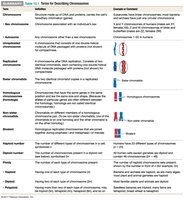
Meiosis: Two Cell Divisions
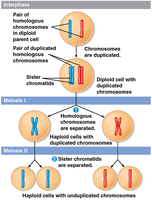
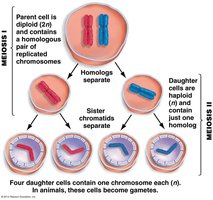
Meiosis consists of two divisions: Meiosis I (reduction division) and Meiosis II (equational division).
Meiosis I: Homologous chromosomes separate; diploid parent cell produces two haploid daughter cells.
Meiosis II: Sister chromatids separate; four genetically distinct haploid cells form.
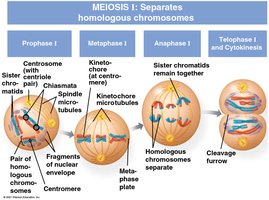
Phases of Meiosis I
Meiosis I is a continuous process with four distinct phases: Prophase I, Metaphase I, Anaphase I, and Telophase I.
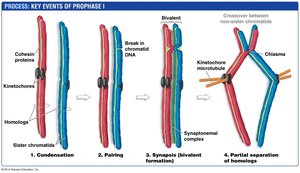
Prophase I: Recombination and Diversity
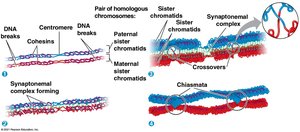
Prophase I is characterized by synapsis and crossing over, which increase genetic diversity.
Synapsis: Homologous chromosomes pair to form tetrads.
Crossing Over: Non-sister chromatids exchange DNA.
Synaptonemal Complex: Structure joining homologs.
Cohesin Proteins: Join sister chromatids.
Result of Meiosis I
Homologs separate, resulting in reduction division: diploid (2n) to haploid (n). Each chromosome still has two sister chromatids.
Meiosis vs. Mitosis
Meiosis II resembles mitosis but starts with haploid cells. Together, Meiosis I and II convert one diploid cell into four haploid cells.
Meiosis: Produces four haploid cells.
Mitosis: Produces two diploid cells.
Errors in Meiosis: Nondisjunction and Aneuploidy
Nondisjunction
Nondisjunction occurs when homologs or chromatids fail to separate properly, resulting in gametes with abnormal chromosome numbers.
Frequency: Occurs in up to 10% of meiotic divisions.
Consequences: Produces aneuploid zygotes (too few or too many chromosomes), most of which are nonviable.
Randomness: Errors are random, not inherited.
Examples of Aneuploidy
Down Syndrome (Trisomy 21): Extra chromosome 21 (47 total chromosomes).
Trisomy 18 (Edwards) and Trisomy 13 (Patau): Severe, often fatal early in life.
Klinefelter Syndrome (XXY): Extra X chromosome in males.
Calico Male Cats (XXY): Calico color requires two X chromosomes; typical males are XY, so calicos must be XXY due to nondisjunction.
Summary Table: Comparison of Mitosis and Meiosis
Feature | Mitosis | Meiosis |
|---|---|---|
Number of Divisions | 1 | 2 |
Number of Daughter Cells | 2 | 4 |
Chromosome Number in Daughter Cells | Diploid (2n) | Haploid (n) |
Genetic Identity | Identical | Unique |
Function | Growth, repair | Gamete production |
Additional info: Table inferred for clarity and completeness.
