 Back
BackMeiosis and Mendelian Genetics: Key Concepts and Processes
Study Guide - Smart Notes
 Tailored notes based on your materials, expanded with key definitions, examples, and context.
Meiosis
Overview of Meiosis
Meiosis is a specialized type of cell division that reduces the chromosome number by half, producing four genetically unique haploid cells from a single diploid parent cell. This process is essential for sexual reproduction and prevents the doubling of chromosome number in each generation.
Purpose: To produce haploid gametes (sperm and egg cells) from diploid cells, ensuring genetic diversity and stability of chromosome number across generations.
Key Features: Involves two consecutive divisions (meiosis I and meiosis II) following a single round of chromosome duplication.
Result: Four non-identical haploid cells, each with half the chromosome number of the original cell.
Importance: Prevents fatal genetic chaos by halving the chromosome number in gametes, which is restored upon fertilization.
Chromosome Structure
Chromosomes are structures within cells that contain DNA. In somatic cells, chromosomes exist in pairs called homologous chromosomes, with one member of each pair inherited from each parent.
Autosomes: Chromosomes not involved in determining sex (in humans, chromosomes 1-22).
Sex Chromosomes: Chromosomes that determine the sex of an individual (X and Y in mammals).
Stages of Meiosis I
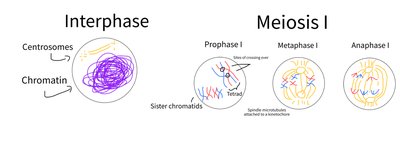
Meiosis I is the first division in meiosis, where homologous chromosomes are separated, reducing the chromosome number by half.
Prophase I: Homologous chromosomes pair up and exchange genetic material through crossing over, forming tetrads. Chiasmata are visible sites of crossing over.
Metaphase I: Tetrads align at the metaphase plate. The orientation of each pair is random, leading to independent assortment of chromosomes.
Anaphase I: Homologous chromosomes are separated and pulled to opposite poles of the cell.
Nondisjunction
Nondisjunction is an error in meiosis (or mitosis) where chromosomes fail to separate properly during anaphase I or II. This can result in gametes with abnormal numbers of chromosomes, leading to genetic disorders.
Consequences: Can produce individuals with missing or extra chromosomes (e.g., Trisomy 21, Turner syndrome).
Polyploidy: In some cases, nondisjunction can result in organisms with extra sets of chromosomes, which may contribute to the evolution of new species.
Mitosis vs. Meiosis
Mitosis and meiosis are both forms of cell division, but they serve different purposes and have distinct outcomes.
Mitosis | Meiosis | |
|---|---|---|
Purpose | Cell growth and repair | Gamete production |
Number of divisions | 1 | 2 |
Number of daughter cells | 2 | 4 |
Daughter cell ploidy | Diploid (2n) | Haploid (n) |
Genetic outcome | 2 identical diploid cells | 4 unique gametes |
Crossing over? | No | Yes (in prophase I) |
Homologs pair up? | No | Yes (in prophase I) |
Who undergoes it? | Somatic cells | Sex cells |
Mendelian Genetics
Key Vocabulary
Heredity: Transmission of traits from one generation to the next.
Genetics: Scientific study of heredity.
Character: A heritable feature that varies among individuals (e.g., flower color).
Trait: A variant of a character (e.g., purple or white flowers).
Allele: Alternative version of a gene.
Dominant allele: Determines phenotype in heterozygotes.
Recessive allele: Has no noticeable effect in heterozygotes.
Genotype: Genetic makeup of an organism (e.g., PP, Pp, or pp).
Phenotype: Physical expression of the genotype (e.g., purple or white flowers).
Homozygous: Both alleles are the same (PP or pp).
Heterozygous: Alleles are different (Pp).
Punnett square: Diagram to predict genetic crosses.
Monohybrid cross: Cross between individuals heterozygous for one trait.
Dihybrid cross: Cross between individuals heterozygous for two traits.
Law of segregation: Allele pairs separate during gamete formation.
Law of independent assortment: Each pair of alleles segregates independently during gamete formation.
Mendel’s Laws
Law of Dominance: In heterozygotes, the dominant allele is expressed, while the recessive allele is masked.
Law of Segregation: Each individual has two alleles for each gene, which segregate during gamete formation so that each gamete receives only one allele.
Law of Independent Assortment: Alleles of different genes assort independently of one another during gamete formation.
Probability in Genetics
Multiplication (Product) Rule: Probability of two independent events both occurring is the product of their individual probabilities. Example:
Addition (Sum) Rule: Probability of an event that can occur in multiple ways is the sum of the probabilities for each way. Example:
Dihybrid Crosses and Independent Assortment
A dihybrid cross examines the inheritance of two different traits. The law of independent assortment states that the alleles for different traits segregate independently during gamete formation, leading to genetic variation.
Genotype Example: AaBb (A and B are dominant; a and b are recessive)
Punnett Square: Used to predict the outcome of dihybrid crosses, showing all possible combinations of alleles.
Genetic Disorders and Chromosomal Mutations
Trisomy 21: Down syndrome, caused by an extra chromosome 21.
Deletion: Loss of a chromosome segment.
Duplication: Repetition of a chromosome segment.
Inversion: Reversal of a chromosome segment.
Translocation: Attachment of a chromosome segment to a nonhomologous chromosome.
Genetic Testing and Pedigrees
Pedigree: Diagram showing inheritance patterns across generations.
Amniocentesis: Prenatal test for genetic disorders using amniotic fluid.
Chorionic Villus Sampling (CVS): Prenatal test for genetic disorders using placental tissue.
