 Back
Meiosis and Metabolism: Study Guide for General Biology I
Study Guide - Smart Notes
 Tailored notes based on your materials, expanded with key definitions, examples, and context.
Meiosis and Genetic Variation
Chromosome Sets and Meiosis
Meiosis is a specialized cell division process that reduces chromosome number and generates genetic diversity. It is essential for sexual reproduction in eukaryotes.
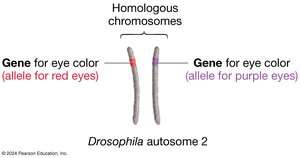
Homologous chromosomes: Each diploid cell contains pairs of homologous chromosomes, one from each parent. Homologs carry the same genes at corresponding loci but may have different alleles.
Sister chromatids: DNA replication produces two identical sister chromatids joined at the centromere. A replicated chromosome is still counted as one chromosome until the chromatids separate.
Haploid and diploid: Diploid cells (2n) have two sets of chromosomes; haploid cells (n) have one set. Meiosis produces haploid gametes, and fertilization restores diploidy.
Example: Homologs may carry different alleles for the same gene, such as eye color in Drosophila.
Meiosis I: Separation of Homologs
Meiosis I is the first division, separating homologous chromosomes and reducing chromosome number.
Interphase and prophase I: Chromosomes replicate, and homologs pair to form bivalents. Crossing over occurs at chiasmata.
Metaphase I and anaphase I: Homologous pairs align at the equator and are separated to opposite poles.
Telophase I and cytokinesis: Cells become haploid, each with one homolog from each pair.
Meiosis II and Genetic Variation
Meiosis II resembles mitosis, separating sister chromatids to produce four haploid cells.
Prophase II and metaphase II: Chromosomes line up individually; no DNA replication occurs between divisions.
Anaphase II and telophase II: Sister chromatids separate, resulting in four haploid products.
Comparison with mitosis: Mitosis produces two identical cells; meiosis produces four genetically distinct haploid cells.
Sources of Variation and Chromosome Number Errors
Meiosis introduces genetic variation through two main mechanisms.
Crossing over: Exchange of DNA between nonsister chromatids creates new allele combinations.
Independent assortment: Homologous pairs orient independently at metaphase I, resulting in diverse combinations of parental chromosomes.
Nondisjunction: Errors in chromosome separation can lead to gametes with abnormal chromosome numbers.
Example: Different orientations of homologous pairs affect which parental chromosomes are inherited together.
Carbohydrates and Energy Storage
Sugar Structure and Polymer Formation
Carbohydrates are essential for energy storage and structural support in cells.
Monosaccharides: Simple sugars; disaccharides are two linked units; oligosaccharides are short chains; polysaccharides are long chains.
Carbonyl position: Aldoses have a terminal carbonyl; ketoses have an internal carbonyl. Glucose (aldose) and fructose (ketose) are common examples.
Carbon number and shape: Trioses (3C), pentoses (5C), hexoses (6C). Glucose forms rings in water; α and β forms differ at the anomeric carbon.
Glycosidic linkage: Covalent bonds join sugars; linkage orientation affects polymer structure and function.
Storage Polysaccharides
Polysaccharides store energy in plants and animals.
Starch: Plant storage; amylose (unbranched), amylopectin (branched).
Glycogen: Animal storage; highly branched, stored in liver and muscle.
Structural and Cell Surface Carbohydrates
Carbohydrates also provide structural support and mediate cell recognition.
Cellulose: β linkages form straight chains; hydrogen bonds create strong fibers in plant cell walls.
Chitin: N-acetylglucosamine polymer supports fungal cell walls and exoskeletons.
Peptidoglycan: Alternating sugars cross-linked by peptides strengthen bacterial cell walls.
Glycoproteins and glycolipids: Carbohydrate chains attached to proteins or lipids serve as cell surface recognition cues.
Example: ABO blood-group markers are glycoproteins.
Energy and Thermodynamics
Energy Changes in Cells
Cells manage energy through metabolic reactions, governed by thermodynamic laws.
Metabolism: Catabolic pathways break down molecules; anabolic pathways build molecules. Enzymes regulate reaction rates.
Kinetic and potential energy: Kinetic is motion; potential is position or arrangement.
First law: Energy is conserved; bond breaking requires energy, bond formation releases energy.
Second law: Spontaneous processes increase entropy; cells build order while increasing overall disorder.
Enthalpy and Gibbs Free Energy
Thermodynamic quantities describe energy changes in reactions.
Enthalpy (H): Heat exchanged at constant pressure; exothermic reactions release heat, endothermic absorb heat.
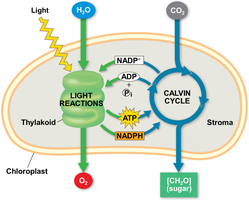
Gibbs free energy (G): Energy available to do work; exergonic reactions release free energy, endergonic require input.
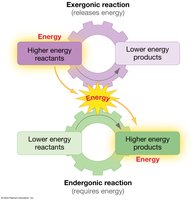
Reaction rate: Depends on activation energy, temperature, and concentration.
Equation:
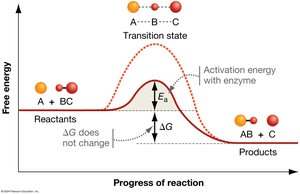
Example: Activation energy is the energy barrier to the transition state; is the difference in free energy between reactants and products.
Energy Coupling and Redox
Coupling and Electron Transfer
Cells couple reactions and transfer electrons to manage energy efficiently.
Energy coupling: Exergonic reactions drive endergonic ones when linked by shared intermediates.
Oxidation and reduction: Oxidation is electron loss; reduction is electron gain. Electron donors are reducing agents; acceptors are oxidizing agents.
Electron carriers: NADH and FADH2 transport electrons during fuel breakdown.
Enzyme Catalysis and Reaction Rate
What Enzymes Do
Enzymes are biological catalysts that speed up reactions by lowering activation energy.
Active site: Substrates bind to a specific region; induced fit positions substrates for reaction.
Three stages: Substrate binding, transition state stabilization, product release.
Activation energy: Enzymes lower the barrier to the transition state; and equilibrium remain unchanged.
What Changes the Rate
Several factors influence enzyme activity and reaction rate.
Substrate concentration: Increasing substrate increases rate until enzyme saturation is reached.
Temperature and pH: Enzymes have optimal conditions; extremes can denature or reduce activity.
Example: Catalyzed reactions approach a maximum rate as substrate concentration increases.
Enzyme Regulation and Metabolic Pathways
Mechanisms of Regulation
Cells regulate enzyme activity to control metabolic pathways.
Competitive inhibition: Inhibitor competes with substrate for active site; effect reduced by increasing substrate.
Allosteric regulation: Regulator binds away from active site, altering enzyme shape and activity.
Phosphorylation: Addition of phosphate changes protein conformation and activity.
How Cells Regulate a Pathway
Metabolic pathways are regulated by feedback mechanisms.
Metabolic pathways: Product of one enzyme is substrate for the next; regulation of early enzymes controls pathway flow.
Feedback inhibition: End product inhibits an early enzyme, reducing pathway activity when product is abundant.
Pathway evolution: Pathways can extend upstream as new enzymes evolve to supply scarce substrates.
Example: Feedback inhibition slows pathway when product accumulates.
Cellular Respiration and Fuel Breakdown
The Flow of Carbon and Energy
Cellular respiration breaks down organic molecules to release energy for cellular work.
Catabolic pathways: Break down molecules and release energy; anabolic pathways build molecules.
Stepwise oxidation: Enzymes break down fuel in stages; electron carriers deliver electrons to the electron transport chain.
Example: Glycolysis, pyruvate oxidation, citric acid cycle, and oxidative phosphorylation are key stages.
The Stages Before Oxidative Phosphorylation
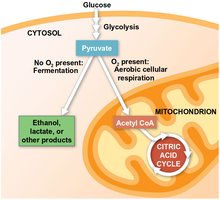
Glycolysis: Occurs in cytosol; splits glucose into pyruvate, produces ATP and NADH.
Pyruvate oxidation: Converts pyruvate to acetyl CoA in mitochondria; releases CO2 and forms NADH.
Citric acid cycle: Oxidizes acetyl group, releases CO2, transfers energy to electron carriers, produces ATP.
Electron Transport and Chemiosmosis
How Mitochondria Make Most of Their ATP
Electron transport and chemiosmosis are central to ATP production in aerobic respiration.
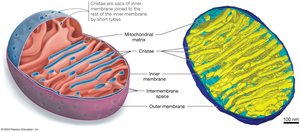
Electron transport chain: Proteins in the inner mitochondrial membrane pass electrons to oxygen, forming water.
Proton gradient: Electron transfer drives protons into the intermembrane space, storing energy.
Chemiosmosis: Protons flow back through ATP synthase, driving ATP production.
Two ways to make ATP: Substrate-level phosphorylation (direct), oxidative phosphorylation (proton gradient).
Fermentation and Metabolic Regulation
How Glycolysis Continues Without Oxygen
Fermentation allows glycolysis to continue in the absence of oxygen by regenerating NAD+.
Regenerating NAD+: Electrons from NADH are transferred to organic molecules, allowing glycolysis to proceed.
Two fermentation pathways: Lactate fermentation (pyruvate to lactate), alcohol fermentation (pyruvate to ethanol).
Anaerobic respiration: Some organisms use electron transport chains with final acceptors other than oxygen.
Example: Pyruvate fate differs between fermentation and aerobic respiration.
Fuel Choice and Feedback
Other fuels: Starch, glycogen, glycerol, fatty acids, and amino acids can enter respiration at various points.
Feedback regulation: High ATP and citrate inhibit glycolysis; AMP stimulates it. Citric acid cycle slows when ATP or NADH is abundant.
Photosynthesis
The Role of Light and Chloroplasts
Photosynthesis captures light energy to build organic molecules and supports life on Earth.
Photoautotrophs: Use light to build organic molecules from CO2; oxygenic photosynthesis releases O2.
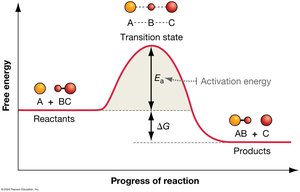
Chloroplast structure: Light reactions occur at thylakoid membranes; Calvin cycle in stroma. Chloroplasts have a double envelope, DNA, and ribosomes.
Two Linked Stages
Light reactions: Light drives electron transfer from water to NADP+, producing NADPH and O2; builds proton gradient for ATP synthesis (photophosphorylation).
Calvin cycle: Incorporates CO2 into organic molecules; uses ATP and NADPH to form sugars; regenerates carbon acceptor.
Link to respiration: Photosynthesis builds organic molecules; respiration extracts energy. Both use membrane-based electron transport and proton gradients.
Example: ATP and NADPH from light reactions power the Calvin cycle; O2 is released, CO2 is fixed.
