 Back
BackMeiosis and Sexual Life Cycles: Genetics, Chromosomes, and Genetic Variation
Study Guide - Smart Notes
 Tailored notes based on your materials, expanded with key definitions, examples, and context.
Ch.10 - Meiosis and Sexual Life Cycles
Concept: Genes & Alleles
Genes are the fundamental units of heredity, encoding the information necessary for the expression of traits. Alleles are alternative forms of a gene that may produce variations in the expression of a trait.
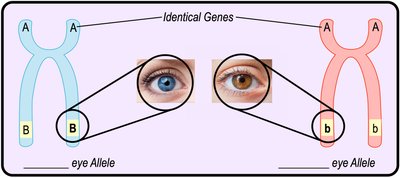
Gene: A segment of DNA that encodes a protein or functional RNA, influencing a specific trait (e.g., gene for eye color).
Allele: Different versions of a specific gene (e.g., blue eye allele vs. brown eye allele).
Alleles are typically represented by capital and lowercase letters (e.g., B = blue eyes, b = brown eyes).
Each individual inherits one allele from each parent for each gene.
Example: The gene for eye color may have a blue allele (B) and a brown allele (b).
Haploid vs. Diploid Cells
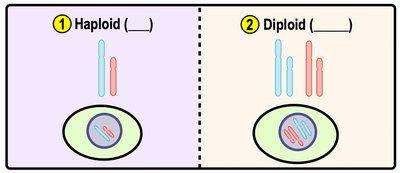
Cell ploidy refers to the number of sets of chromosomes present in a cell. Organisms alternate between haploid and diploid stages in their life cycles.
Haploid (n): Cells with one set of chromosomes (e.g., gametes such as sperm and egg).
Diploid (2n): Cells with two sets of chromosomes, one from each parent (e.g., somatic cells).
Example: Human somatic cells are diploid (2n = 46), while human gametes are haploid (n = 23).
Concept: Homologous Chromosomes
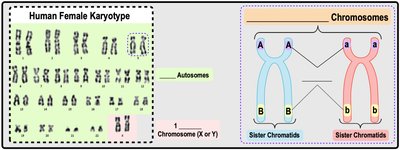
Homologous chromosomes are pairs of chromosomes that are similar in size, shape, and gene content, but may carry different alleles.
Karyotype: An ordered display of all chromosomes in a cell.
Humans have 23 pairs of chromosomes (46 total): 22 pairs of autosomes and 1 pair of sex chromosomes (XX or XY).
Homologous chromosomes carry the same genes but may have different alleles.
One chromosome of each pair is inherited from the mother, the other from the father.
Example: Human female karyotype showing 22 pairs of autosomes and XX sex chromosomes.
Concept: Life Cycle of Sexual Reproducers
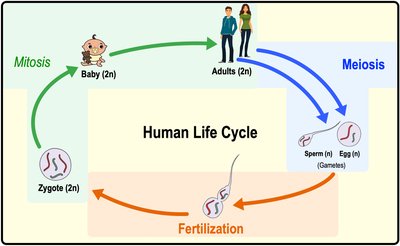
Sexual life cycles involve both mitosis and meiosis, alternating between diploid and haploid stages. Fertilization restores diploidy, while meiosis reduces chromosome number to haploid.
Meiosis: Produces haploid gametes (sperm or egg cells) from diploid germ cells.
Fertilization: Fusion of gametes to form a diploid zygote.
Zygote: The first diploid cell of a new organism, which divides by mitosis to grow and develop.
Example: Human life cycle showing alternation between diploid and haploid stages.
Concept: Introduction to Meiosis
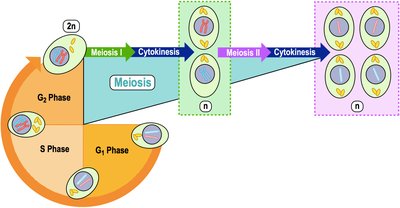
Meiosis is a specialized form of cell division that reduces the chromosome number by half, producing four genetically diverse haploid gametes from a single diploid germ cell.
DNA replication occurs before meiosis during interphase.
Meiosis consists of two sequential divisions: Meiosis I and Meiosis II.
Germ cells: Precursor cells that undergo meiosis to produce gametes.
Result: Four genetically unique haploid gametes.
Concept: Meiosis I (Reductional Division)
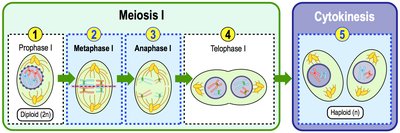
Meiosis I separates homologous chromosomes, reducing the chromosome number by half and producing two haploid cells.
Prophase I: Homologous chromosomes pair and crossing over occurs.
Metaphase I: Homologous pairs align in two rows at the metaphase plate.
Anaphase I: Homologous chromosomes are separated; sister chromatids remain attached.
Telophase I and Cytokinesis: Two haploid cells are formed.
Concept: Meiosis II (Equational Division)
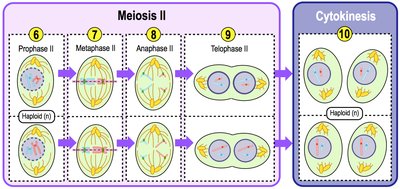
Meiosis II is similar to mitosis, where sister chromatids are separated, resulting in four genetically diverse haploid gametes.
Each haploid cell from Meiosis I divides again without further DNA replication.
Metaphase II: Chromosomes align in a single row.
Anaphase II: Sister chromatids are separated.
Result: Four genetically unique haploid gametes.
Concept: Mitosis & Meiosis Review
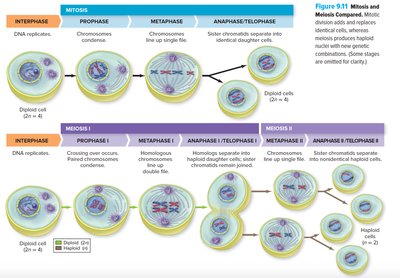
Mitosis and meiosis are both forms of cell division but serve different purposes and have distinct outcomes.
Mitosis: Occurs in somatic cells, produces two genetically identical diploid cells for growth and repair.
Meiosis: Occurs in germ cells, produces four genetically diverse haploid gametes for sexual reproduction.
Homologous chromosomes pair and undergo crossing over in meiosis but not in mitosis.
Cytokinesis occurs once in mitosis, twice in meiosis.
Meiosis can only occur in diploid cells; mitosis can occur in both diploid and haploid cells.
Concept: Genetic Variation During Meiosis
Meiosis generates genetic diversity through two main mechanisms: crossing over and independent assortment.
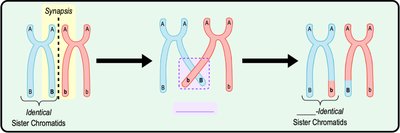
Crossing Over: Exchange of genetic material between non-sister chromatids of homologous chromosomes during Prophase I, resulting in recombinant chromosomes.
Synapsis: Homologous chromosomes pair and align gene by gene.
Chiasma: The physical site of crossing over.
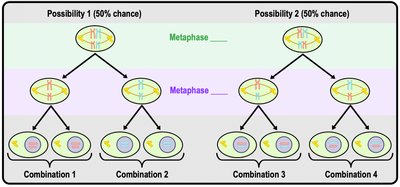
Independent Assortment: Random orientation of homologous chromosome pairs during Metaphase I leads to a variety of possible genetic combinations in gametes.
Number of possible combinations: (where n = haploid number of chromosomes).
Example: In humans (n = 23), there are about 8 million possible combinations due to independent assortment alone.
Nondisjunction
Nondisjunction is an error in meiosis when chromosomes fail to separate properly, resulting in gametes with abnormal chromosome numbers (aneuploidy).
Aneuploid Cells: Cells with too many or too few chromosomes.
Can lead to genetic disorders such as trisomy 21 (Down syndrome) or cell death.
Nondisjunction can occur during Anaphase I or II of meiosis.
Summary Table: Key Differences Between Mitosis and Meiosis
Feature | Mitosis | Meiosis |
|---|---|---|
Number of Divisions | 1 | 2 |
Number of Daughter Cells | 2 | 4 |
Genetic Identity | Identical to parent | Genetically unique |
Chromosome Number | Same as parent | Half of parent |
Role | Growth, repair | Sexual reproduction |
