 Back
BackMeiosis and Sexual Life Cycles: Mechanisms and Genetic Variation
Study Guide - Smart Notes
 Tailored notes based on your materials, expanded with key definitions, examples, and context.
Meiosis and Sexual Life Cycles
Differences Between Sexual and Asexual Reproduction
Reproduction is the biological process by which organisms produce offspring. There are two primary modes: asexual reproduction and sexual reproduction.
Asexual reproduction: Involves a single parent; offspring are genetically identical to the parent (clones). No fusion of gametes occurs, and reproduction is typically via mitosis. Common in single-celled organisms (e.g., yeast, amoeba) and some multicellular organisms. Genetic variation is minimal, arising only through mutations.
Sexual reproduction: Involves two parents; offspring inherit unique combinations of genes from both. Fusion of gametes (egg and sperm) occurs, resulting in genetically diverse offspring. This diversity is crucial for adaptation and evolution.
The Role of Meiosis and Fertilization in Sexually Reproducing Organisms
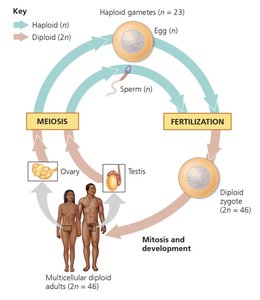
Sexually reproducing organisms rely on meiosis and fertilization to maintain chromosome number and generate genetic diversity.
Meiosis: Specialized cell division that reduces chromosome number from diploid (2n) to haploid (n), producing gametes (sperm and eggs).
Fertilization: Fusion of two haploid gametes restores the diploid state in the zygote.
Humans have 46 chromosomes (23 pairs); 22 pairs are autosomes, and 1 pair are sex chromosomes (XX or XY).
Meiosis prevents chromosome number from doubling each generation and introduces genetic variation among gametes.
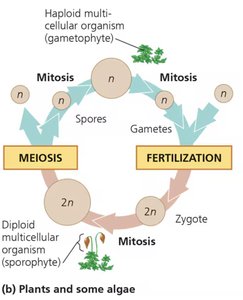
Example: In fungi such as mushrooms, meiosis produces haploid spores that grow into multicellular haploid organisms via mitosis. These organisms can then produce gametes by mitosis, as their cells are already haploid.
The Importance of Homologous Chromosomes to Meiosis
Homologous chromosomes are pairs of chromosomes, one from each parent, carrying the same genes at the same loci but possibly different alleles. Their behavior is central to meiosis.
Homologs pair up during meiosis I (synapsis), allowing for crossing over and genetic recombination.
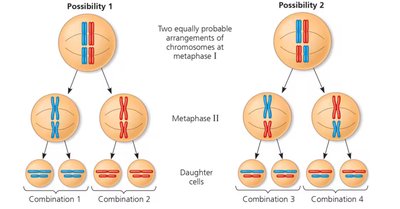
Random alignment of homologous pairs during metaphase I leads to independent assortment.
Separation of homologs in anaphase I reduces chromosome number, producing haploid cells.
Errors in separation can lead to nondisjunction and chromosomal disorders.
Reduction of Chromosome Number: Diploid to Haploid
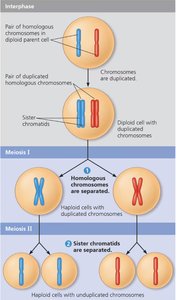
Meiosis consists of two sequential divisions: meiosis I and meiosis II. This process ensures gametes have half the chromosome number of somatic cells.
Meiosis I: Homologous chromosomes separate, reducing the chromosome number by half.
Meiosis II: Sister chromatids separate, resulting in four unique haploid gametes.
Fertilization restores the diploid state in the zygote.
Stages of Meiosis: Key Events
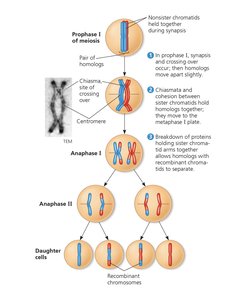
Prophase I: Homologous chromosomes pair and exchange genetic material (crossing over). Synaptonemal complex forms between homologs.
Metaphase I: Homologous pairs align at the metaphase plate; orientation is random.
Anaphase I: Homologs separate to opposite poles; chromosome number is halved.
Meiosis II: Sister chromatids separate, producing four haploid cells.
Key Differences Between Mitosis and Meiosis
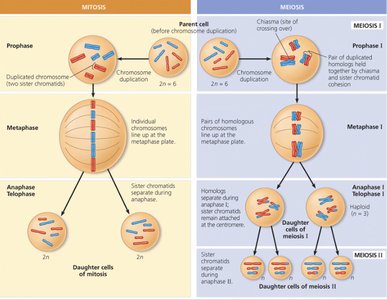
Mitosis and meiosis are both forms of cell division, but they serve different purposes and have distinct outcomes.
Pairing of chromosomes: Homologs pair in meiosis (synapsis), not in mitosis.
Crossing over: Occurs in meiosis I, never in mitosis.
Separation: Homologs separate first in meiosis I; sister chromatids separate in mitosis and meiosis II.
Purpose: Mitosis is for growth, repair, and asexual reproduction; meiosis produces gametes for sexual reproduction.
Genetic makeup: Mitosis yields identical cells; meiosis yields genetically distinct gametes.
Mechanisms Increasing Genetic Variability
Genetic variation is essential for evolution and adaptation. Three mechanisms in sexual reproduction increase variability:
Independent assortment: Random distribution of maternal and paternal chromosomes during meiosis I creates millions of possible gamete combinations.
Crossing over: Exchange of DNA between homologous chromosomes during prophase I produces recombinant chromosomes with new allele combinations.
Random fertilization: Any sperm can fertilize any egg, resulting in trillions of possible zygote combinations.
Mathematical Example: For humans, the number of possible chromosome combinations due to independent assortment is (over 8 million). With random fertilization, the number of possible zygote combinations is (over 70 trillion).
Key Terms and Definitions
Homologous chromosomes: Chromosome pairs with the same genes but possibly different alleles.
Alleles: Different versions of the same gene.
Locus (plural: loci): The specific location of a gene on a chromosome.
Autosomes: Non-sex chromosomes (22 pairs in humans).
Sex chromosomes: Chromosomes that determine biological sex (XX or XY).
Diploid (2n): Cells with two sets of chromosomes.
Haploid (n): Cells with one set of chromosomes.
Gametes: Haploid reproductive cells (sperm and egg).
Zygote: Diploid cell formed by fertilization.
Crossing over: Exchange of genetic material between homologous chromosomes.
Independent assortment: Random distribution of homologous chromosomes during meiosis I.
Random fertilization: Random combination of gametes during fertilization.
Summary Table: Mitosis vs. Meiosis
Feature | Mitosis | Meiosis |
|---|---|---|
Number of divisions | 1 | 2 |
Number of daughter cells | 2 | 4 |
Chromosome number in daughter cells | Diploid (2n) | Haploid (n) |
Genetic identity | Identical to parent | Genetically unique |
Purpose | Growth, repair, asexual reproduction | Sexual reproduction (gamete formation) |
Crossing over | No | Yes (prophase I) |
