 Back
BackMeiosis and Sexual Life Cycles: Mechanisms of Genetic Variation
Study Guide - Smart Notes
 Tailored notes based on your materials, expanded with key definitions, examples, and context.
Meiosis and Sexual Life Cycles
Introduction to Heredity and Variation
Heredity is the transmission of traits from one generation to the next, while variation refers to the differences in appearance that offspring show from parents and siblings. Genetics is the scientific study of heredity and variation, providing the foundation for understanding how traits are inherited and how genetic diversity arises in populations.
Heredity: The passing of traits from parents to offspring.
Variation: Differences in physical appearance and genetic makeup among individuals.
Genetics: The branch of biology that studies heredity and variation.
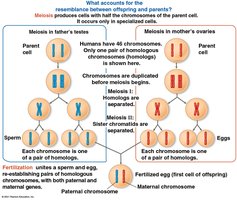
Genes, Chromosomes, and Loci
Genes are the fundamental units of heredity, composed of DNA segments located at specific positions (loci) on chromosomes. Each gene encodes information for a particular trait, such as eye or hair color. Genes are transmitted to offspring via gametes (sperm and eggs), which carry half the genetic material of somatic cells.
Gene: A segment of DNA that codes for a specific trait.
Locus (plural: loci): The specific location of a gene on a chromosome.
Gametes: Reproductive cells (sperm and eggs) that carry one set of chromosomes (haploid).
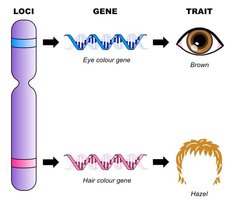
Concept 13.1: Offspring Acquire Genes from Parents by Inheriting Chromosomes
Chromosome Sets in Human Cells
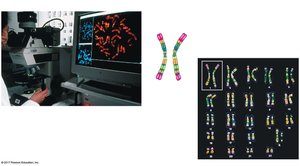
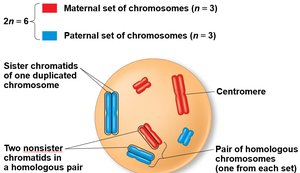
Humans have 46 chromosomes in their somatic cells, organized into 23 pairs. Each pair consists of homologous chromosomes, one inherited from each parent. Homologous chromosomes are similar in length, shape, and gene content, but may carry different versions (alleles) of the same gene.
Somatic cells: All body cells except gametes and their precursors; diploid (2n = 46 in humans).
Homologous chromosomes: Chromosome pairs with the same genes but possibly different alleles.
Diploid (2n): Cells with two sets of chromosomes.
Haploid (n): Cells with one set of chromosomes (gametes; n = 23 in humans).
Comparison of Asexual and Sexual Reproduction
Modes of Reproduction
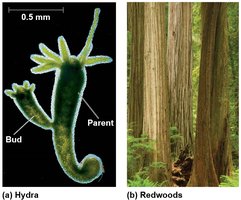
Asexual reproduction involves a single parent and produces genetically identical offspring (clones). In contrast, sexual reproduction involves two parents and results in offspring with unique combinations of genes, increasing genetic diversity.
Asexual reproduction: Offspring arise from a single parent without gamete fusion; produces clones.
Sexual reproduction: Offspring result from the fusion of gametes from two parents; increases genetic variation.
Concept 13.2: Fertilization and Meiosis Alternate in Sexual Life Cycles
The Human Life Cycle
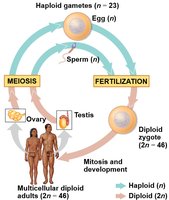
The life cycle is the sequence of stages in the reproductive history of an organism. In sexually reproducing organisms, meiosis and fertilization alternate to maintain chromosome number across generations. Meiosis reduces chromosome number by half, and fertilization restores the diploid state.
Meiosis: Cell division that reduces chromosome number from diploid to haploid.
Fertilization: Fusion of haploid gametes to form a diploid zygote.
Variety of Sexual Life Cycles
All sexually reproducing organisms alternate between meiosis and fertilization, but the timing and dominance of haploid and diploid stages vary among animals, plants, fungi, and protists.
Animals: Diploid stage dominates; gametes are the only haploid cells.
Plants and some algae: Alternation of generations with multicellular haploid (gametophyte) and diploid (sporophyte) stages.
Fungi and some protists: Haploid stage dominates; zygote is the only diploid stage.
Concept 13.3: Meiosis Reduces the Number of Chromosome Sets from Diploid to Haploid
Overview of Meiosis
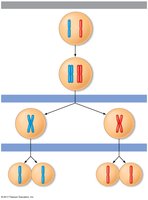
Meiosis consists of two consecutive cell divisions: meiosis I and meiosis II. These divisions result in four genetically distinct haploid cells, each with half the chromosome number of the original diploid cell.
Meiosis I: Homologous chromosomes separate, reducing chromosome number by half.
Meiosis II: Sister chromatids separate, similar to mitosis.
The Stages of Meiosis
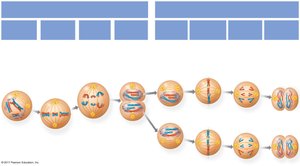
Each meiotic division is subdivided into four phases. Meiosis I includes prophase I, metaphase I, anaphase I, and telophase I with cytokinesis. Meiosis II includes prophase II, metaphase II, anaphase II, and telophase II with cytokinesis.
Prophase I: Homologous chromosomes pair and exchange genetic material (crossing over).
Metaphase I: Homologous pairs align at the metaphase plate.
Anaphase I: Homologous chromosomes separate to opposite poles.
Telophase I and Cytokinesis: Two haploid cells form; chromosomes are still duplicated.
Meiosis II: Sister chromatids separate, resulting in four haploid cells.
Unique Events in Meiosis
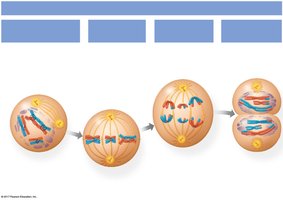
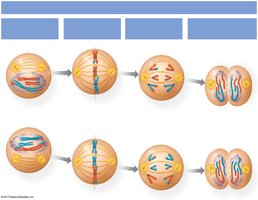
Three events distinguish meiosis from mitosis, all occurring during meiosis I:
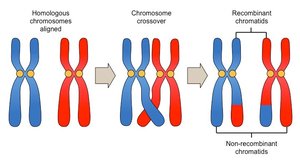
Synapsis and crossing over: Homologous chromosomes physically connect and exchange genetic material.
Homologous pairs at the metaphase plate: Homologs align as pairs, not individual chromosomes.
Separation of homologs: Homologous chromosomes, not sister chromatids, separate during anaphase I.
Comparison of Mitosis and Meiosis
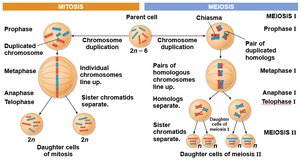
Mitosis produces two genetically identical diploid cells, conserving chromosome number. Meiosis produces four genetically distinct haploid cells, reducing chromosome number by half and increasing genetic diversity.
Feature | Mitosis | Meiosis |
|---|---|---|
Number of divisions | 1 | 2 |
Number of daughter cells | 2 | 4 |
Chromosome number in daughter cells | Diploid (2n) | Haploid (n) |
Genetic identity | Identical to parent | Genetically unique |
Concept 13.4: Genetic Variation Produced in Sexual Life Cycles Contributes to Evolution
Sources of Genetic Variation
Genetic variation is essential for evolution and adaptation. It arises from mutations (changes in DNA) and the reshuffling of alleles during sexual reproduction. Three main mechanisms contribute to genetic diversity among offspring:
Crossing over: Exchange of genetic material between homologous chromosomes during prophase I.
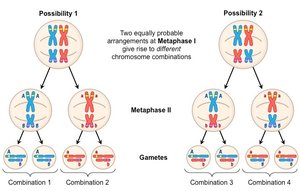
Independent assortment: Random orientation of homologous pairs during metaphase I leads to different combinations of chromosomes in gametes.
Random fertilization: Any sperm can fuse with any egg, producing a zygote with a unique genetic makeup.
Mathematical Basis of Genetic Variation
The number of possible chromosome combinations due to independent assortment is , where is the haploid number. For humans (), this results in over 8 million possible combinations. When considering random fertilization, the number of possible diploid combinations is the product of the number of possible gametes from each parent.
Equation for independent assortment:
Equation for random fertilization:
For humans: possible gametes per parent; possible zygotes (not including crossing over).
Additional info: Crossing over further increases genetic diversity by producing recombinant chromosomes, which combine DNA from both parents into a single chromosome.
