 Back
Meiosis and Sexual Life Cycles: Mechanisms of Genetic Variation
Study Guide - Smart Notes
 Tailored notes based on your materials, expanded with key definitions, examples, and context.
Meiosis and Sexual Life Cycles
Introduction to Meiosis and Sexual Reproduction
Meiosis is a specialized type of cell division that reduces the chromosome number by half, producing haploid gametes or spores. Sexual reproduction involves the fusion of these gametes, resulting in offspring with genetic variation. This process is fundamental to the continuity of life and the evolution of populations.
Heredity, Variation, and Genetics
Key Concepts
Heredity: The transmission of traits from one generation to the next.
Variation: Differences in appearance and traits among offspring, parents, and siblings.
Genetics: The scientific study of heredity and variation.
Modes of Reproduction
Asexual vs. Sexual Reproduction
Asexual reproduction: A single individual passes genes to offspring without gamete fusion, producing genetically identical clones.
Sexual reproduction: Two parents contribute genes, resulting in offspring with unique genetic combinations due to gamete fusion.
Life Cycles and Chromosome Sets
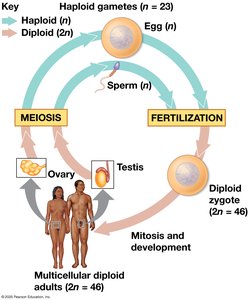
Alternation of Meiosis and Fertilization
A life cycle is the sequence of stages in the reproductive history of an organism. In sexually reproducing organisms, meiosis and fertilization alternate, maintaining chromosome number across generations.
Diploid (2n): Cells with two sets of chromosomes (one from each parent).
Haploid (n): Cells with one set of chromosomes (gametes).
Homologous Chromosomes
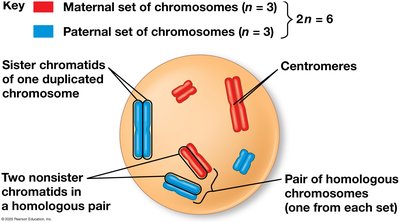
Homologous chromosomes are pairs, one from each parent, carrying the same genes but possibly different alleles.
Meiosis separates homologous pairs, creating haploid gametes.
Types of Sexual Life Cycles
Animal Life Cycle
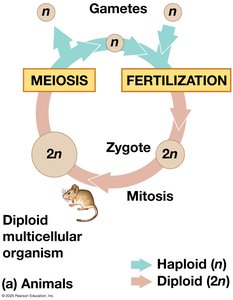
In animals, meiosis produces haploid gametes. Fertilization restores the diploid state, and mitosis produces a multicellular diploid organism.
Plant Life Cycle (Alternation of Generations)
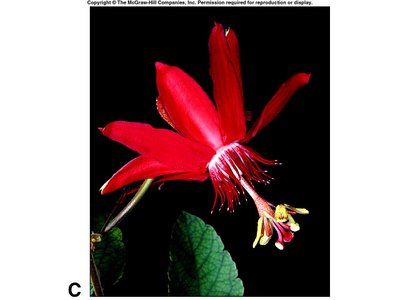
Plants and some algae exhibit alternation of generations, with both multicellular diploid (sporophyte) and multicellular haploid (gametophyte) stages.
Sporophyte (2n): Produces haploid spores by meiosis.
Gametophyte (n): Produces gametes by mitosis.
Fungal and Protist Life Cycles
Most fungi and some protists have a life cycle dominated by the haploid stage. The zygote is the only diploid cell, which undergoes meiosis to produce haploid cells.
Mechanisms of Meiosis
Overview of Meiosis
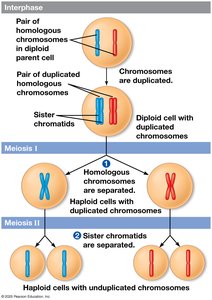
Meiosis consists of two sequential divisions: meiosis I and meiosis II. It results in four haploid cells, each genetically distinct from the parent cell and from each other.
Meiosis I: Homologous chromosomes separate.
Meiosis II: Sister chromatids separate.
Comparison of Mitosis and Meiosis
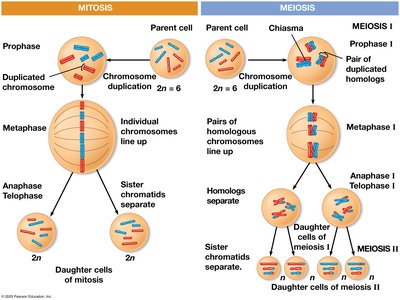
Mitosis: Conserves chromosome number, producing genetically identical cells.
Meiosis: Reduces chromosome number by half, producing genetically unique cells.
Genetic Variation in Sexual Life Cycles
Sources of Genetic Variation
Mutations: The original source of genetic diversity, creating new alleles.
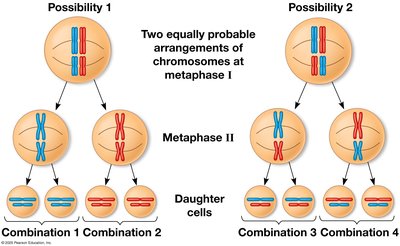
Independent assortment: Random orientation of homologous chromosomes during metaphase I of meiosis.
Crossing over: Exchange of genetic material between nonsister chromatids during prophase I, producing recombinant chromosomes.
Random fertilization: Any sperm can fuse with any egg, increasing genetic combinations.
Mathematical Basis of Independent Assortment
The number of possible chromosome combinations due to independent assortment is , where is the haploid number.
For humans (): possible combinations.
Significance of Genetic Variation
Genetic variation is essential for evolution and adaptation.
Sexual reproduction increases genetic diversity, which can enhance survival in changing environments.
Summary Table: Comparison of Mitosis and Meiosis
Feature | Mitosis | Meiosis |
|---|---|---|
Number of divisions | 1 | 2 |
Number of daughter cells | 2 | 4 |
Chromosome number in daughter cells | Diploid (2n) | Haploid (n) |
Genetic identity | Identical to parent | Genetically unique |
Role in organism | Growth, repair, asexual reproduction | Sexual reproduction, genetic diversity |
Key Takeaways
Meiosis and fertilization are central to sexual life cycles, maintaining chromosome number and generating genetic diversity.
Genetic variation arises from mutations, independent assortment, crossing over, and random fertilization.
Sexual reproduction is adaptive, promoting evolution and survival in changing environments.
