 Back
Meiosis and Sexual Life Cycles: Mechanisms of Heredity and Genetic Variation
Study Guide - Smart Notes
 Tailored notes based on your materials, expanded with key definitions, examples, and context.
Heredity, Variation, and Genetics; Chapter 10
Key Terminology
Understanding heredity and genetic variation is fundamental to biology. The following terms are essential:
Heredity: The transmission of traits from one generation to the next.
Variation: Differences in appearance or traits among offspring, parents, and siblings.
Genetics: The scientific study of heredity and variation.
Genes: Units of heredity, composed of DNA segments, located at specific loci on chromosomes.
Gametes: Reproductive cells (sperm and eggs) that transmit genes to offspring.
Somatic cells: All body cells except gametes and their precursors.
Homologous chromosomes: Chromosome pairs, one from each parent, with the same genes at the same loci.
Modes of Reproduction
Asexual vs. Sexual Reproduction
Organisms reproduce either asexually or sexually, with significant implications for genetic diversity.
Asexual reproduction: A single individual produces offspring genetically identical to itself (clones), without gamete fusion.
Sexual reproduction: Two parents contribute genes, resulting in offspring with unique genetic combinations.
Example: Many plants and some animals can reproduce asexually (e.g., hydra budding), while humans and most animals reproduce sexually.
Chromosome Sets and Ploidy
Diploid and Haploid Cells
Chromosome number is a key feature of cells:
Diploid (2n): Cells with two sets of chromosomes (one from each parent). In humans, 2n = 46.
Haploid (n): Cells with one set of chromosomes. Human gametes are haploid (n = 23).
Somatic cells are diploid, while gametes are haploid. Fertilization restores the diploid state in the zygote.
Human Karyotype and Sex Chromosomes
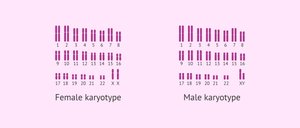
Humans have 22 pairs of autosomes and one pair of sex chromosomes (XX in females, XY in males).
The Human Sexual Life Cycle
Alternation of Meiosis and Fertilization
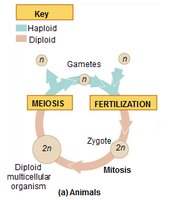
The sexual life cycle alternates between haploid and diploid stages. Meiosis reduces chromosome number, and fertilization restores it.
Meiosis: Produces haploid gametes from diploid cells.
Fertilization: Fusion of gametes forms a diploid zygote.
Mitosis: Enables growth and development of the multicellular organism from the zygote.
Meiosis: Mechanism and Phases
Overview of Meiosis
Meiosis consists of two sequential divisions (meiosis I and II), resulting in four genetically distinct haploid cells.
Preceded by chromosome replication during interphase.
Meiosis I: Homologous chromosomes separate.
Meiosis II: Sister chromatids separate (similar to mitosis).
Meiosis I: Reductional Division
Meiosis I reduces the chromosome number by half and introduces genetic variation.
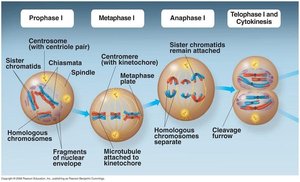
Prophase I: Chromosomes condense, homologous chromosomes pair (synapsis), and crossing over occurs.
Metaphase I: Tetrads align at the metaphase plate.
Anaphase I: Homologous chromosomes separate to opposite poles.
Telophase I and Cytokinesis: Two haploid cells form, each with duplicated chromosomes.
Meiosis II: Equational Division
Meiosis II separates sister chromatids, producing four haploid cells.
Prophase II: Spindle apparatus forms; chromosomes move toward the metaphase plate.
Metaphase II: Chromosomes align at the metaphase plate.
Anaphase II: Sister chromatids separate and move to opposite poles.
Telophase II and Cytokinesis: Nuclei form, chromosomes decondense, and four genetically distinct haploid cells result.
Comparison: Mitosis vs. Meiosis
Key Differences
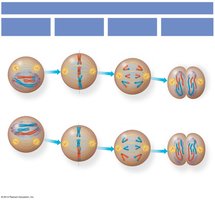
Mitosis and meiosis differ in their outcomes and roles in the life cycle.
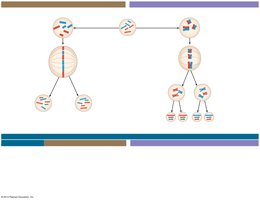
Property | Mitosis | Meiosis |
|---|---|---|
DNA replication | Occurs during interphase before mitosis | Occurs during interphase before meiosis I |
Number of divisions | One | Two |
Synapsis of homologous chromosomes | Does not occur | Occurs during prophase I (crossing over) |
Number of daughter cells and genetic composition | Two, diploid, genetically identical | Four, haploid, genetically distinct |
Role in animal body | Growth, repair, asexual reproduction | Production of gametes, genetic diversity |
Unique Events in Meiosis
Three Key Events
Synapsis and crossing over (Prophase I): Homologous chromosomes physically connect and exchange genetic material.
Homologous pairs at metaphase plate (Metaphase I): Homologous pairs, not individual chromosomes, align at the metaphase plate.
Separation of homologs (Anaphase I): Homologous chromosomes, not sister chromatids, separate.
Genetic Variation in Sexual Life Cycles
Sources of Genetic Diversity
Sexual reproduction generates genetic variation through three main mechanisms:
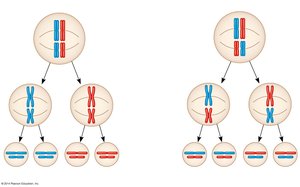
Independent assortment of chromosomes: Random orientation of homologous pairs during metaphase I leads to many possible combinations of maternal and paternal chromosomes in gametes.
Crossing over: Exchange of genetic material between nonsister chromatids during prophase I creates recombinant chromosomes.
Random fertilization: Any sperm can fuse with any egg, further increasing genetic variation.
Mathematical Basis of Variation
The number of possible chromosome combinations due to independent assortment is , where n is the haploid number. For humans (n = 23):
possible combinations per gamete.
Random fertilization (combining two gametes) yields about 70 trillion possible diploid combinations.
Role of Mutation
Mutations are changes in DNA sequence and are the original source of new alleles, contributing to genetic diversity and evolution.
Summary
Meiosis and fertilization alternate in sexual life cycles, maintaining chromosome number across generations.
Meiosis produces haploid gametes and introduces genetic variation through independent assortment, crossing over, and random fertilization.
Genetic variation is essential for evolution and adaptation in populations.
