 Back
BackMeiosis and Sexual Life Cycles: Structured Study Notes
Study Guide - Smart Notes
 Tailored notes based on your materials, expanded with key definitions, examples, and context.
Meiosis and Sexual Life Cycles
Genes, Alleles, and Chromosomes
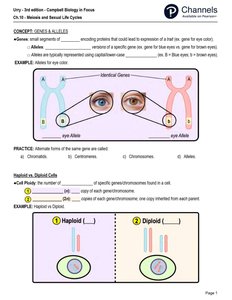
The foundation of heredity lies in the transmission of genes, which are segments of DNA encoding traits. Alleles are different versions of a gene, and their combination determines the phenotype of an organism. Chromosomes carry these genes, and each organism inherits chromosomes from both parents.
Gene: A segment of DNA that codes for a specific trait.
Allele: Alternative forms of a gene (e.g., eye color).
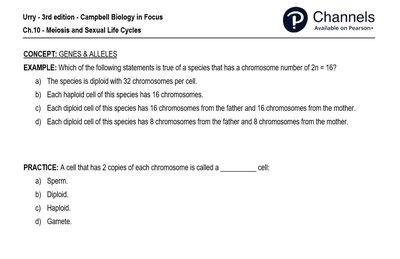
Diploid (2n): Cells with two sets of chromosomes, one from each parent.
Haploid (n): Cells with one set of chromosomes, typical of gametes.
Example: Eye color alleles on homologous chromosomes.
Homologous Chromosomes and Karyotypes
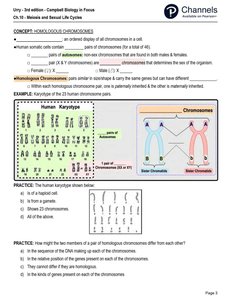
Homologous chromosomes are pairs that carry the same genes but may have different alleles. Human somatic cells contain 23 pairs of chromosomes, including autosomes and sex chromosomes. Karyotyping is the process of arranging chromosomes to study their number and structure.
Homologous Chromosomes: Chromosome pairs with the same gene loci.
Karyotype: Ordered display of chromosomes from a cell.
Example: Human karyotype showing 23 pairs.
Life Cycle of Sexual Reproducers
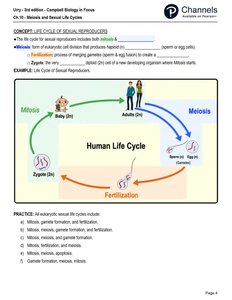
Sexual reproduction involves the alternation between haploid and diploid stages. Fertilization restores diploidy, while meiosis reduces chromosome number to haploid. The human life cycle illustrates these transitions.
Meiosis: Produces haploid gametes (sperm or egg).
Fertilization: Fusion of gametes restores diploid state.
Mitosis: Growth and development of diploid organisms.
Example: Human life cycle diagram.
Introduction to Meiosis
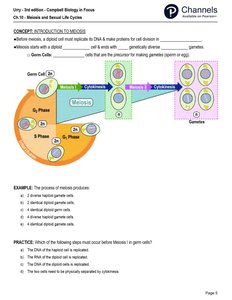
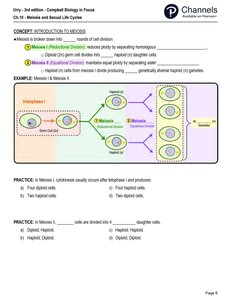
Meiosis is a specialized cell division process that produces gametes with half the chromosome number of the parent cell. It consists of two consecutive divisions: Meiosis I and Meiosis II.
Meiosis I: Homologous chromosomes separate.
Meiosis II: Sister chromatids separate.
Result: Four genetically unique haploid cells.
Example: Diagram of meiosis stages.
Meiosis I: Key Events
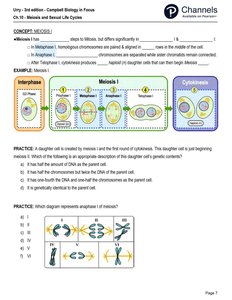
Meiosis I differs from mitosis in that homologous chromosomes pair and exchange genetic material through crossing over. This increases genetic diversity among offspring.
Prophase I: Homologous chromosomes pair and crossing over occurs.
Metaphase I: Paired homologs align at the metaphase plate.
Anaphase I: Homologs separate to opposite poles.
Telophase I & Cytokinesis: Two haploid cells form.
Example: Diagram of Meiosis I stages.
Meiosis II: Key Events
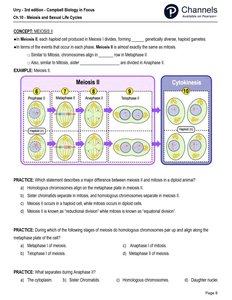
Meiosis II resembles mitosis, where sister chromatids are separated, resulting in four haploid cells. Each cell is genetically distinct due to prior crossing over and independent assortment.
Prophase II: Chromosomes condense in each haploid cell.
Metaphase II: Chromosomes align at the metaphase plate.
Anaphase II: Sister chromatids separate.
Telophase II & Cytokinesis: Four haploid gametes are produced.
Example: Diagram of Meiosis II stages.
Mitosis vs. Meiosis: Comparison
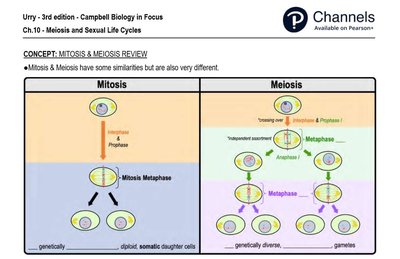
Mitosis and meiosis are both forms of cell division, but they serve different purposes and produce different outcomes. Mitosis results in genetically identical diploid cells, while meiosis produces genetically diverse haploid gametes.
Mitosis: One division, produces two diploid cells.
Meiosis: Two divisions, produces four haploid cells.
Genetic Diversity: Meiosis introduces variation via crossing over and independent assortment.
Example: Side-by-side diagram of mitosis and meiosis.
Genetic Variation During Meiosis
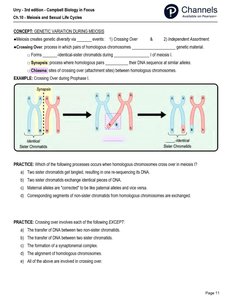
Meiosis increases genetic variation through two main mechanisms: crossing over and independent assortment. These processes ensure that each gamete is genetically unique.
Crossing Over: Exchange of genetic material between homologous chromosomes during Prophase I.
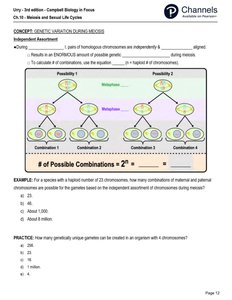
Independent Assortment: Random alignment of chromosome pairs during Metaphase I.
Example: Diagram of crossing over and independent assortment.
Mathematical Basis of Genetic Variation
The number of possible chromosome combinations due to independent assortment is given by , where n is the haploid number of chromosomes. This formula illustrates the vast potential for genetic diversity.
Formula: possible combinations.
Example: For n = 23 (humans), ≈ 8 million combinations.
Nondisjunction and Chromosome Abnormalities
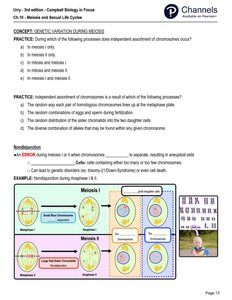
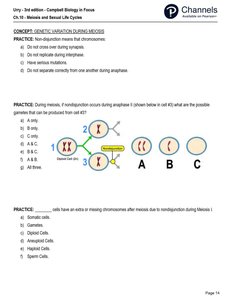
Nondisjunction occurs when chromosomes fail to separate properly during meiosis, resulting in gametes with abnormal chromosome numbers. This can lead to genetic disorders such as Down syndrome.
Nondisjunction: Failure of homologous chromosomes or sister chromatids to separate.
Result: Gametes with extra or missing chromosomes.
Example: Diagram showing nondisjunction in meiosis.
Summary Table: Mitosis vs. Meiosis
This table summarizes the key differences between mitosis and meiosis, including the number of divisions, chromosome number, and genetic diversity.
Feature | Mitosis | Meiosis |
|---|---|---|
Number of Divisions | 1 | 2 |
Number of Daughter Cells | 2 | 4 |
Chromosome Number | Diploid | Haploid |
Genetic Diversity | Identical | Diverse |
Function | Growth, repair | Gamete production |
Practice Questions and Applications
Understanding meiosis and its role in heredity is essential for explaining genetic variation and inheritance patterns. Practice questions reinforce key concepts and applications in biology.
Example: Which process results in daughter cells with half the chromosome number of the parent cell?
Application: Predicting genetic outcomes in offspring.
 Additional info: These notes expand on brief points with academic context, definitions, and examples to ensure completeness and clarity for college-level biology students.
