 Back
Meiosis and Sexual Life Cycles: Study Notes for General Biology
Study Guide - Smart Notes
 Tailored notes based on your materials, expanded with key definitions, examples, and context.
Meiosis and Sexual Life Cycles
Concept 13.1: Offspring Acquire Genes from Parents by Inheriting Chromosomes
Inheritance is the process by which offspring receive genetic material from their parents. Genes, the units of heredity, are segments of DNA located at specific positions (loci) on chromosomes. These genes are passed to the next generation via gametes (sperm and egg cells).
Gene: A segment of DNA that codes for a specific trait.
Locus: The physical location of a gene on a chromosome.
Gametes: Reproductive cells (sperm and egg) that carry genetic information to offspring.
Chromosomes: Structures made of DNA and proteins that contain genes.
Comparison of Asexual and Sexual Reproduction
Organisms reproduce either asexually or sexually, each method affecting genetic diversity differently.
Asexual Reproduction: Involves a single parent and produces genetically identical offspring (clones). No fusion of gametes occurs.
Sexual Reproduction: Involves two parents and produces genetically unique offspring. Gametes are required and are produced via meiosis.
Clones: Offspring that are exact genetic copies of the parent.
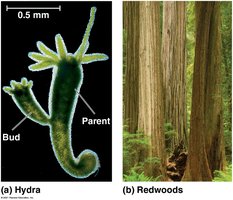
Concept 13.2: Fertilization and Meiosis Alternate in Sexual Life Cycles
Sexual life cycles involve the alternation of fertilization and meiosis, ensuring genetic diversity and the maintenance of chromosome number across generations.
Somatic Cells: All body cells except gametes; humans have 23 pairs (46 total).
Karyotype: An ordered display of the pairs of chromosomes in a cell.
Homologous Chromosomes (Homologs): Chromosome pairs with the same length, shape, and genes (but possibly different alleles).
Sex Chromosomes: X and Y chromosomes determine biological sex (XX = female, XY = male).
Autosomes: The remaining 22 pairs of chromosomes not involved in sex determination.
Diploid and Haploid Cells
Diploid (2n): Cells with two sets of chromosomes (one from each parent); in humans, 2n = 46.
Haploid (n): Gametes with a single set of chromosomes; in humans, n = 23.
Zygote: The fertilized egg, which is diploid and develops into an adult via mitosis.
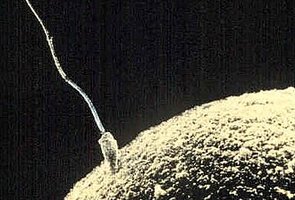
The Variety of Sexual Life Cycles
There are three main types of sexual life cycles, differing in the timing of meiosis and fertilization:
Animal Life Cycle: Meiosis produces gametes directly.
Plant Life Cycle: Alternation of generations; diploid sporophyte produces haploid spores, which grow into haploid gametophytes.
Fungal Life Cycle: No multicellular diploid stage; haploid cells fuse to form a diploid zygote, which undergoes meiosis.
Concept 13.3: Meiosis Reduces the Number of Chromosome Sets from Diploid to Haploid
Meiosis is a specialized type of cell division that reduces the chromosome number by half, producing four haploid cells from one diploid cell. It consists of two consecutive divisions: Meiosis I and Meiosis II.
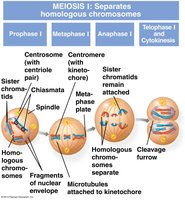
Meiosis I: Homologous chromosomes pair up and separate, reducing chromosome number.
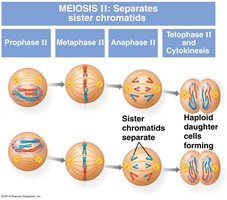
Meiosis II: Sister chromatids separate, similar to mitosis.
Result: Four unique haploid daughter cells.
Three Events Unique to Meiosis
Prophase I: Synapsis and crossing over occur; homologous chromosomes pair and exchange genetic material.
Metaphase I: Homologous chromosomes align as tetrads at the metaphase plate.
Anaphase I: Homologous chromosomes separate.
Meiosis II
Prophase II: Chromosomes condense, spindle forms.
Metaphase II: Sister chromatids align at the metaphase plate.
Anaphase II: Sister chromatids separate.
Telophase II and Cytokinesis: Nuclei reform, chromosomes decondense, cytoplasm divides.
A Comparison of Mitosis and Meiosis
Mitosis and meiosis are both forms of cell division, but they serve different purposes and produce different outcomes.
Mitosis: Conserves chromosome number, produces genetically identical diploid cells.
Meiosis: Reduces chromosome number, produces genetically unique haploid cells.
Process | Chromosome Number | Genetic Identity | Number of Cells Produced |
|---|---|---|---|
Mitosis | Diploid (2n) | Identical to parent | 2 |
Meiosis | Haploid (n) | Unique | 4 |
Concept 13.4: Genetic Variation Produced in Sexual Life Cycles Contributes to Evolution
Genetic variation is essential for evolution and is produced through mutations and the mechanisms of sexual reproduction.
Mutation: The original source of genetic diversity; creates new alleles.
Independent Assortment: Homologous chromosomes orient randomly during metaphase I, leading to many possible combinations.
Crossing Over: Homologous chromosomes exchange genetic material during prophase I, creating new allele combinations.
Random Fertilization: Any sperm can fuse with any egg, further increasing genetic diversity.
Possible Combinations
The number of possible chromosome combinations due to independent assortment is , where n is the haploid number. For humans, yields over 8 million combinations. Random fertilization multiplies this diversity, resulting in about 70 trillion possible diploid combinations.
The Evolutionary Significance of Genetic Variation
Natural Selection: Requires genetic variation to act upon.
Sexual Reproduction: Ensures genetic diversity within populations, which is crucial for adaptation and survival.
Example: Animals that reproduce exclusively asexually are rare, highlighting the evolutionary advantage of sexual reproduction.
