 Back
Meiosis and Sexual Life Cycles: Study Notes for General Biology
Study Guide - Smart Notes
 Tailored notes based on your materials, expanded with key definitions, examples, and context.
Meiosis and Sexual Life Cycles
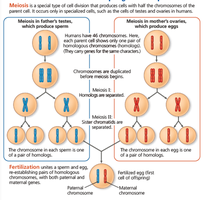
Overview of Meiosis
Meiosis is a specialized type of cell division that reduces the chromosome number by half, producing four genetically distinct gametes. This process is fundamental to sexual reproduction and ensures genetic diversity among offspring.
Occurs in germ cells: Testes in males and ovaries in females.
Chromosome reduction: Diploid (2n) cells become haploid (n) gametes.
Result: Four non-identical haploid cells (gametes).
Genetic variation: Arises through crossing over and independent assortment.
Homologous Chromosomes
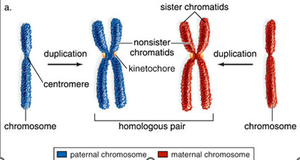
Homologous chromosomes are pairs found in diploid cells, each consisting of one chromosome from each parent. They have the same length, centromere position, and staining pattern, but may carry different alleles.
Somatic cells: Contain homologous pairs (2n).
Identical gene order: Genes are arranged in the same sequence.
Alleles: Variations of genes may differ between homologs.
Chromosome Sets and Karyotype
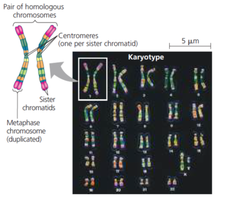
Human cells are diploid with 46 chromosomes. A karyotype is an ordered display of these chromosomes, used to identify chromosomal abnormalities and study inheritance.
Diploid number: 2n = 46 in humans.
Karyotype: Visual representation of homologous pairs.
Chromosome features: Length, centromere position, staining properties.
Alternation of Meiosis and Fertilization
Meiosis and fertilization alternate in sexual life cycles. Meiosis produces haploid gametes, which fuse during fertilization to restore the diploid state in the zygote.
Meiosis: Produces gametes with n chromosomes.
Fertilization: Fusion of male and female gametes forms a diploid zygote.
Mitosis: Zygote undergoes mitosis to become a multicellular diploid organism.
Stages of Meiosis
Meiosis consists of two sequential divisions: Meiosis I and Meiosis II. Each division has distinct phases that contribute to genetic diversity and chromosome reduction.
Meiosis I: Separates homologous chromosomes.
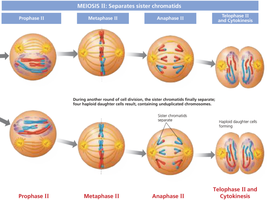
Meiosis II: Separates sister chromatids (similar to mitosis).
Result: Four genetically different haploid gametes.
Meiosis I: Prophase I
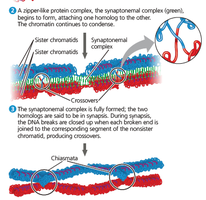
Prophase I is characterized by the pairing of homologous chromosomes (synapsis) and crossing over, which increases genetic variation.
Synapsis: Homologous chromosomes pair to form tetrads (bivalents).
Crossing over: Exchange of genetic material between non-sister chromatids at chiasmata.
Genetic diversity: Reshuffling of genes.
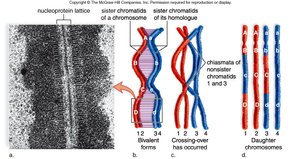
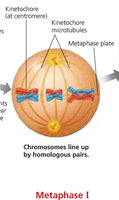
Meiosis I: Metaphase I
Homologous chromosomes align independently at the metaphase plate, leading to independent assortment.
Independent assortment: Each pair aligns independently, increasing genetic variation.
Metaphase plate: Chromosomes line up at the cell's equator.
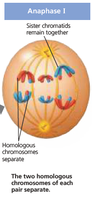
Meiosis I: Anaphase I
Homologous chromosomes are separated and move toward opposite poles, while sister chromatids remain together.
Separation: Homologous chromosomes move to opposite poles.
Sister chromatids: Remain attached; centromere does not divide.
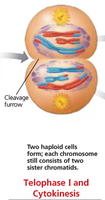
Meiosis I: Telophase I and Cytokinesis
Two haploid cells are formed, each containing duplicated chromosomes (two sister chromatids per chromosome).
Cleavage furrow: Plasma membrane pinches inward.
Cytokinesis: Division of cytoplasm.
Result: Two haploid cells.
Meiosis II: Separation of Sister Chromatids
Meiosis II is similar to mitosis, but occurs in haploid cells. Sister chromatids are separated, resulting in four haploid gametes.
Prophase II: Chromosomes condense.
Metaphase II: Chromosomes align at the metaphase plate.
Anaphase II: Sister chromatids separate.
Telophase II and Cytokinesis: Four haploid daughter cells form.
Genetic Variation in Meiosis
Meiosis increases genetic variation through three main mechanisms: crossing over, independent assortment, and random fertilization.
Crossing over: Occurs in Prophase I.
Independent assortment: Occurs in Metaphase I.
Random fertilization: Fusion of gametes from two parents.
Comparison of Mitosis and Meiosis
Mitosis and meiosis are both forms of cell division, but they differ in their outcomes and roles in the life cycle.
Feature | Mitosis | Meiosis |
|---|---|---|
Number of divisions | 1 | 2 |
Number of daughter cells | 2 | 4 |
Chromosome number | Diploid (2n) | Haploid (n) |
Genetic identity | Identical | Non-identical |
Function | Growth, repair | Sexual reproduction |
Specialized Gamete Formation
Spermatogenesis
Spermatogenesis is the process of forming spermatids, which are converted to sperm cells through spermiogenesis.
Oogenesis
Oogenesis is the formation of egg cells. Polar bodies are produced, and meiosis II is delayed until fertilization.
Key Concepts and Summary
Meiosis I: Separation of homologous chromosomes.
Meiosis II: Separation of sister chromatids.
Crossing over: Occurs in Prophase I.
Independent assortment: Occurs in Metaphase I.
Genetic variation: Crossing over, independent assortment, random fertilization.
Human chromosome number: 46 in somatic cells, 23 in gametes.
Synapsis and tetrads: Unique to meiosis.
One diploid cell (2n): Produces four non-identical haploid cells (n).
Additional info: Meiosis is essential for maintaining chromosome number across generations and for promoting genetic diversity, which is crucial for evolution and adaptation.
