 Back
BackMeiosis and Sexual Reproduction: Mechanisms, Genetic Variation, and Chromosomal Abnormalities
Study Guide - Smart Notes
 Tailored notes based on your materials, expanded with key definitions, examples, and context.
Meiosis and Sexual Reproduction
Introduction to Meiosis
Meiosis is a specialized type of cell division that reduces the chromosome number by half, producing haploid gametes (sperm and egg) from diploid parent cells. This process is essential for sexual reproduction and ensures genetic diversity among offspring.
Key Question: If mitosis produces identical copies, how do offspring end up different from their parents? The answer lies in meiosis and the mechanisms that generate genetic variation.
Purpose of Meiosis: Prevents chromosome number from doubling each generation and introduces genetic diversity.
The Problem and Solution: Chromosome Number Maintenance
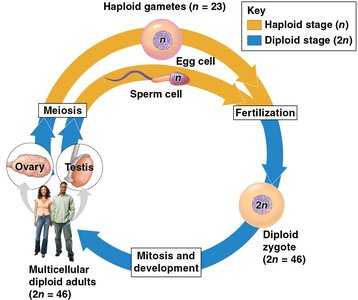
If gametes were produced by mitosis, chromosome numbers would double with each generation, leading to genetic instability. Meiosis solves this by halving the chromosome number in gametes, restoring the diploid state upon fertilization.
Diploid (2n): Two sets of chromosomes (e.g., human somatic cells have 46).
Haploid (n): One set of chromosomes (e.g., human gametes have 23).
Fertilization: Fusion of two haploid gametes restores the diploid number.
Key Vocabulary and Concepts
Essential Terms
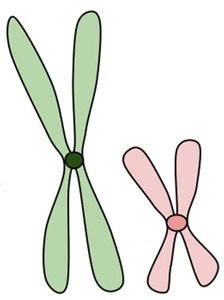
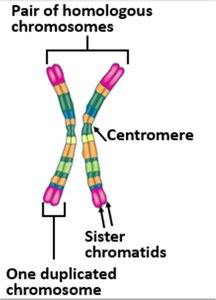
Homologous Chromosomes: Chromosome pairs (one from each parent) with the same genes but possibly different alleles.
Diploid (2n): Cell with two sets of chromosomes.
Haploid (n): Cell with one set of chromosomes.
Gamete: Sex cell (sperm or egg) produced by meiosis.
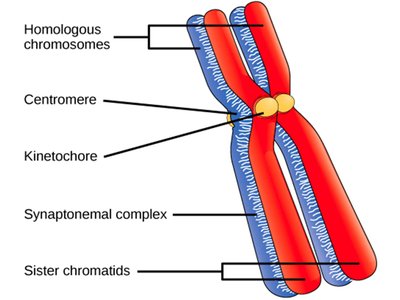
Synapsis: Pairing of homologous chromosomes during Prophase I.
Crossing Over (Recombination): Exchange of DNA segments between non-sister chromatids of homologous chromosomes, creating new allele combinations.
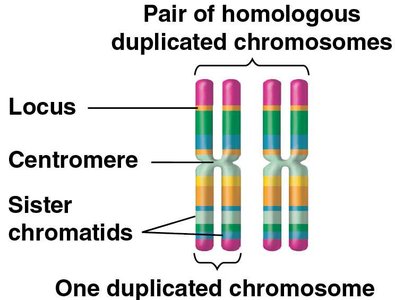
Sister Chromatids: Identical copies of a duplicated chromosome, joined at the centromere.
Locus (pl. Loci): Specific location of a gene on a chromosome.
Allele: Different versions of a gene at the same locus.
Phases of Meiosis
Overview of Meiosis I and II
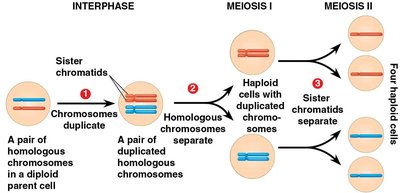
Meiosis consists of two sequential divisions: Meiosis I (reductive division) and Meiosis II (equational division). DNA replication occurs only before Meiosis I.
Meiosis I: Homologous chromosomes separate, reducing chromosome number by half.
Meiosis II: Sister chromatids separate, similar to mitosis, but starting from haploid cells.
Unique Events in Meiosis I
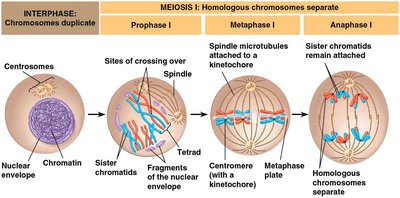
Prophase I: Homologous chromosomes pair (synapsis) and exchange genetic material (crossing over) at chiasmata, forming tetrads.
Metaphase I: Tetrads align randomly at the metaphase plate (independent assortment).
Anaphase I: Homologous chromosomes (not sister chromatids) are separated.
Telophase I: Two haploid cells are formed, each with duplicated chromosomes.
Meiosis II
Meiosis II resembles mitosis but occurs in haploid cells. Sister chromatids are separated, resulting in four genetically unique haploid cells.
Mechanisms of Genetic Variation
Sources of Genetic Diversity
Crossing Over: Occurs during Prophase I, producing recombinant chromosomes with new allele combinations.
Independent Assortment: Random orientation of homologous pairs during Metaphase I leads to many possible combinations of chromosomes in gametes. The number of possible combinations is , where is the haploid number.
Random Fertilization: Any sperm can fertilize any egg, further increasing genetic diversity.
Comparing Mitosis and Meiosis
Key Differences and Similarities
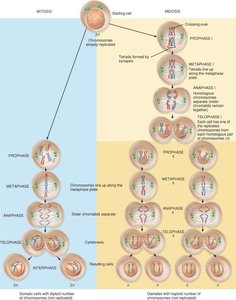
Feature | Mitosis | Meiosis |
|---|---|---|
Purpose | Growth, repair, asexual reproduction | Production of gametes for sexual reproduction |
Number of divisions | 1 | 2 (Meiosis I & II) |
Number of daughter cells | 2 | 4 |
Daughter cell ploidy | Diploid (2n) | Haploid (n) |
Genetic outcome | Genetically identical | Genetically unique |
Synapsis/crossing over | No | Yes (Prophase I) |
Homologs pair up? | No | Yes (Prophase I) |
Who undergoes it? | All dividing body cells | Cells in gonads (testes/ovaries) |
Chromosomal Abnormalities and Nondisjunction
Nondisjunction
Nondisjunction is the failure of homologous chromosomes (in Meiosis I) or sister chromatids (in Meiosis II) to separate properly. This results in gametes with abnormal numbers of chromosomes, leading to disorders such as Down syndrome (trisomy 21) or sex chromosome aneuploidies (e.g., Turner syndrome, Klinefelter syndrome).
Down Syndrome: Caused by an extra copy of chromosome 21 (trisomy 21).
Klinefelter Syndrome (XXY): Male with an extra X chromosome; sterile, some female characteristics.
Turner Syndrome (XO): Female with only one X chromosome; sterile, immature sex organs.
Alterations of Chromosome Structure
Deletion: Loss of a chromosome segment (e.g., Cri du chat syndrome).
Duplication: Repetition of a chromosome segment.
Inversion: Reversal of a chromosome segment.
Translocation: Segment moves to a nonhomologous chromosome (e.g., Philadelphia chromosome in leukemia).
Summary Table: Meiosis I vs. Meiosis II
Feature | Meiosis I | Meiosis II |
|---|---|---|
Division type | Reductive (2n → n) | Equational (n → n) |
What separates? | Homologous chromosomes | Sister chromatids |
Start / End | 1 diploid cell → 2 haploid cells | 2 haploid cells → 4 haploid cells |
Chromosome # change? | YES — halved | NO — stays haploid |
DNA replication before? | YES (S phase before Meiosis I) | NO (no S phase between) |
Crossing over? | YES — Prophase I | NO |
Similar to mitosis? | NO — unique to meiosis | YES — very similar |
Review and Application
Three sources of genetic variation: Crossing over, independent assortment, random fertilization.
Why are siblings (except identical twins) never genetically identical? Each gamete is genetically unique due to the above mechanisms.
What would happen if crossing over did not occur? Genetic variation would decrease, but independent assortment and random fertilization would still produce some variation.
What is the formula for the number of possible gamete combinations due to independent assortment? , where is the haploid number.
Gametogenesis
Gametogenesis is the process by which cells undergo meiosis to form gametes. In animals, this includes spermatogenesis (formation of sperm) and oogenesis (formation of eggs).
Conclusion
Meiosis is fundamental to sexual reproduction, ensuring genetic continuity and diversity. Errors in meiosis can lead to chromosomal abnormalities, which have significant biological and medical consequences. Understanding meiosis is essential for comprehending inheritance, evolution, and many genetic disorders.
