 Back
Meiosis and Sexual Reproduction: Study Notes for General Biology
Study Guide - Smart Notes
 Tailored notes based on your materials, expanded with key definitions, examples, and context.
Meiosis and Sexual Reproduction
Introduction to Heredity
Heredity is the process by which traits are passed from one generation to the next through reproduction. This process is fundamental to the continuity of life and is governed by genetic principles.
Trait: A genetically determined characteristic coded for by genes.
Gene: The basic unit of heredity, consisting of a segment of DNA.
Locus: The specific location of a gene on a chromosome.
Asexual vs. Sexual Reproduction
Organisms can reproduce either asexually or sexually, with significant differences in genetic outcomes.
Asexual reproduction: A single individual produces offspring that are genetically identical to itself (clones).
Sexual reproduction: Two parents contribute genetic material, resulting in offspring with unique combinations of genes.
Chromosome Number and Ploidy
Sexually reproducing organisms alternate between diploid and haploid states to maintain chromosome number across generations.
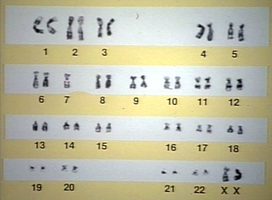
Diploid (2n): Cells with two sets of chromosomes, one from each parent.
Haploid (n): Cells with a single set of chromosomes, such as gametes (sperm and egg).
Gametes and Fertilization
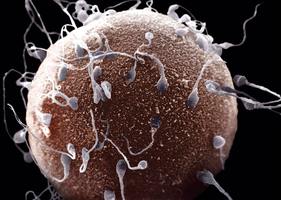
Gametes are specialized haploid cells that fuse during fertilization to restore the diploid state in the zygote.
Gamete: A haploid reproductive cell (sperm or egg).
Fertilization: The fusion of two gametes to form a diploid zygote.
Sexual Life Cycles
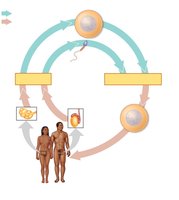
Sexual life cycles vary among organisms but always involve alternation between haploid and diploid stages.
Animals: The diploid stage is dominant; gametes are the only haploid cells.
Plants and some algae: Exhibit alternation of generations, with both multicellular diploid (sporophyte) and haploid (gametophyte) stages.
Fungi and some protists: The haploid stage is dominant; only the zygote is diploid.
Overview of Meiosis
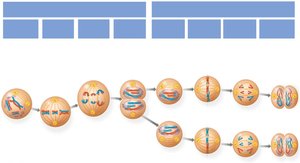
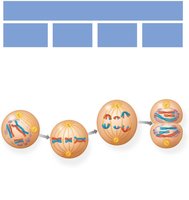
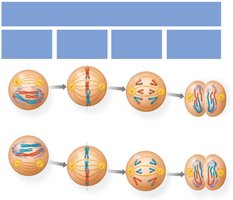
Meiosis is a specialized type of cell division that reduces the chromosome number by half, producing four genetically distinct haploid cells from one diploid cell. It consists of two sequential divisions: Meiosis I and Meiosis II.
Meiosis I: Homologous chromosomes separate, reducing the chromosome number by half.
Meiosis II: Sister chromatids separate, similar to mitosis.
Phases of Meiosis
Each meiotic division consists of four phases: Prophase, Metaphase, Anaphase, and Telophase, followed by cytokinesis.
Prophase I: Homologous chromosomes pair and exchange genetic material (crossing over).
Metaphase I: Homologous pairs align at the metaphase plate.
Anaphase I: Homologous chromosomes separate to opposite poles.
Telophase I and Cytokinesis: Two haploid cells form; chromosomes are still duplicated.
Meiosis II: Similar to mitosis; sister chromatids separate, resulting in four haploid cells.
Unique Events in Meiosis
Meiosis includes several events not found in mitosis, contributing to genetic diversity.
Crossing over: Exchange of genetic material between homologous chromosomes during Prophase I.
Independent assortment: Random orientation of homologous pairs during Metaphase I.
Reduction division: Chromosome number is halved during Meiosis I.
Genetic Variation in Sexual Reproduction
Sexual reproduction generates genetic diversity through three main mechanisms:
Independent assortment of chromosomes during meiosis.
Crossing over between homologous chromosomes.
Random fertilization of gametes.
Comparison of Mitosis and Meiosis
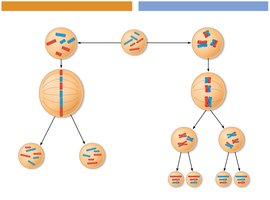
Feature | Mitosis | Meiosis |
|---|---|---|
Number of divisions | 1 | 2 |
Number of daughter cells | 2 | 4 |
Chromosome number in daughter cells | Diploid (2n) | Haploid (n) |
Genetic identity | Identical to parent | Genetically unique |
Role | Growth, repair, asexual reproduction | Sexual reproduction |
Fungal Life Cycle Example: Sordaria fimicola
The fungus Sordaria fimicola demonstrates a life cycle with both haploid and diploid stages, typical of many fungi.
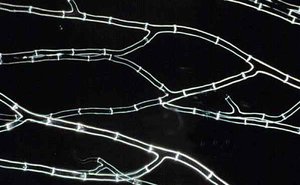
Hyphae/mycelium (n): Haploid structures that undergo mating to form a diploid zygote.
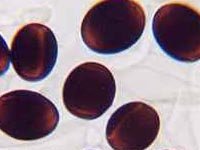
Ascospore (n): Haploid spores produced after meiosis in the ascus.
Perithecium: Fruiting body containing asci (sacs) where meiosis and spore formation occur.
Additional info: The alternation of generations and the mechanisms of genetic variation are central to understanding evolution and inheritance in eukaryotes.
