 Back
Meiosis and the Heritability of Traits: Chromosome Structure, Ploidy, and Genetic Variation
Study Guide - Smart Notes
 Tailored notes based on your materials, expanded with key definitions, examples, and context.
Meiosis and the Heritability of Traits
Introduction to Heritability and Genetic Variation
Understanding how traits are inherited and how genetic variation arises is central to biology. This section explores the molecular basis of heritability, focusing on genes, alleles, and the processes that generate diversity in sexually reproducing organisms.
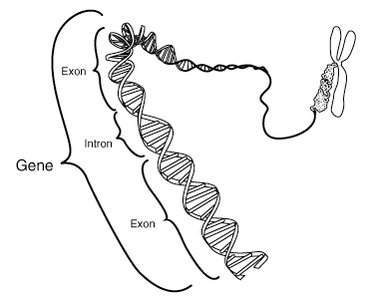
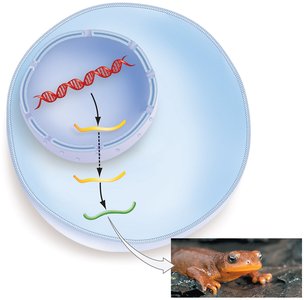
Genes: Sequences of DNA that code for one or more proteins, which determine organism-level traits (phenotypes).
Proteins: Molecules that perform cellular functions, resulting in observable traits.
Alleles: Different DNA sequences (variants) of the same gene, leading to different phenotypes within a species.
Mutations: Changes in DNA sequence that create new alleles, contributing to genetic diversity.
Chromosome Structure and Types
Chromosomes, Homologous Chromosomes, and Sister Chromatids
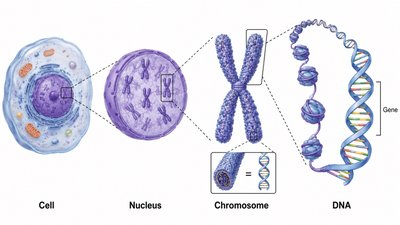
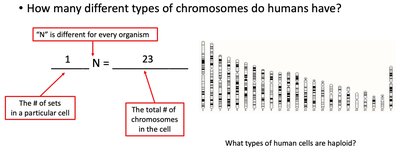
Chromosomes are the structures that organize and carry genetic information in cells. In eukaryotes, chromosomes are long double helices of DNA. Each species has a characteristic number of chromosomes, organized into sets.
Homologous Chromosomes (Homologs): Chromosomes of the same type, containing the same genes in the same order, but possibly different alleles.
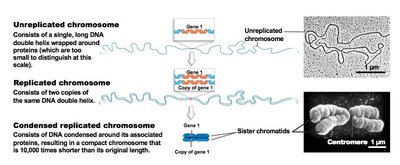
Sister Chromatids: Identical copies of a chromosome, produced during DNA replication and joined at the centromere.
Replicated vs. Unreplicated Chromosomes: Replicated chromosomes consist of two sister chromatids; unreplicated chromosomes have only one DNA molecule.
Ploidy: Haploid and Diploid Cells
Ploidy refers to the number of sets of chromosomes in a cell. Most animals and plants alternate between haploid and diploid stages in their life cycles.
Haploid (n): Cells with one set of chromosomes (e.g., gametes: sperm and egg).
Diploid (2n): Cells with two sets of chromosomes (e.g., somatic cells in animals and adult plants).
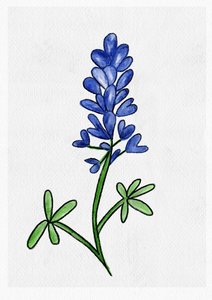
Different species have different numbers of chromosomes in a set (e.g., humans: n = 23, fruit flies: n = 4, Texas Bluebonnets: n = 24).
The Role of Meiosis in Sexual Life Cycles
Overview of Sexual Life Cycles
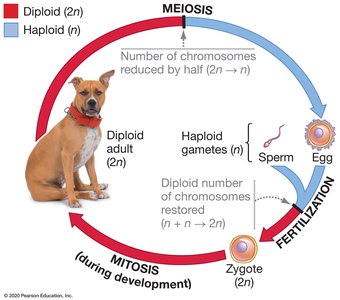
Sexual reproduction involves the alternation of meiosis and fertilization, ensuring genetic continuity and variation across generations.
Meiosis: Reduces chromosome number by half, producing haploid gametes from diploid cells.
Fertilization: Fusion of two haploid gametes restores the diploid state in the zygote.
Mitosis: Responsible for growth and development, maintaining chromosome number in somatic cells.
Major Events of Meiosis
Meiosis consists of two sequential divisions: Meiosis I and Meiosis II. These divisions ensure the reduction of chromosome number and the generation of genetic diversity.
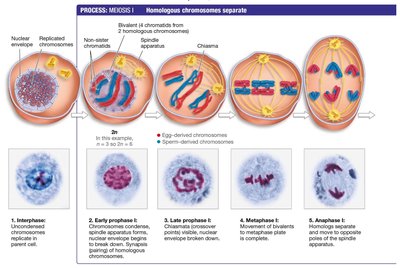
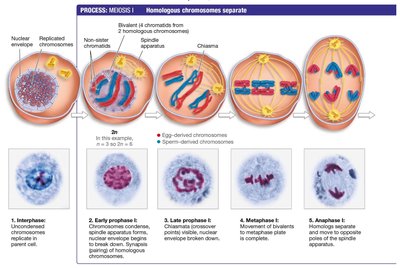
Meiosis I: Homologous chromosomes separate, reducing the chromosome number from diploid to haploid.
Meiosis II: Sister chromatids separate, similar to mitosis, resulting in four haploid cells.
Chromosome-Number Reduction During Meiosis
The reduction from diploid to haploid occurs during Meiosis I, specifically at Anaphase I, when homologous chromosomes are separated into different cells.
After Meiosis I: Cells are haploid but chromosomes are still replicated (sister chromatids).
After Meiosis II: Cells are haploid with unreplicated chromosomes.
Comparison of Meiosis and Mitosis
Meiosis and mitosis are both forms of cell division, but they have distinct processes and outcomes.
Meiosis I: Homologous chromosomes separate (unique to meiosis).
Meiosis II: Sister chromatids separate (similar to mitosis).
Mitosis: Produces two genetically identical diploid cells.
Meiosis: Produces four genetically unique haploid cells.
Genetic Variation: Mechanisms and Calculations
Independent Assortment
During Meiosis I, homologous pairs of chromosomes assort independently, leading to a variety of possible gamete combinations.
The number of possible combinations due to independent assortment is $2^n$, where n is the number of chromosome types in a set.
For humans (n = 23): $2^{23} = 8,388,608$ possible gamete combinations.
For Texas Bluebonnets (n = 24): $2^{24} = 16,777,216$ possible gamete combinations (without crossing over).
Crossing Over
During Prophase I of meiosis, homologous chromosomes exchange genetic material at chiasmata, a process called crossing over. This further increases genetic diversity among gametes.
Each meiosis event in humans involves 50-60 crossovers.
Crossing over results in new combinations of alleles on each chromosome.
Random Fertilization
Genetic variation is further increased by the random combination of gametes during fertilization. The total number of possible zygote genotypes is the product of the number of possible gametes from each parent.
For humans: $8,388,608 \times 8,388,608 = 70,368,744,177,664$ possible combinations (not including crossing over).
Evolutionary Significance of Sexual Reproduction
Sexual vs. Asexual Reproduction
Although asexual reproduction is faster and more efficient, sexual reproduction is favored in changing environments because it generates genetic diversity, which can be advantageous for survival.
Sexual reproduction is especially beneficial when facing new diseases, parasites, or environmental changes.
Many organisms can switch between sexual and asexual reproduction depending on environmental conditions.
The Red Queen Hypothesis
The Red Queen Hypothesis (Changing Environment Hypothesis) proposes that sexual reproduction is maintained in populations because it allows for rapid adaptation to evolving pathogens and parasites.
Experimental evidence shows that pathogens and parasites can maintain sexual reproduction in species capable of both sexual and asexual reproduction.
Summary Table: Key Differences Between Mitosis and Meiosis
Feature | Mitosis | Meiosis |
|---|---|---|
Number of Divisions | 1 | 2 |
Number of Daughter Cells | 2 | 4 |
Genetic Identity | Identical to parent | Genetically unique |
Chromosome Number | Diploid (2n) | Haploid (n) |
Role | Growth, repair | Gamete production |
Practice Problem Example
Example: Texas Bluebonnets have 24 different types of chromosomes. If two different bluebonnets are crossed, how many genetically different offspring can be produced (assuming no crossing over)?
Number of possible gametes per parent: $2^{24} = 16,777,216$
Number of possible offspring combinations: $16,777,216 \times 16,777,216 = 281,474,976,710,656$
Additional info: This calculation does not include the additional variation generated by crossing over.
