 Back
BackMeiosis and the Sexual Life Cycle
Study Guide - Smart Notes
 Tailored notes based on your materials, expanded with key definitions, examples, and context.
Meiosis and Mitosis
Overview of Cell Division
Cell division is fundamental to the continuity of life. Two main types of cell division are meiosis and mitosis, each serving distinct biological roles.
Meiosis: Specialized for the production of gametes (reproductive cells such as sperm and eggs). It reduces the chromosome number by half, resulting in haploid cells (n).
Mitosis: Responsible for growth, development, and repair by producing somatic cells. It generates genetically identical diploid cells (2n).
Key Differences:
Meiosis produces four non-identical haploid cells; mitosis produces two identical diploid cells.
Meiosis introduces genetic variation; mitosis maintains genetic consistency.
Themes of Heredity and Variation
Genetics, Heredity, and Variation
Offspring resemble their parents due to the transmission of genetic information. Heredity is the passing of traits from one generation to the next, while variation refers to differences among individuals. Genetics is the scientific study of heredity and variation.
Genes: Units of heredity composed of DNA segments, located on chromosomes.
Locus: The specific location of a gene on a chromosome.
Gametes: Reproductive cells (sperm and eggs) that carry genes to the next generation.
Children inherit genes, not traits directly, from their parents. Most DNA is organized into chromosomes, with humans having 46 chromosomes in somatic cells.
Modes of Reproduction
Asexual vs. Sexual Reproduction
Asexual reproduction: A single individual passes all its genes to offspring without gamete fusion, producing genetically identical clones.
Sexual reproduction: Two parents contribute genes, resulting in offspring with unique genetic combinations.
The life cycle is the sequence of stages in the reproductive history of an organism.
Chromosome Sets in Human Cells
Homologous Chromosomes and Karyotypes
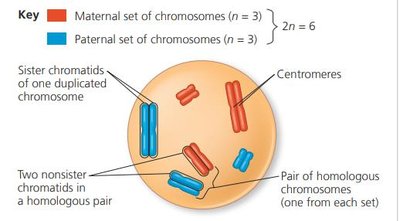
Human somatic cells contain 23 pairs of chromosomes, forming a karyotype (an ordered display of chromosomes). Each pair consists of homologous chromosomes—one maternal and one paternal—that are similar in length, shape, and gene content.
Sex chromosomes (X and Y): Determine biological sex; XX in females, XY in males.
Autosomes: The remaining 22 pairs of chromosomes.
Diploid number in humans:
Behaviour of Chromosome Sets in the Human Life Cycle
Fertilization and Development
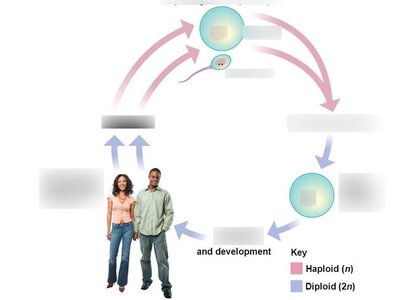
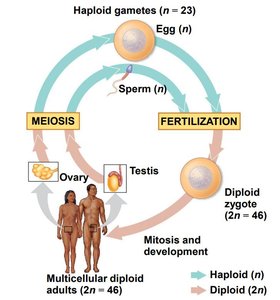
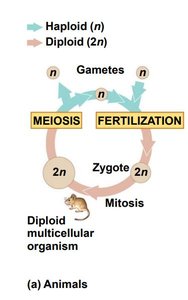
Fertilization is the union of haploid gametes (sperm and egg), forming a diploid zygote. The zygote undergoes mitosis to develop into a multicellular adult. This alternation between haploid and diploid stages is central to sexual life cycles.
Sexual Life Cycle in Humans and Animals
Gamete Formation and Chromosome Number Maintenance
At sexual maturity, the ovaries and testes produce haploid gametes via meiosis. Gametes are the only haploid cells in animals and do not divide further before fertilization. Fertilization restores the diploid state, and mitosis leads to the development of a multicellular organism.
Meiosis: Reduces chromosome number from diploid (2n) to haploid (n).
Fertilization: Restores diploid chromosome number.
Sexual Life Cycles in Plants, Algae, Fungi, and Protists
Alternation of Generations in Plants and Algae
Plants and some algae exhibit alternation of generations, with both diploid (sporophyte) and haploid (gametophyte) multicellular stages. The sporophyte produces haploid spores by meiosis, which grow into gametophytes. Gametophytes produce gametes by mitosis; fertilization forms a diploid sporophyte.
Life Cycle in Fungi and Some Protists
In fungi and some protists, the only diploid stage is the single-celled zygote. The zygote undergoes meiosis to produce haploid cells, which grow by mitosis into multicellular haploid organisms. These adults produce gametes by mitosis.
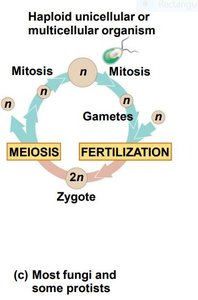
Summary Table: Comparison of Sexual Life Cycles
Group | Dominant Stage | Haploid/Diploid Multicellular Stage | Gamete Production |
|---|---|---|---|
Animals | Diploid | Diploid multicellular organism | Meiosis |
Plants & Algae | Both | Alternation of generations | Mitosis (in gametophyte) |
Fungi & Some Protists | Haploid | Haploid multicellular organism | Mitosis |
Additional info: The alternation of meiosis and fertilization ensures the maintenance of chromosome number across generations, while introducing genetic diversity through recombination and independent assortment during meiosis.
