 Back
Meiosis and the Sexual Life Cycle: Study Notes for General Biology
Study Guide - Smart Notes
 Tailored notes based on your materials, expanded with key definitions, examples, and context.
Meiosis and the Sexual Life Cycle
Introduction to Meiosis
Meiosis is a specialized type of cell division that occurs in sexually reproducing organisms, resulting in the formation of gametes (sperm and eggs). This process reduces the chromosome number by half, ensuring genetic diversity and stability across generations. The alternation of meiosis and fertilization is fundamental to the sexual life cycle.
Inheritance and Chromosomes
Concepts of Heredity and Variation
Inheritance, or heredity, is the transmission of traits from parents to offspring. While offspring inherit genes from their parents, they are not identical to either parent or their siblings, due to genetic variation. The study of heredity and variation is called genetics.
Genes: Units of heredity made up of DNA segments.
Chromosomes: Structures that package most DNA; humans have 46 chromosomes in somatic cells.
Locus: The specific position of a gene on a chromosome.
Asexual vs. Sexual Reproduction
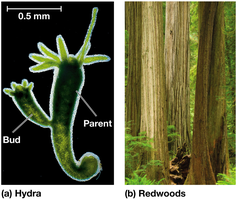
Asexual reproduction involves a single parent and produces genetically identical offspring (clones). Sexual reproduction involves two parents and results in offspring with unique gene combinations.
Asexual reproduction: No fusion of gametes; offspring are clones.
Sexual reproduction: Fusion of gametes; offspring have genetic variation.
Chromosome Sets and Types
Somatic Cells, Gametes, Autosomes, and Sex Chromosomes
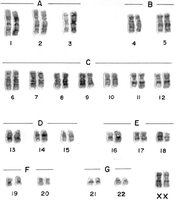
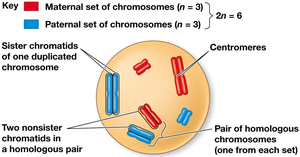
Human somatic cells contain 23 pairs of chromosomes, including autosomes and sex chromosomes. Autosomes are non-sex chromosomes, while sex chromosomes (X and Y) determine an individual's sex.
Somatic cells: Diploid (2n = 46), contain two sets of chromosomes.
Gametes: Haploid (n = 23), contain one set of chromosomes.
Autosomes: 22 pairs in humans.
Sex chromosomes: XX (female), XY (male).
Chromosome Replication and Structure
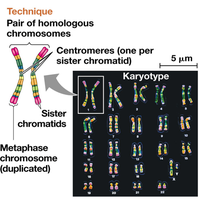
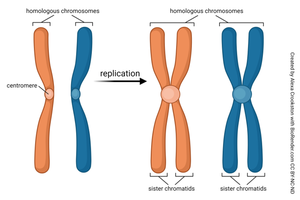
Each chromosome is replicated before cell division, resulting in two identical sister chromatids joined at the centromere. Homologous chromosomes are pairs, one from each parent, carrying genes for the same traits.
Homologous chromosomes: Same length, centromere position, and gene content.
Sister chromatids: Identical copies formed by DNA replication.
Sexual Life Cycles and Alternation of Meiosis and Fertilization
Human Life Cycle
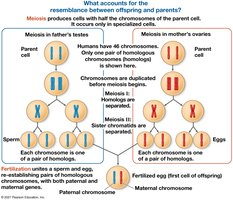
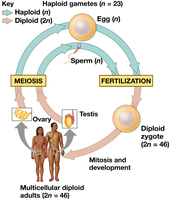
In humans, meiosis produces haploid gametes, which fuse during fertilization to form a diploid zygote. The zygote undergoes mitosis to develop into a multicellular adult.
Fertilization: Union of sperm and egg, forming a zygote (2n).
Meiosis: Produces gametes (n).
Mitosis: Produces somatic cells for growth and development.
Types of Sexual Life Cycles
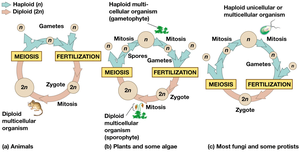
There are three main types of sexual life cycles in eukaryotes, differing in the timing of meiosis and fertilization:
Animals: Gametes are the only haploid cells; fertilization forms a diploid zygote.
Plants and some algae: Alternation of generations with both diploid (sporophyte) and haploid (gametophyte) multicellular stages.
Fungi and some protists: The zygote is the only diploid stage; most of the life cycle is haploid.
Meiosis: Process and Stages
Overview of Meiosis
Meiosis consists of two consecutive divisions: meiosis I and meiosis II. It results in four haploid daughter cells, each genetically distinct from the parent cell.
Meiosis I: Homologous chromosomes separate.
Meiosis II: Sister chromatids separate.
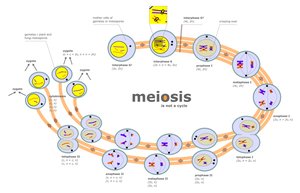
Stages of Meiosis
Each division of meiosis includes prophase, metaphase, anaphase, and telophase, followed by cytokinesis.
Prophase I: Homologous chromosomes pair and crossing over occurs (chiasmata).
Metaphase I: Homologous pairs align at the metaphase plate.
Anaphase I: Homologous chromosomes separate to opposite poles.
Telophase I and Cytokinesis: Two haploid cells form.
Meiosis II: Similar to mitosis; sister chromatids separate.
At the end of meiosis, four genetically distinct haploid cells are produced.
Crossing Over and Synapsis
During prophase I, homologous chromosomes undergo synapsis and crossing over, exchanging genetic material between nonsister chromatids. This process increases genetic variation.
Synaptonemal complex: Protein structure that holds homologs together.
Chiasmata: Sites of crossover.
Comparison of Mitosis and Meiosis
Key Differences
Mitosis produces two genetically identical diploid cells, while meiosis produces four genetically distinct haploid cells. Three events are unique to meiosis:
Synapsis and crossing over in prophase I
Alignment of homologous pairs at the metaphase plate
Separation of homologs during anaphase I
Genetic Variation in Sexual Life Cycles
Mechanisms of Genetic Variation
Sexual reproduction generates genetic variation through several mechanisms:
Independent assortment: Homologous chromosomes orient randomly during metaphase I, creating many possible combinations.
Crossing over: Produces recombinant chromosomes with DNA from both parents.
Random fertilization: Any sperm can fuse with any egg, resulting in a unique zygote.
For humans, independent assortment alone produces over 8 million possible gamete combinations. Combined with crossing over and random fertilization, the genetic diversity is immense.
Summary Table: Comparison of Mitosis and Meiosis
Feature | Mitosis | Meiosis |
|---|---|---|
Number of divisions | 1 | 2 |
Number of daughter cells | 2 | 4 |
Chromosome number | Diploid (2n) | Haploid (n) |
Genetic identity | Identical to parent | Genetically distinct |
Role | Growth, repair | Gamete production |
Key Terms and Definitions
Meiosis: Cell division that reduces chromosome number by half.
Gamete: Reproductive cell (sperm or egg).
Zygote: Fertilized egg cell.
Diploid (2n): Two sets of chromosomes.
Haploid (n): One set of chromosomes.
Homologous chromosomes: Chromosome pairs with the same genes.
Crossing over: Exchange of genetic material between homologous chromosomes.
Independent assortment: Random orientation of chromosome pairs during meiosis.
Equations and Formulas
The number of possible chromosome combinations due to independent assortment is:
Where n is the haploid number. For humans, , so possible combinations.
Random fertilization further increases genetic variation:
For humans, this results in about 70 trillion possible diploid combinations.
Additional info: These notes expand on the original content by providing definitions, examples, and equations for clarity and completeness.
