 Back
Meiosis, Chromosomes, and Genetic Variation: Laboratory Supplement Study Notes
Study Guide - Smart Notes
 Tailored notes based on your materials, expanded with key definitions, examples, and context.
Introduction to Meiosis and Chromosomal Variation
Meiosis is a specialized type of cell division that reduces the chromosome number by half, producing genetically unique gametes. This process is fundamental to sexual reproduction and is a major source of genetic diversity among offspring. Understanding meiosis helps explain why siblings differ and how genetic variation arises in populations.
Chromosomes
Definition and Structure
Chromosomes are long, thread-like structures composed of DNA and proteins, carrying genetic information. Each species has a characteristic number of chromosomes in its cells. Chromosomes exist in pairs in diploid organisms, with one set inherited from each parent.
Diploid (2n): Cells with two sets of chromosomes (one from each parent).
Haploid (n): Cells with one set of chromosomes (e.g., gametes).
Example: Humans have 46 chromosomes (23 pairs), while fruit flies have 8 (4 pairs).
Species | Number of Chromosomes |
|---|---|
Dog | 78 |
Cat | 38 |
Fruit fly | 8 |
Onion | 16 |
Human | 46 |
Frog | 26 |
Corn | 20 |
Genes and Chromosomes
Genes are segments of DNA located on chromosomes. Each gene occupies a specific position, or locus, on a chromosome. While genes are not visible in standard karyotypes, their positions are mapped through genetic studies. Chromosomes are numbered and arranged by size and centromere position in karyotypes.
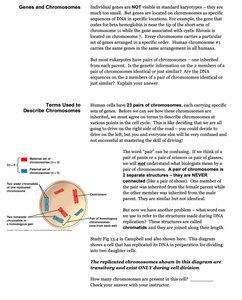
Terms Used to Describe Chromosomes
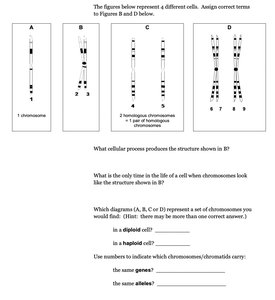
Homologous chromosomes: Chromosome pairs with the same genes but possibly different alleles.
Sister chromatids: Identical copies of a chromosome connected at the centromere after DNA replication.
Autosomes: Non-sex chromosomes.
Sex chromosomes: Chromosomes that determine sex (e.g., X and Y in humans).
Karyotypes
A karyotype is an ordered display of an individual's chromosomes, arranged by size and centromere position. Karyotypes are used to detect chromosomal abnormalities and to determine sex.
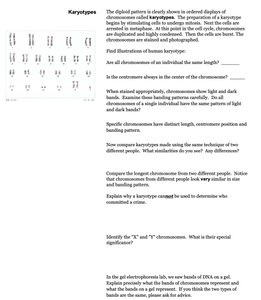
Chromosomes vary in length and centromere position.
Staining reveals characteristic banding patterns for identification.
Karyotypes can identify chromosomal disorders (e.g., Down syndrome, Turner syndrome).
Sexual Reproduction
Sexual reproduction involves the fusion of haploid gametes (egg and sperm) to form a diploid zygote. This process restores the diploid chromosome number and introduces genetic variation.
Gametes: Specialized haploid cells (egg or sperm).
Zygote: The diploid cell formed by fertilization.
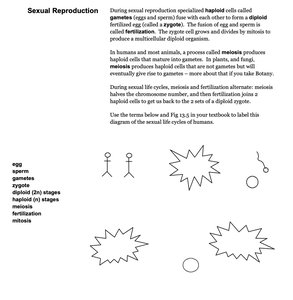
Gametes
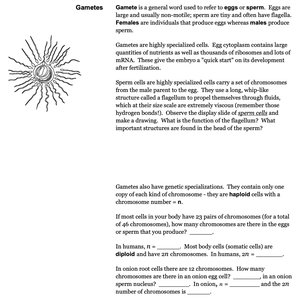
Gametes are highly specialized cells. Eggs are large and non-motile, containing nutrients for early development. Sperm are small, motile, and carry chromosomes to the egg. Each gamete contains one set of chromosomes (haploid, n).
Humans have 23 chromosomes in gametes.
Gametes are produced by meiosis in reproductive organs.
Fertilization
Fertilization is the fusion of gametes, restoring the diploid number and combining genetic material from two parents to form a unique zygote. Fertilization can be external (outside the body) or internal (inside the body).
External fertilization: Gametes fuse outside the body (common in aquatic animals).
Internal fertilization: Gametes fuse inside the body (common in terrestrial animals).
Meiosis
Meiosis is a two-part cell division process that produces four haploid cells from one diploid cell. Each daughter cell has half the chromosome number of the parent and is genetically unique.
Meiosis I: Homologous chromosomes separate, reducing chromosome number by half.
Meiosis II: Sister chromatids separate, similar to mitosis.
Key outcome: Meiosis creates four haploid daughter cells, each with a unique combination of genes.
Sexual Reproduction & Genetic Variation
Sexual reproduction increases genetic variation through three main mechanisms: independent assortment, crossing over, and random fertilization.
Independent Assortment
During meiosis I, homologous chromosomes are randomly distributed to daughter cells, resulting in new combinations of chromosomes. The number of possible combinations is given by:
where n is the haploid number of chromosomes.
Crossing Over
During prophase I of meiosis, homologous chromosomes exchange genetic material, creating new combinations of alleles. This process increases genetic diversity among gametes.
Random Fertilization
Any sperm can fertilize any egg, further increasing genetic variation. The combination of independent assortment, crossing over, and random fertilization results in a vast number of possible genetic outcomes.
Mutations
Mutations are changes in DNA sequence that can occur during DNA replication. Mutations in gametes can be passed to offspring, contributing to genetic diversity. Most mutations are neutral or harmful, but some can be beneficial and drive evolution.
Summary Table: Mechanisms of Genetic Variation
Mechanism | Description | Result |
|---|---|---|
Independent Assortment | Random distribution of homologous chromosomes during meiosis I | New combinations of chromosomes in gametes |
Crossing Over | Exchange of genetic material between homologous chromosomes | New combinations of alleles |
Random Fertilization | Any sperm can fertilize any egg | Unique genetic makeup of offspring |
Mutation | Change in DNA sequence | Potential new traits or genetic disorders |
Summary Questions
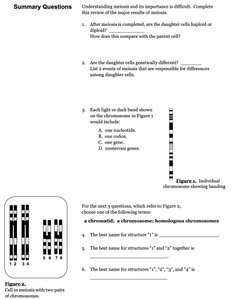
After meiosis is completed, are the daughter cells haploid or diploid? How does this compare with the parent cell?
Are the daughter cells genetically different? Explain why.
What are the main mechanisms responsible for genetic variation in sexually reproducing organisms?
Additional info: These notes integrate foundational concepts from chapters on meiosis, chromosomes, genetic variation, and sexual reproduction, as outlined in standard college biology curricula.
