 Back
Meiosis, Genetics, and DNA: Study Guide for BIOL 1201 Exam 3
Study Guide - Smart Notes
 Tailored notes based on your materials, expanded with key definitions, examples, and context.
Meiosis and Sexual Reproduction
Sexual vs. Asexual Reproduction
Reproduction is fundamental to biology, and organisms can reproduce sexually or asexually. Sexual reproduction involves the fusion of gametes, resulting in offspring with genetic variation, while asexual reproduction produces genetically identical clones.
Sexual Reproduction: Fusion of sperm and egg (gametes) forms a zygote; offspring inherit a unique combination of genes.
Asexual Reproduction: Single parent produces clones; variation arises only from mutations.
Example: Humans reproduce sexually; bacteria reproduce asexually by binary fission.
Chromosomes and the Human Genome
Chromosomes are structures that house genetic information. Humans have 46 chromosomes (23 pairs), including autosomes and sex chromosomes.
Homologous Chromosomes: Pairs with same length and gene loci, but may carry different alleles.
Karyotype: Visual display of chromosomes arranged by size.
Diploid (2n): Two sets of chromosomes; somatic cells.
Haploid (n): One set; gametes.
Autosomes: 22 pairs; Sex Chromosomes: 1 pair (XX or XY).
Life Cycles and Chromosome Number
Organisms maintain chromosome number through fertilization, meiosis, and mitosis. Life cycles differ among animals, plants, fungi, and protists.
Animal Life Cycle: Only gametes are haploid; fertilization restores diploid state.
Plant/Algae Life Cycle: Alternation of generations; both multicellular haploid (gametophyte) and diploid (sporophyte) stages.
Fungi/Protist Life Cycle: Multicellular haploid stage; diploid zygote undergoes meiosis.
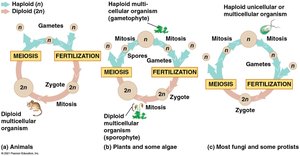
Meiosis Overview
Meiosis is a two-part cell division process that produces four genetically unique haploid cells. It consists of Meiosis I (separates homologs) and Meiosis II (separates sister chromatids).
Meiosis I: Homologous chromosomes separate.
Meiosis II: Sister chromatids separate.
Result: Four haploid cells.
Stages of Meiosis
Each stage of meiosis contributes to genetic variation and chromosome reduction.
Prophase I: Synapsis and crossing over occur.
Metaphase I: Homologous pairs align; independent assortment.
Anaphase I: Homologs separate; sister chromatids remain attached.
Telophase I & Cytokinesis: Two haploid cells form.
Meiosis II: Similar to mitosis; chromatids separate.
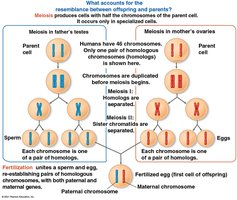
Genetic Variation in Meiosis
Meiosis generates genetic diversity through three mechanisms:
Independent Assortment: Random orientation of homologs during Metaphase I. Formula: possible combinations (n = haploid number).
Crossing Over: Exchange of genetic material between homologs in Prophase I.
Random Fertilization: Any sperm can fertilize any egg, multiplying possible combinations.
Comparing Mitosis vs. Meiosis
Mitosis and meiosis differ in purpose, division number, genetic outcome, and chromosome behavior.
Feature | Mitosis | Meiosis |
|---|---|---|
Purpose | Growth, repair, asexual reproduction | Gamete formation |
Divisions | One | Two |
Resulting Cells | Two diploid (2n) | Four haploid (n) |
Genetic Identity | Identical | Unique |
Chromosome Number | Conserved | Reduced by half |
Unique Events | No synapsis/crossing over | Synapsis, crossing over |
Homologs | Do not pair | Pair in Prophase I |
Genetics & Inheritance
Mendelian Genetics
Gregor Mendel's experiments with pea plants established the laws of inheritance. Traits are inherited as discrete units (genes), not blended.
Law of Segregation: Alleles separate during gamete formation.
Law of Independent Assortment: Alleles for different traits assort independently.
Alleles: Alternate versions of a gene.
Dominance: Dominant allele masks recessive allele.
Homozygous: Two identical alleles.
Heterozygous: Two different alleles.
Punnett Squares and Probability
Punnett squares visualize genetic crosses. Probability rules help predict inheritance outcomes.
Multiplication Rule: Probability of independent events occurring together.
Addition Rule: Probability of mutually exclusive events.
Pedigrees and Human Genetics
Pedigrees track inheritance of traits across generations. Symbols indicate affected, unaffected, and carrier individuals.
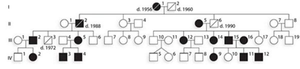
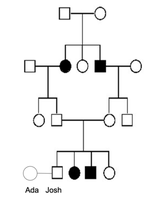
Genetic Disorders
Recessive Disorders: Two copies of recessive allele required (e.g., albinism).
Dominant Disorders: One copy of dominant allele required (e.g., Huntington's disease).
Multifactorial Disorders: Influenced by genetics and environment (e.g., heart disease).
Chromosomal Theory of Inheritance
Genes and Chromosomes
Genes are located on chromosomes. Chromosome movement during meiosis explains Mendel's laws.
Diploid organisms: Homologous pairs; alleles segregate during meiosis.
Thomas Hunt Morgan: Fruit fly experiments proved genes are on chromosomes.
Sex-Linked Inheritance
Traits linked to sex chromosomes show different inheritance patterns in males and females.
XY System: Males (XY), females (XX).
ZW System: Females (ZW), males (ZZ).
Haplo-diploid System: Females diploid, males haploid.
X-Linked Genes and Disorders
Hemizygous males: Express recessive X-linked traits (e.g., color blindness).
X-Chromosome Inactivation: One X in females is inactivated (Barr body).
Linked Genes and Genetic Mapping
Genes close together on a chromosome are inherited together (linkage). Recombination frequency is used to map gene distances.
Chromosomal Alterations
Nondisjunction: Failure to separate chromosomes; leads to aneuploidy.
Structural Changes: Deletion, duplication, inversion, translocation.
DNA as the Genetic Material
Discovery of DNA as Genetic Material
Experiments by Griffith, Avery-MacLeod-McCarty, and Hershey-Chase established DNA as the molecule of heredity.
DNA Structure
Double Helix: Two antiparallel strands; sugar-phosphate backbone; base pairs (A-T, G-C).
Chargaff's Rules: A=T, G=C.
Watson and Crick: Double helix model.
DNA Replication
DNA replication is semi-conservative, producing two molecules each with one old and one new strand. Replication involves several enzymes and occurs in the 5' to 3' direction.
Helicase: Unwinds DNA.
Single-strand binding proteins: Stabilize unwound DNA.
Topoisomerase: Relieves strain.
Primase: Synthesizes RNA primer.
DNA Polymerase III: Adds nucleotides.
DNA Polymerase I: Removes primer, fills gaps.
DNA Ligase: Seals fragments.
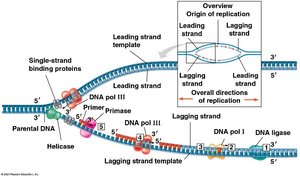
Leading vs. Lagging Strands
Leading Strand: Synthesized continuously.
Lagging Strand: Synthesized in Okazaki fragments.
DNA Damage and Mutations
Mutations: Changes in DNA sequence; source of genetic variation.
DNA Repair: Mechanisms fix errors (e.g., nucleotide excision repair).
Telomeres
Telomeres: Repetitive sequences at chromosome ends; protect genes.
Telomerase: Enzyme that lengthens telomeres.
DNA Packaging
Prokaryotes: Circular chromosome; supercoiled.
Eukaryotes: Linear DNA; wrapped around histones (nucleosomes).
Euchromatin: Loosely packed; active.
Heterochromatin: Tightly packed; inactive.
Gene Expression: Transcription and Translation
The Central Dogma
Genetic information flows from DNA to RNA to protein. Transcription copies DNA into mRNA; translation synthesizes protein from mRNA.
Transcription: DNA to mRNA.
Translation: mRNA to protein.
Transcription and Translation Overview
Template Strand: Used to synthesize mRNA.
Coding Strand: Sequence matches mRNA (except T replaced by U).
Triplet Code: mRNA read in codons (three bases).
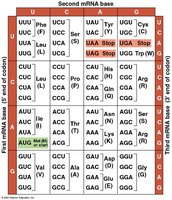
Stages of Transcription
Initiation: RNA polymerase binds promoter.
Elongation: RNA polymerase synthesizes RNA.
Termination: RNA polymerase releases RNA at terminator.
Eukaryotic RNA Processing
5' Cap: Modified guanine added.
Poly-A Tail: Adenine nucleotides added.
RNA Splicing: Introns removed, exons joined; alternative splicing allows multiple proteins from one gene.
Stages of Translation
Initiation: Ribosome binds mRNA; initiator tRNA finds start codon.
Elongation: Amino acids added; tRNA and ribosome facilitate codon recognition and peptide bond formation.
Termination: Stop codon reached; polypeptide released.
Post-Translational Modifications and Protein Targeting
Modifications: Glycosylation, methylation, etc.
Protein Targeting: Signal peptides direct proteins to specific cellular locations.
Mutations and Their Effects
Point Mutations: Single base changes; can be silent, missense, or nonsense.
Frameshift Mutations: Insertions/deletions alter reading frame.
Mutagens: Physical/chemical agents causing mutations.
Summary Table: Types of Mutations
Type | Effect | Example |
|---|---|---|
Silent | No change in amino acid | Redundancy in code |
Missense | Change in amino acid | Sickle cell anemia |
Nonsense | Premature stop codon | Truncated protein |
Frameshift | Altered reading frame | Disastrous protein |
