 Back
BackMeiosis: Mechanisms and Biological Significance
Study Guide - Smart Notes
 Tailored notes based on your materials, expanded with key definitions, examples, and context.
Meiosis
Introduction to Meiosis
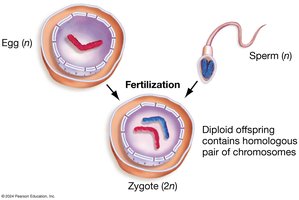
Meiosis is a specialized form of cell division that reduces the chromosome number by half, producing gametes—sperm and egg cells—in sexually reproducing organisms. This reduction is essential to maintain a stable chromosome number across generations. Fertilization restores the diploid chromosome number by uniting two haploid gametes.
Gametes: Reproductive cells (sperm and egg) with half the chromosome number of somatic cells.
Fertilization: The fusion of two gametes to form a diploid zygote.
Meiosis ensures genetic diversity and stability of chromosome number in offspring.
Chromosomes and Homologous Pairs
Chromosomes are threadlike structures composed of DNA and proteins. In sexually reproducing organisms, chromosomes exist in pairs called homologous chromosomes or homologs. Each homologous pair contains the same genes at the same loci, but may have different versions (alleles) of those genes.
Homologous chromosomes: Chromosomes of the same type, one inherited from each parent.
Gene: A segment of DNA that influences a trait.
Allele: Different versions of a specific gene.
Homologs may carry different alleles for the same gene.
The Concept of Ploidy
Ploidy refers to the number of sets of chromosomes in a cell. The haploid number (n) is the number of distinct types of chromosomes present. The ploidy (n, 2n, 3n, etc.) indicates the number of complete chromosome sets.
Diploid (2n): Two sets of chromosomes (e.g., humans: 2n = 46).
Haploid (n): One set of chromosomes (e.g., human gametes: n = 23).
Polyploid: Three or more sets of chromosomes (e.g., 3n, 4n).
Sex chromosomes count as a single type in the haploid number.
Overview of Meiosis
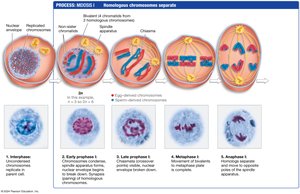
Meiosis consists of two sequential cell divisions: Meiosis I and Meiosis II. These divisions result in four haploid cells from one diploid parent cell. Each division has distinct phases, and no chromosome replication occurs between Meiosis I and II.
Meiosis I: Homologous chromosomes separate, reducing chromosome number by half.
Meiosis II: Sister chromatids separate, similar to mitosis.
Result: Four genetically unique haploid cells.
Phases of Meiosis I
Meiosis I is a continuous process with five distinct phases:
Early Prophase I: Chromosomes condense, homologs pair up, and crossing over begins.
Late Prophase I: Crossing over is completed, and spindle fibers attach to homologs.
Metaphase I: Homologous pairs align at the metaphase plate.
Anaphase I: Homologs separate and move to opposite poles.
Telophase I: Chromosomes reach poles, and the cell divides (cytokinesis).
Phases of Meiosis II
Meiosis II resembles mitosis and includes four phases:
Prophase II: Chromosomes condense, and spindle fibers form.
Metaphase II: Chromosomes align at the metaphase plate.
Anaphase II: Sister chromatids separate and move to opposite poles.
Telophase II: Chromatids reach poles, and cells divide, resulting in four haploid cells.
Mitosis Versus Meiosis
Mitosis and meiosis are both forms of cell division, but they have distinct outcomes and processes:
Mitosis: Produces two diploid daughter cells genetically identical to the parent cell; homologs do not pair.
Meiosis: Produces four haploid daughter cells genetically distinct from each other and the parent cell; homologs pair and separate, resulting in reduction division.
Genetic Variation: Independent Assortment and Crossing Over
Meiosis generates genetic diversity through two main mechanisms:
Independent Assortment: Random alignment and separation of homologous chromosomes during meiosis I leads to gametes with different combinations of maternal and paternal chromosomes.
Crossing Over: Exchange of genetic material between homologous chromosomes during prophase I creates new allele combinations within chromosomes.
Both mechanisms contribute to genetic recombination and diversity in offspring.
Errors in Meiosis: Nondisjunction
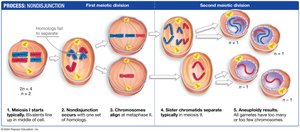
Errors during meiosis can result in abnormal chromosome numbers in gametes, a phenomenon known as nondisjunction. This occurs when homologs or sister chromatids fail to separate properly.
Nondisjunction: Failure of homologous chromosomes or sister chromatids to separate during meiosis.
Results in gametes with an extra chromosome (n + 1) or a missing chromosome (n - 1).
Can lead to disorders such as Down syndrome (trisomy 21).
Summary Table: Key Differences Between Mitosis and Meiosis
Feature | Mitosis | Meiosis |
|---|---|---|
Number of Divisions | One | Two |
Number of Daughter Cells | Two | Four |
Chromosome Number in Daughter Cells | Diploid (2n) | Haploid (n) |
Genetic Identity | Identical to parent | Genetically unique |
Role | Growth, repair, asexual reproduction | Sexual reproduction, genetic diversity |
Key Equations
Diploid chromosome number:
Haploid chromosome number:
Number of possible gamete combinations due to independent assortment: (where is the haploid number)
