 Back
Meiosis: Mechanisms, Genetic Variation, and Evolutionary Significance
Study Guide - Smart Notes
 Tailored notes based on your materials, expanded with key definitions, examples, and context.
Ch. 13 - Meiosis
Introduction to Meiosis and Sexual Reproduction
Meiosis is a specialized type of cell division that reduces the chromosome number by half, producing haploid gametes (sperm and egg) essential for sexual reproduction. This process is fundamental for genetic diversity and the continuation of species.
Sexual reproduction exists to promote genetic variation and adaptability.
Gametes are reproductive cells containing half the chromosome number of somatic cells.
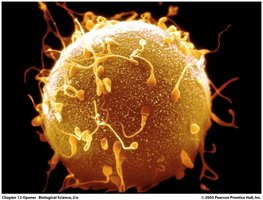
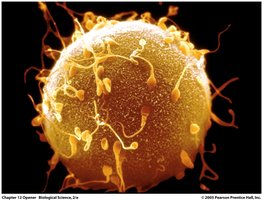
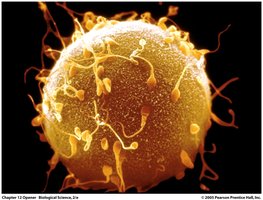
Two key processes: fertilization (union of sperm and egg) and meiosis (halving chromosome number).
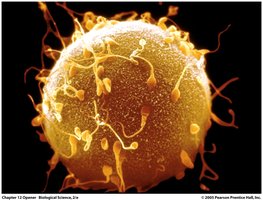
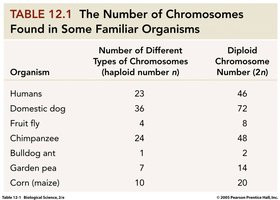
Variation and Chromosome Number
Each organism has a characteristic number of chromosomes, but chromosome number does not necessarily indicate complexity. Chromosomes exist in pairs in diploid organisms.
Diploid (2n): Two of each type of chromosome.
Haploid (n): One of each type of chromosome.
Organism | Haploid Number (n) | Diploid Number (2n) |
|---|---|---|
Humans | 23 | 46 |
Domestic dog | 36 | 72 |
Fruit fly | 4 | 8 |
Chimpanzee | 24 | 48 |
Bulldog ant | 1 | 2 |
Garden pea | 7 | 14 |
Corn (maize) | 10 | 20 |
Chromosome Types and Structure
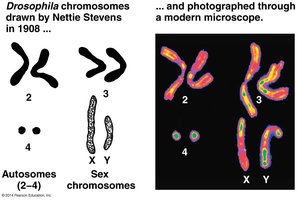
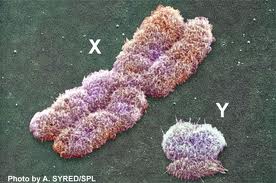
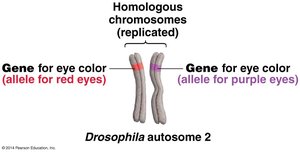
Chromosomes are classified as autosomes or sex chromosomes. Homologous chromosomes are pairs that have the same size, shape, and gene content, but may carry different alleles.
Homologous chromosomes: Same genes, possibly different alleles.
Sex chromosomes: Determine sex (XX = female, XY = male).
Autosomes: Non-sex chromosomes.
Genetic Content of Chromosomes
Genes are sections of DNA that influence hereditary traits. Alleles are different versions of a gene, contributing to genetic diversity.
Gene: DNA segment influencing a trait.
Allele: Variant form of a gene.
Karyotype and Ploidy
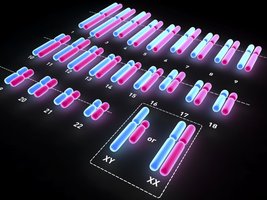
A karyotype is a display of an individual's chromosomes, arranged by size and type. Ploidy refers to the number of sets of chromosomes in a cell.
Diploid (2n): Two sets, one from each parent.
Haploid (n): One set.
Meiosis Overview
Meiosis consists of two consecutive divisions: Meiosis I and Meiosis II. Chromosomes are replicated before meiosis begins.
Meiosis I: Homologs separate.
Meiosis II: Sister chromatids separate.
Sexual Life Cycles
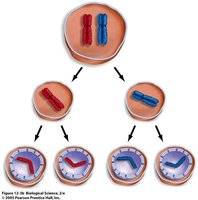
Sexual life cycles involve meiosis and fertilization, with three main types: diploid-dominant, haploid-dominant, and alternation of generations.
Diploid-dominant: Multicellular organism is diploid; gametes are haploid.
Haploid-dominant: Multicellular organism is haploid; zygote is diploid.
Alternation of generations: Both diploid and haploid multicellular stages.
Meiosis I: Steps and Significance
Meiosis I begins after chromosome replication. Key events include synapsis and crossing over, which promote genetic recombination.
Prophase I: Chromosomes condense; homologs pair (synapsis); crossing over occurs.
Metaphase I: Tetrads align on metaphase plate; independent assortment.
Anaphase I: Homologs separate.
Telophase I: Cell divides; two haploid cells result.
Meiosis II: Steps and Significance
Meiosis II separates sister chromatids, similar to mitosis, resulting in four haploid cells.
Interkinesis: Chromosomes relax between divisions.
Prophase II: Chromosomes condense.
Metaphase II: Chromosomes align.
Anaphase II: Chromatids separate.
Telophase II: Nuclear envelopes form; cytokinesis occurs.
Genetic Variation in Meiosis
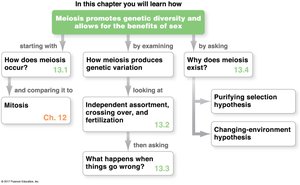
Meiosis promotes genetic variation through crossing over, independent assortment, and random fertilization.
Crossing over: Exchange of genetic material between homologs during Prophase I.
Independent assortment: Random alignment of homologs during Metaphase I.
Fertilization: Random fusion of gametes.
Consequences of Errors in Meiosis
Nondisjunction is the failure of homologs or chromatids to separate, leading to aneuploidy (abnormal chromosome number).
Trisomy (2n+1): Extra chromosome.
Monosomy (2n-1): Missing chromosome.
Common disorders: Down syndrome (trisomy 21), Klinefelter syndrome (XXY), Turner syndrome (XO).
Why Does Meiosis Exist?
Meiosis and sexual reproduction are energetically costly but provide significant evolutionary advantages.
Purifying Selection Hypothesis: Sexual reproduction helps eliminate deleterious alleles.
Changing Environment Hypothesis: Genetic variation increases adaptability to changing environments.
Comparison: Mitosis vs. Meiosis
Mitosis produces genetically identical cells for growth and repair, while meiosis produces genetically diverse gametes for reproduction.
Process | Purpose | Outcome |
|---|---|---|
Mitosis | Growth, repair | 2 identical diploid cells |
Meiosis | Sexual reproduction | 4 genetically unique haploid cells |
Additional info: The notes expand on the mechanisms and consequences of meiosis, including genetic variation and chromosomal disorders, to provide a comprehensive overview suitable for exam preparation.
