Back
BackMeiosis, Mitosis, and Chromosome Inheritance
Study Guide - Smart Notes
 Tailored notes based on your materials, expanded with key definitions, examples, and context.
Chromosome Number and Cell Types
Haploid (n) and Diploid (2n) Cells
Organisms maintain their chromosome number across generations through specialized cell types and processes. Understanding haploid and diploid cells is fundamental to genetics and cell biology.
Haploid (n): Contains a single set of chromosomes. In humans, n = 23. Haploid cells are produced by sexual reproduction and include gametes such as sperm and egg cells.
Diploid (2n): Contains two sets of chromosomes (one from each parent). In humans, 2n = 46 chromosomes (22 pairs of autosomes and 1 pair of sex chromosomes). Diploid cells make up most of the organism's body (somatic cells).
Zygote
The zygote is the first diploid cell formed when two haploid gametes (sperm and egg) fuse during fertilization.
Contains a complete set of genetic material from both parents.
Undergoes repeated mitotic divisions to develop into a multicellular organism.
Overview of Meiosis
Purpose and Phases
Meiosis is a specialized type of cell division that reduces the chromosome number by half, producing four genetically unique haploid cells (gametes). This process is essential for sexual reproduction and genetic diversity.
Involves two sequential divisions: Meiosis I and Meiosis II.
Results in four haploid daughter cells from one diploid parent cell.
Meiosis I
Homologous chromosomes separate, reducing chromosome number by half.
Key events: Prophase I (crossing over, synapsis), Metaphase I (homologous pairs align), Anaphase I (homologs separate), Telophase I and Cytokinesis (two haploid cells form).
Meiosis II
Similar to mitosis; sister chromatids separate.
Results in four genetically diverse haploid cells.
Phases of Meiosis and Mitosis
Prophase (Mitosis and Meiosis)
Prophase (Mitosis): Chromatin condenses into visible chromosomes; spindle forms; nuclear envelope breaks down.
Prophase I (Meiosis): Chromosome condensation, synapsis (homologous chromosomes pair), crossing over (exchange of genetic material), spindle formation, nuclear envelope breakdown.
Prophase II (Meiosis): Chromosome condensation (if decondensed), spindle formation, nuclear envelope breakdown. No synapsis or crossing over.
Metaphase (Mitosis and Meiosis)
Metaphase (Mitosis): Chromosomes align single file at the metaphase plate; spindle fibers attach to kinetochores.
Metaphase I (Meiosis): Homologous chromosomes align in pairs (tetrads) at the metaphase plate; random orientation increases genetic diversity.
Metaphase II (Meiosis): Individual chromosomes align at the metaphase plate (like mitosis).
Anaphase (Mitosis and Meiosis)
Anaphase (Mitosis): Sister chromatids separate and move to opposite poles, resulting in two genetically identical diploid daughter cells.
Anaphase I (Meiosis): Homologous chromosomes (each with two sister chromatids) are pulled apart, reducing chromosome number by half; two haploid cells form.
Anaphase II (Meiosis): Sister chromatids separate, resulting in four genetically diverse haploid cells.
Comparison of Mitosis and Meiosis
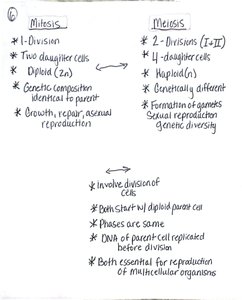
Mitosis | Meiosis | |
|---|---|---|
Number of Divisions | 1 | 2 (Meiosis I & II) |
Daughter Cells Produced | 2 | 4 |
Chromosome Number | Diploid (2n) | Haploid (n) |
Genetic Composition | Identical to parent | Genetically different |
Function | Growth, repair, asexual reproduction | Formation of gametes, sexual reproduction, genetic diversity |
Both involve division of cells and start with a diploid parent cell.
Phases are similar, and DNA is replicated before division.
Both are essential for reproduction of multicellular organisms.
Key Terms and Concepts
Synapsis: Pairing of homologous chromosomes during prophase I of meiosis.
Crossing Over: Exchange of genetic material between homologous chromosomes, increasing genetic diversity.
Tetrad: Structure formed by synapsed homologous chromosomes (four chromatids).
Genetic Diversity: Result of crossing over and independent assortment during meiosis.
Summary Table: Key Differences Between Mitosis and Meiosis
Feature | Mitosis | Meiosis |
|---|---|---|
Number of Divisions | 1 | 2 |
Number of Daughter Cells | 2 | 4 |
Chromosome Number in Daughter Cells | 2n (diploid) | n (haploid) |
Genetic Identity | Identical to parent | Genetically unique |
Role | Growth, repair | Gamete production |
Relevant Images