 Back
Meiosis: Reduction of Chromosome Number and Key Stages
Study Guide - Smart Notes
 Tailored notes based on your materials, expanded with key definitions, examples, and context.
Meiosis: Reduction of Chromosome Number
Overview of Meiosis
Meiosis is a specialized type of cell division that reduces the chromosome number by half, resulting in the formation of haploid gametes from diploid cells. This process is essential for sexual reproduction and genetic diversity.
Diploid (2n): Cells with two sets of chromosomes.
Haploid (n): Cells with one set of chromosomes.
Meiosis I: First division, separates homologous chromosomes.
Meiosis II: Second division, separates sister chromatids.
Stages of Meiosis
Meiosis consists of two sequential divisions: Meiosis I and Meiosis II. Each division has distinct phases.
Prophase I: Chromosomes condense, homologous chromosomes pair up (synapsis), crossing over occurs.
Metaphase I: Homologous pairs align at the metaphase plate.
Anaphase I: Homologous chromosomes move toward opposite poles.
Telophase I and Cytokinesis: Chromosomes arrive at poles, cell splits.
Prophase II: Chromosomes condense again in each haploid cell.
Metaphase II: Chromosomes align at the metaphase plate.
Anaphase II: Sister chromatids separate.
Telophase II and Cytokinesis: Chromatids arrive at poles, cells split, resulting in four haploid cells.
Key Features and Differences from Mitosis
Meiosis differs from mitosis in several important ways:
Reduction Division: Chromosome number is halved (2n to n).
Genetic Variation: Crossing over and independent assortment increase genetic diversity.
Number of Cells: Meiosis produces four haploid cells; mitosis produces two diploid cells.
Unique Events: Synapsis and crossing over occur only in meiosis.
Functions of Meiosis
Maintains Chromosome Number: Ensures offspring have the same chromosome number as parents.
Genetic Diversity: Enables variation among offspring.
Illustration of Meiosis Stages
The following diagram visually represents the stages of meiosis, including chromosome behavior and cell division:
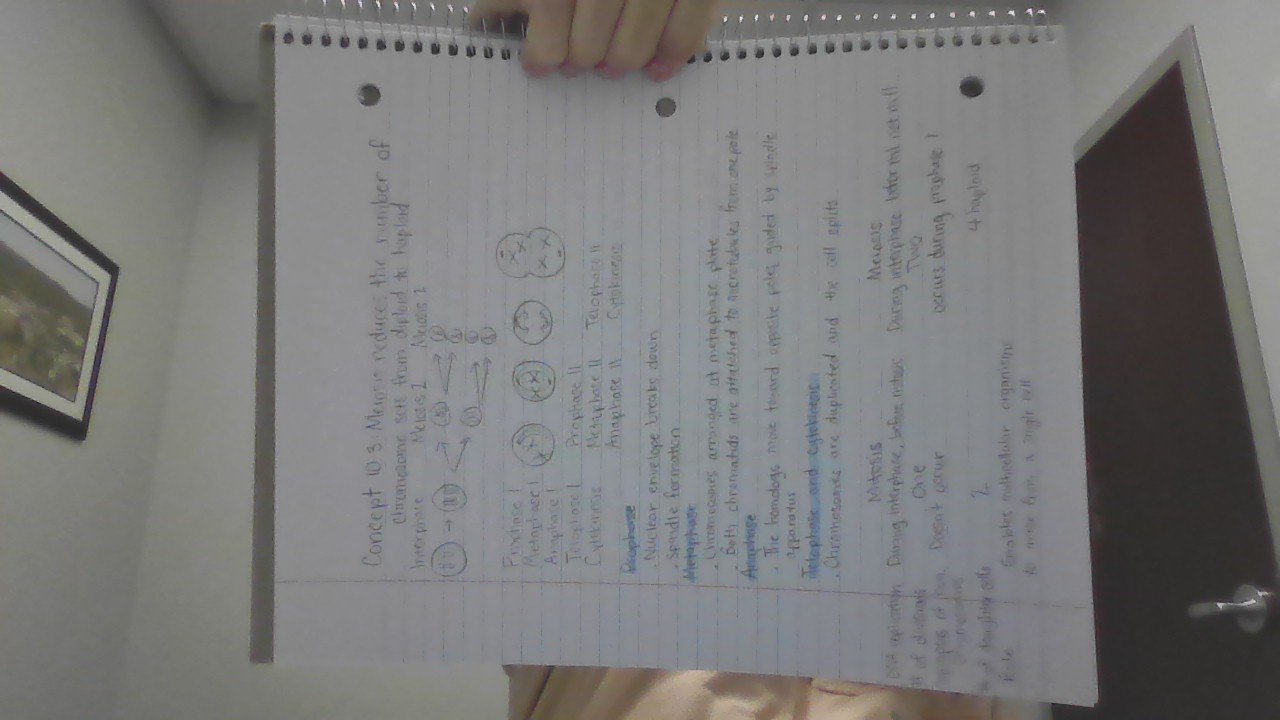
Summary Table: Comparison of Mitosis and Meiosis
Feature | Mitosis | Meiosis |
|---|---|---|
Number of divisions | One | Two |
Number of daughter cells | Two | Four |
Chromosome number in daughter cells | Diploid (2n) | Haploid (n) |
Genetic variation | None (identical) | Yes (variation) |
Function | Growth, repair | Gamete formation |
Key Terms
Synapsis: Pairing of homologous chromosomes during prophase I.
Crossing Over: Exchange of genetic material between homologous chromosomes.
Independent Assortment: Random distribution of homologous chromosomes during meiosis I.
Cytokinesis: Division of the cytoplasm to form separate cells.
Equations
The reduction in chromosome number can be represented as:
Where n is the haploid number of chromosomes.
----------------------------------------
