 Back
Chapter 13: Meiosis, Sexual Life Cycles, and Genetic Variation
Study Guide - Smart Notes
 Tailored notes based on your materials, expanded with key definitions, examples, and context.
Meiosis and Its Role in Heredity
Differences Between Mitosis and Meiosis
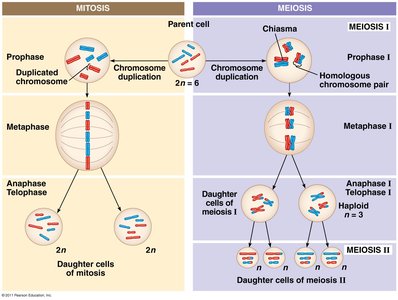
Meiosis and mitosis are two distinct types of cell division processes. While mitosis produces genetically identical cells for growth and repair, meiosis generates gametes (egg and sperm) with half the chromosome number, enabling sexual reproduction and genetic diversity.
Mitosis: Results in two diploid (2n) daughter cells, identical to the parent cell.
Meiosis: Results in four haploid (n) cells, each genetically unique.
Key Difference: Meiosis involves two rounds of division (Meiosis I and II), while mitosis involves only one.
Genetic Variation: Meiosis introduces variation through independent assortment and crossing over.
Heredity and Chromosomes
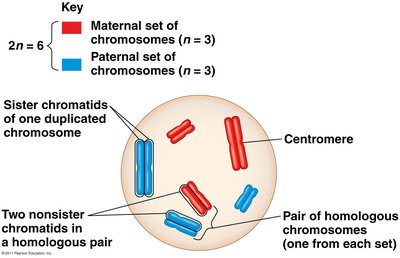
Heredity is the transmission of genetic information from parents to offspring. Genes, composed of DNA, are located on chromosomes. Each chromosome contains many loci, which are specific locations for genes. Variants of genes are called alleles.
Diploid (2n): Cells with two sets of chromosomes (one from each parent).
Haploid (n): Cells with one set of chromosomes (gametes).
Sexual Reproduction: Offspring inherit genes from both parents, increasing genetic diversity.
Homologous Chromosomes and the Human Genome
Structure and Function
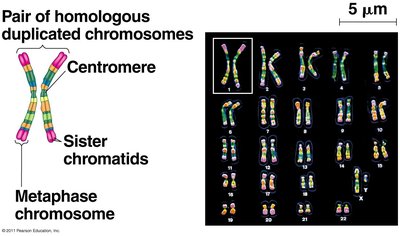
Humans have 23 pairs of chromosomes, each pair consisting of homologous chromosomes. Homologous chromosomes carry the same types of genes, but may have different alleles.
Locus: The specific location of a gene on a chromosome.
Allele: Different versions of a gene found at the same locus.
The Human Life Cycle
Generation of Haploid Cells and Variation
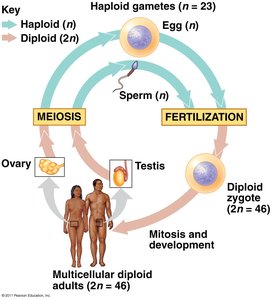
The human life cycle involves the alternation between diploid and haploid stages. Meiosis produces haploid gametes, which fuse during fertilization to restore the diploid state. This process generates variation in offspring.
Meiosis: Produces haploid gametes (egg and sperm).
Fertilization: Fusion of gametes restores diploid chromosome number.
Variation: Arises from independent assortment, crossing over, and random fertilization.
Variation in Sexual Life Cycles
Alternation of Generations
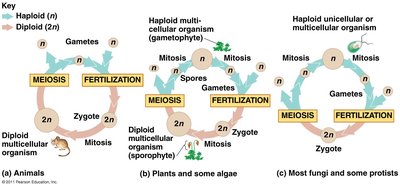
Different organisms exhibit variations in their sexual life cycles. In some, mitosis can produce gametes, and in others, alternation of generations occurs, where both haploid and diploid multicellular stages exist.
Animals: Diploid multicellular organism produces haploid gametes via meiosis.
Plants and Some Algae: Alternation of generations with both haploid (gametophyte) and diploid (sporophyte) multicellular stages.
Fungi and Protists: Haploid unicellular or multicellular organism produces gametes via mitosis.
Asexual Reproduction
Slime Mold Life Cycle
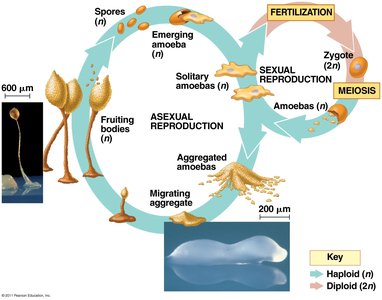
Not all organisms reproduce sexually. Asexual reproduction involves the production of genetically identical offspring from a single parent, relying on mitosis rather than meiosis. Slime molds are an example, with a life cycle that includes both asexual and sexual phases.
Identical Offspring: No genetic variation except through mutation.
Single Parent: Offspring arise from one parent without fertilization.
Mitosis: Responsible for cell division in asexual reproduction.
Details of Meiosis: Reduction Division
Meiosis I and II
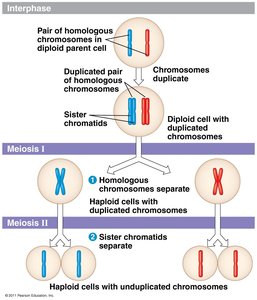
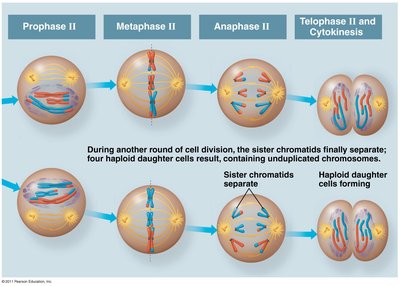
Meiosis consists of two sequential divisions: Meiosis I and Meiosis II. The process reduces the chromosome number from diploid to haploid, preparing cells for sexual reproduction.
Meiosis I: Homologous chromosomes separate, resulting in two haploid cells with duplicated chromosomes.
Meiosis II: Sister chromatids separate, resulting in four haploid cells with unduplicated chromosomes.
Sources of Genetic Variation in Offspring
Independent Assortment
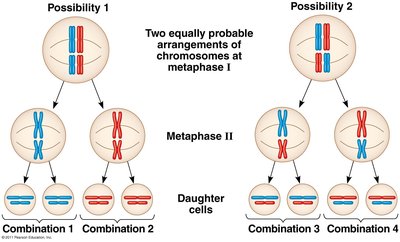
During meiosis, chromosomes are randomly distributed to gametes, resulting in numerous possible combinations. This process is known as independent assortment.
Independent Assortment: Each pair of chromosomes segregates independently, increasing genetic diversity.
Formula: The number of possible combinations is , where n is the number of chromosome pairs.
Crossing Over
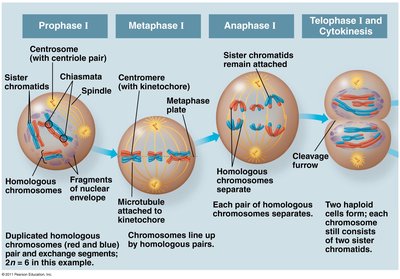
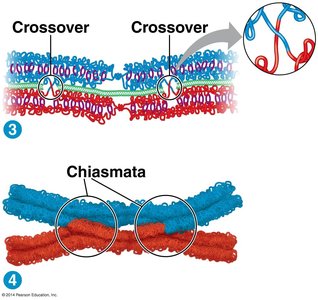
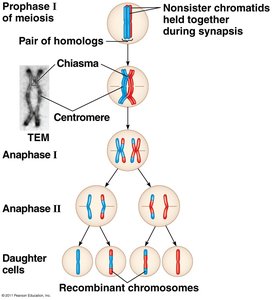
Crossing over occurs during prophase I of meiosis, where homologous chromosomes exchange genetic material. This process creates new combinations of alleles.
Chiasmata: Sites where crossing over occurs.
Synaptonemal Complex: Protein structure that facilitates chromosome pairing and crossing over.
Result: Recombinant chromosomes with new allele combinations.
Random Fertilization
Random fertilization further increases genetic variation, as any sperm can fuse with any egg, each carrying different genetic combinations.
Genetic Diversity: The combination of independent assortment, crossing over, and random fertilization results in unique offspring.
Summary Table: Comparison of Mitosis and Meiosis
The following table summarizes the key differences between mitosis and meiosis:
Feature | Mitosis | Meiosis |
|---|---|---|
Number of Divisions | 1 | 2 |
Number of Daughter Cells | 2 | 4 |
Chromosome Number | Diploid (2n) | Haploid (n) |
Genetic Identity | Identical | Unique |
Function | Growth, repair | Gamete production |
Conclusion
Meiosis is essential for sexual reproduction, ensuring genetic diversity through independent assortment, crossing over, and random fertilization. The alternation of generations and variation in life cycles among organisms highlight the complexity and adaptability of biological systems.
