 Back
BackLEC 5:Membrane Structure and Function: A Comprehensive Study Guide
Study Guide - Smart Notes
 Tailored notes based on your materials, expanded with key definitions, examples, and context.
Membrane Structure and Function
Introduction to Biological Membranes
The plasma membrane is a fundamental structure that separates the living cell from its external environment. It exhibits selective permeability, allowing certain substances to cross more easily than others, thus maintaining homeostasis within the cell.
Phospholipid Bilayer: The Foundation of Membranes
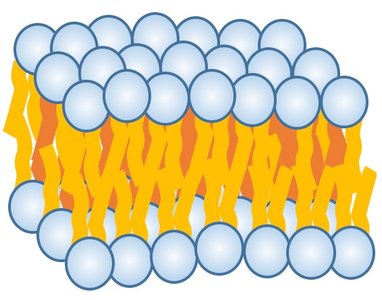
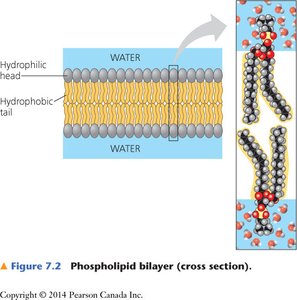
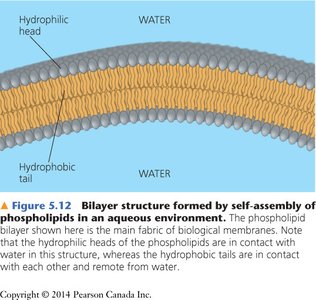
The basic structure of all biological membranes is the phospholipid bilayer. Phospholipids are amphipathic molecules, containing both hydrophilic (water-attracting) heads and hydrophobic (water-repelling) tails. In aqueous environments, they spontaneously arrange into bilayers, with hydrophobic tails facing inward and hydrophilic heads facing outward.
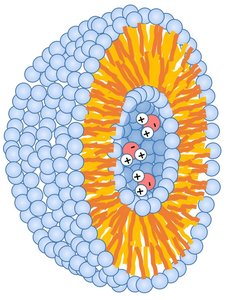
Liposome: A spherical vesicle with a phospholipid bilayer, often used as a model for biological membranes.
Self-assembly: Phospholipids naturally form bilayers in water due to their amphipathic nature.
The Fluid Mosaic Model
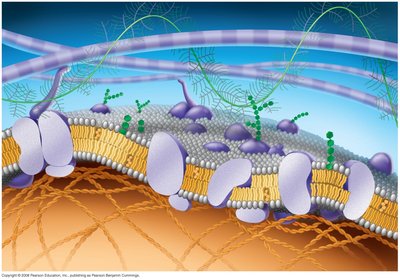
The Fluid Mosaic Model describes the plasma membrane as a dynamic and flexible structure composed of a phospholipid bilayer with proteins embedded throughout. The 'mosaic' aspect refers to the patchwork of proteins that float in or on the fluid lipid bilayer.
Membrane Proteins: Integral (intrinsic) proteins are embedded within the bilayer, while peripheral (extrinsic) proteins are loosely attached to the membrane's surface.
Membrane Fluidity: Phospholipids and some proteins can move laterally within the layer, contributing to membrane flexibility.
Components of Biological Membranes
In addition to phospholipids and proteins, membranes contain other important components:
Glycolipids: Lipids with attached sugars, involved in cell recognition.
Glycoproteins: Proteins with attached sugars, crucial for cell-cell recognition and signaling.
Cholesterol: A lipid that modulates membrane fluidity and stability, especially in animal cells.
Membrane Fluidity and Its Regulation
Membrane fluidity is essential for proper function and is influenced by several factors:
Fatty Acid Length: Shorter fatty acid chains increase fluidity; longer chains decrease it.
Degree of Saturation: Unsaturated fatty acids (with double bonds) introduce kinks, preventing tight packing and increasing fluidity.
Cholesterol: Acts as a fluidity buffer, preventing solidification at low temperatures and reducing fluidity at moderate temperatures.
At high temperatures, membranes become more fluid and permeable; at low temperatures, they can solidify (phase transition).
Types and Functions of Membrane Proteins
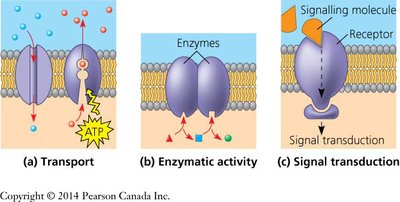
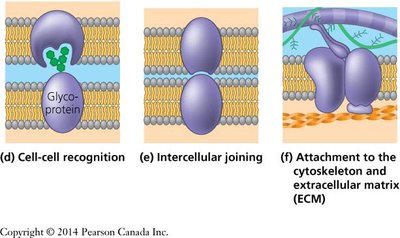
Membrane proteins perform a variety of essential functions:
Transport: Move substances across the membrane.
Enzymatic Activity: Catalyze reactions at the membrane surface.
Signal Transduction: Relay signals from outside to inside the cell.
Cell-Cell Recognition: Allow cells to identify each other.
Intercellular Joining: Connect adjacent cells.
Attachment to Cytoskeleton and ECM: Anchor the membrane to internal and external structures.
Transport Across Membranes
The movement of molecules across the plasma membrane is tightly regulated. There are three main mechanisms:
Diffusion (Passive Transport): Movement of molecules from high to low concentration, down their concentration gradient. Small, nonpolar molecules (e.g., O2, CO2) diffuse easily.
Facilitated Diffusion: Passive movement aided by transport proteins (channel or carrier proteins). Allows polar or charged molecules to cross the membrane.
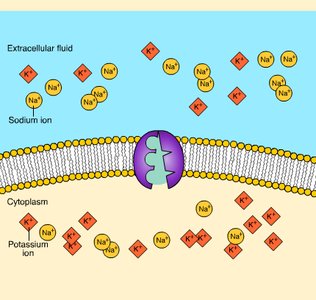
Active Transport: Movement of substances against their concentration gradient, requiring energy (usually from ATP). Examples include the sodium-potassium pump and proton pumps.
Diffusion and Osmosis
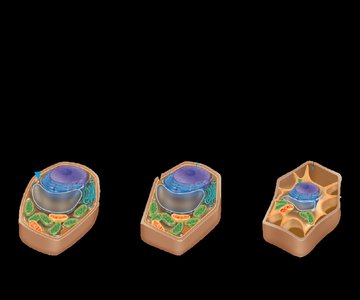
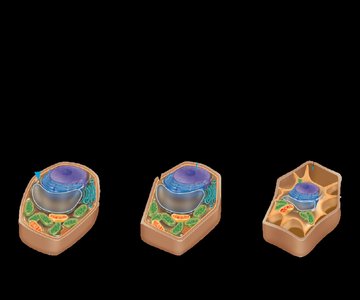
Osmosis is the diffusion of water across a selectively permeable membrane. Water moves from areas of high free water concentration (low solute) to low free water concentration (high solute).
Tonicity: The relative concentration of solutes determines whether a cell gains or loses water (hypotonic, isotonic, hypertonic solutions).
Facilitated Diffusion
Facilitated diffusion uses specific transport proteins:
Channel Proteins: Form hydrophilic channels for specific molecules or ions (e.g., aquaporins for water, ion channels for ions).
Carrier Proteins: Undergo conformational changes to move molecules across the membrane.
Active Transport
Active transport requires energy to move substances against their gradients. The sodium-potassium pump is a classic example, maintaining high K+ and low Na+ inside animal cells.
ATP Hydrolysis: Provides the energy for active transport ().
Electrogenic Pumps: Create membrane potential by moving ions (e.g., sodium-potassium pump in animals, proton pump in plants/fungi/bacteria).
Cotransport: Couples the downhill movement of one solute to the uphill movement of another (e.g., sucrose-H+ cotransporter in plants).
Summary Table: Types of Membrane Transport
Type | Energy Required? | Direction | Example |
|---|---|---|---|
Simple Diffusion | No | Down concentration gradient | O2, CO2 |
Facilitated Diffusion | No | Down concentration gradient | Glucose, ions via channels |
Active Transport | Yes (ATP) | Against concentration gradient | Na+/K+ pump |
Cotransport | Indirect (uses gradient) | Against for one, down for another | Sucrose-H+ cotransporter |
Key Terms and Definitions
Selective Permeability: Property of membranes that allows some substances to cross more easily than others.
Amphipathic: Molecule with both hydrophilic and hydrophobic regions.
Membrane Potential: Voltage difference across a membrane due to unequal distribution of ions.
Electrochemical Gradient: Combined effect of concentration and electrical gradients on ion movement.
