 Back
Membrane Structure and Function: Bulk Transport and Membrane Dynamics
Study Guide - Smart Notes
 Tailored notes based on your materials, expanded with key definitions, examples, and context.
Membrane Structure and Function
Bulk Transport Across the Plasma Membrane
The plasma membrane regulates the movement of substances into and out of the cell. While small molecules and water can cross the membrane via the lipid bilayer or transport proteins, large molecules require specialized mechanisms known as bulk transport. Bulk transport processes include exocytosis and endocytosis, both of which require energy.
Exocytosis: Transport vesicles migrate to the membrane, fuse with it, and release their contents outside the cell. This process is essential for the export of products by secretory cells, such as the release of insulin by pancreatic cells.
Endocytosis: Macromolecules are taken into the cell in vesicles. The membrane forms a pocket that deepens and pinches off, enclosing the material for transport.
Example: Cells in the pancreas secrete insulin by exocytosis.
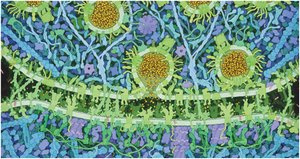
Types of Endocytosis
Endocytosis is classified into three main types, each with distinct mechanisms and functions:
Phagocytosis ("cellular eating"): The cell engulfs a particle by extending pseudopodia around it, enclosing it in a membranous sac called a food vacuole.
Pinocytosis ("cellular drinking"): The cell takes up molecules by "gulping" extracellular fluid into tiny vesicles.
Receptor-mediated endocytosis: Specific molecules (ligands) bind to receptors on the cell surface, triggering vesicle formation. A ligand is any molecule that binds specifically to a receptor site of another molecule.
Key Terms and Concepts
Amphipathic molecules: Molecules with both hydrophilic and hydrophobic regions, such as phospholipids in the membrane.
Aquaporins: Channel proteins that facilitate the rapid transport of water across the membrane.
Diffusion: The passive movement of molecules from an area of higher concentration to an area of lower concentration.
Membrane Fluidity
Membrane fluidity is influenced by temperature and membrane composition:
Higher temperatures increase fluidity, while lower temperatures decrease it.
The presence of unsaturated fatty acids in phospholipids increases fluidity, whereas saturated fatty acids decrease it.
Membrane Proteins
Peripheral proteins: Proteins attached to the exterior or interior surfaces of the membrane.
Integral proteins: Proteins embedded within the membrane, often spanning its entire width.
Channel proteins: Provide passageways for molecules to diffuse across the membrane.
Carrier proteins: Bind to molecules and change shape to shuttle them across the membrane.
Transport Mechanisms
Osmosis: Diffusion of water across a selectively permeable membrane.
Facilitated diffusion: Passive transport of molecules via transport proteins.
Active transport: Movement of molecules against their concentration gradient, requiring energy.
Solution Types
Hypertonic: Higher solute concentration outside the cell; water leaves the cell.
Hypotonic: Lower solute concentration outside the cell; water enters the cell.
Isotonic: Equal solute concentration; no net movement of water.
Electrogenic Pumps
Electrogenic pumps create voltage across a membrane by moving ions:
Sodium-potassium pump and proton pump are examples of electrogenic pumps.
Transport of Large Molecules
Large molecules, such as polysaccharides and proteins, are transported across the cell membrane via bulk transport mechanisms (exocytosis and endocytosis), often involving vesicles and requiring energy.
Summary Table: Types of Membrane Transport
Transport Type | Mechanism | Energy Required? | Example |
|---|---|---|---|
Simple Diffusion | Direct movement through lipid bilayer | No | O2 and CO2 movement |
Facilitated Diffusion | Via channel or carrier proteins | No | Glucose transport |
Active Transport | Via carrier proteins, against gradient | Yes | Sodium-potassium pump |
Exocytosis | Vesicle fusion with membrane | Yes | Insulin secretion |
Endocytosis | Vesicle formation from membrane | Yes | Phagocytosis of bacteria |
Additional info: Academic context was added to clarify the mechanisms and provide definitions for key terms, as well as to expand on the types of membrane transport and their significance in cell biology.
