Back
BackMembrane Structure and Function: Study Guide
Study Guide - Smart Notes
 Tailored notes based on your materials, expanded with key definitions, examples, and context.
Membrane Structure and Function
Life at the Edge: The Plasma Membrane
The plasma membrane forms the boundary between the living cell and its environment, maintaining cellular integrity and regulating the passage of substances. Its selective permeability allows the cell to control its internal composition by permitting certain molecules to pass while restricting others.
Fluid Mosaic Model of Membrane Structure
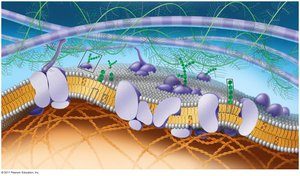
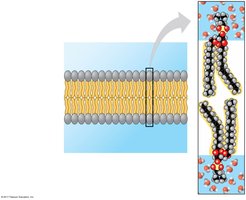
The fluid mosaic model describes the plasma membrane as a dynamic structure composed of a bilayer of phospholipids with embedded proteins. The membrane is held together primarily by weak hydrophobic interactions, allowing most lipids and some proteins to move laterally within the layer.
Phospholipids form the basic structure, with hydrophilic heads facing outward and hydrophobic tails inward.
Proteins are interspersed throughout, serving various functions.
Cholesterol and other molecules contribute to membrane fluidity and stability.
Membrane Proteins and Their Functions
Membrane proteins are classified based on their association with the lipid bilayer:
Peripheral proteins: Bound to the membrane surface.
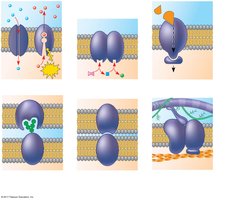
Integral proteins: Penetrate the hydrophobic core; those spanning the membrane are called transmembrane proteins.
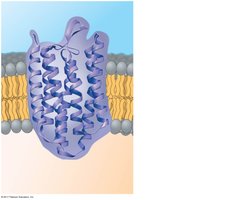
Cell-surface proteins perform diverse functions:
Transport: Move substances across the membrane.
Enzymatic activity: Catalyze reactions at the membrane surface.
Signal transduction: Relay signals from outside to inside the cell.
Cell-cell recognition: Allow cells to identify each other.
Intercellular joining: Connect adjacent cells.
Attachment to cytoskeleton and ECM: Maintain cell shape and stabilize membrane.
Membrane Fluidity
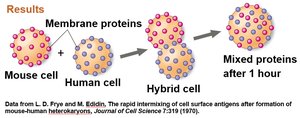
Membrane fluidity is essential for function, allowing proteins and lipids to move and interact. Experiments with hybrid cells demonstrate the mixing of membrane proteins, supporting the fluid mosaic model.
Selective Permeability of Membranes
Permeability of the Lipid Bilayer
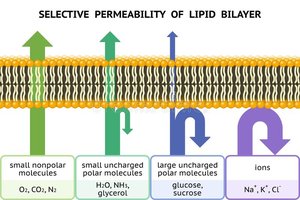
The lipid bilayer is selectively permeable, allowing certain molecules to pass more easily than others:
Hydrophobic (nonpolar) molecules (e.g., hydrocarbons) pass rapidly.
Hydrophilic (polar) molecules and ions do not cross easily.
Transport Proteins
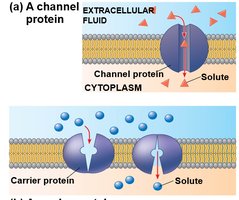
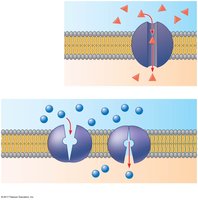
Transport proteins facilitate the movement of hydrophilic substances across the membrane. Carrier proteins bind to molecules and change shape to shuttle them across, and each transport protein is specific for the substance it moves.
Passive Transport: Diffusion and Osmosis
Diffusion
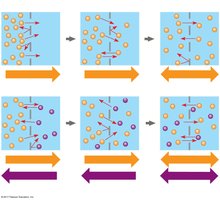
Diffusion is the movement of molecules from an area of high concentration to low concentration, driven by random molecular motion. The process is passive and does not require energy.
Substances diffuse down their concentration gradient.
Diffusion across a biological membrane is called passive transport.
Osmosis
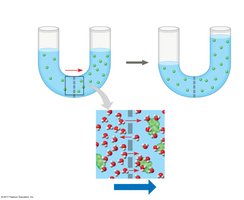
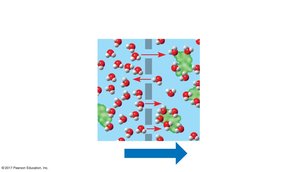
Osmosis is the diffusion of water across a selectively permeable membrane. Water moves from regions of lower solute concentration to higher solute concentration until equilibrium is reached.
Osmosis is crucial for maintaining cellular water balance.
Effects of Osmosis on Cells
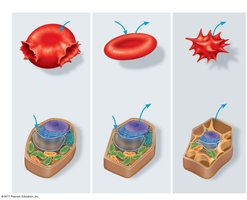
Cells respond differently to osmotic environments:
Hypotonic: Water enters the cell; animal cells may lyse, plant cells become turgid.
Isotonic: No net water movement; animal cells are normal, plant cells are flaccid.
Hypertonic: Water leaves the cell; animal cells shrivel, plant cells plasmolyze.
Facilitated Diffusion
Facilitated diffusion is passive transport aided by proteins. Ion channels facilitate the movement of ions, and some are gated, opening or closing in response to stimuli.
Active Transport
Mechanism and Need for Energy
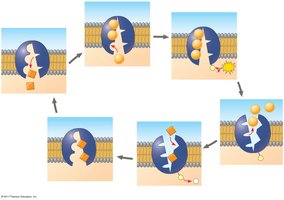
Active transport moves solutes against their concentration gradients, requiring energy, usually from ATP hydrolysis. This process is essential for maintaining concentration differences across the membrane.
Example: Sodium-potassium pump ( per ATP hydrolyzed).
Cotransport
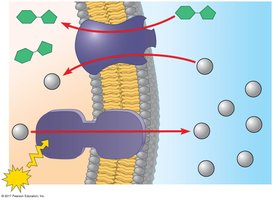
Cotransport involves the coupled transport of two substances by a membrane protein. For example, a proton pump creates a gradient used to drive the uptake of sucrose.
Comparison of Passive and Active Transport
Type | Energy Required | Direction | Example |
|---|---|---|---|
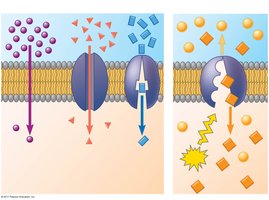
Passive Transport | No | Down gradient | Diffusion, facilitated diffusion |
Active Transport | Yes (ATP) | Against gradient | Sodium-potassium pump |
Bulk Transport: Exocytosis and Endocytosis
Mechanisms of Bulk Transport
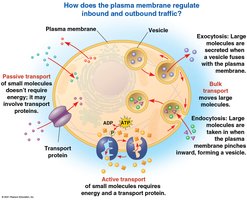
Bulk transport moves large molecules across the membrane via vesicles and requires energy:
Exocytosis: Secretion of large molecules when vesicles fuse with the plasma membrane.
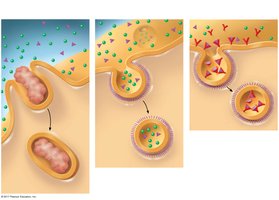
Endocytosis: Uptake of large molecules by pinching in the membrane to form vesicles.
Types of endocytosis: Phagocytosis (cell eating), Pinocytosis (cell drinking), Receptor-mediated endocytosis (specific uptake).
Summary Table: Membrane Transport Mechanisms
Transport Type | Energy Requirement | Substances Moved | Mechanism |
|---|---|---|---|
Simple Diffusion | No | Small nonpolar molecules | Directly through bilayer |
Facilitated Diffusion | No | Ions, polar molecules | Via transport proteins |
Active Transport | Yes | Ions, polar molecules | Via pumps, against gradient |
Bulk Transport | Yes | Large molecules | Via vesicles (exo-/endocytosis) |